What this worksheet helps children practise
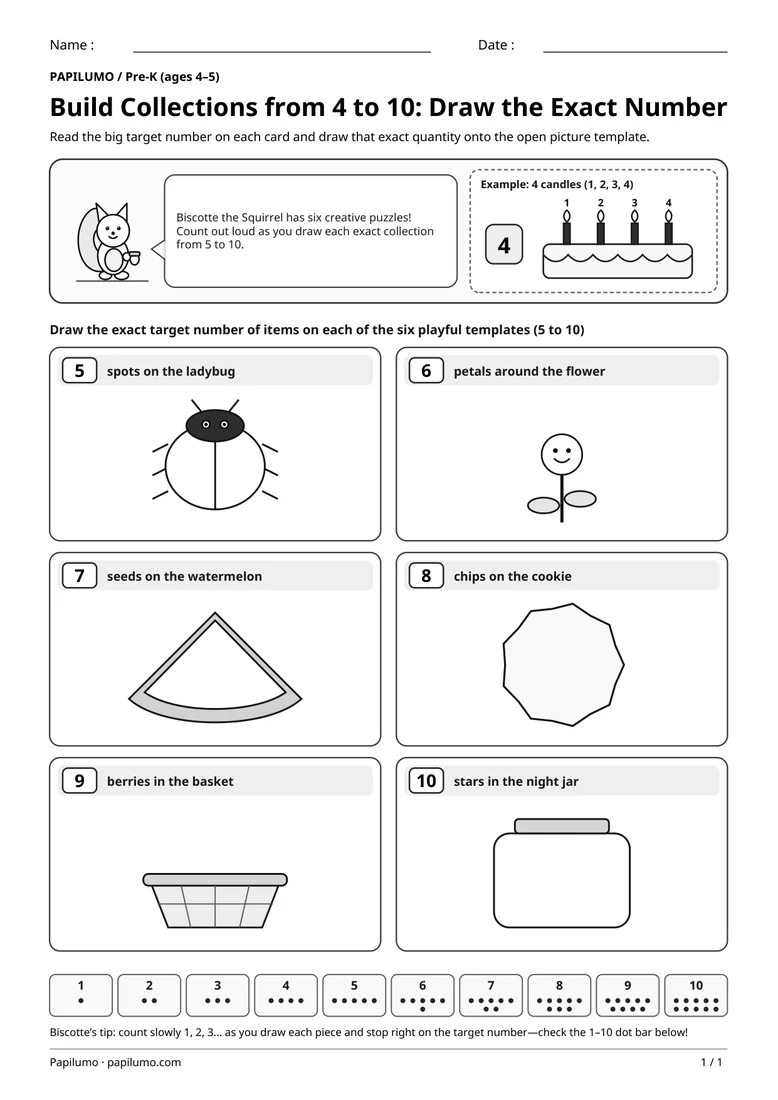
Say each number aloud right as your pencil draws it, and freeze the moment you reach the card’s big numeral!
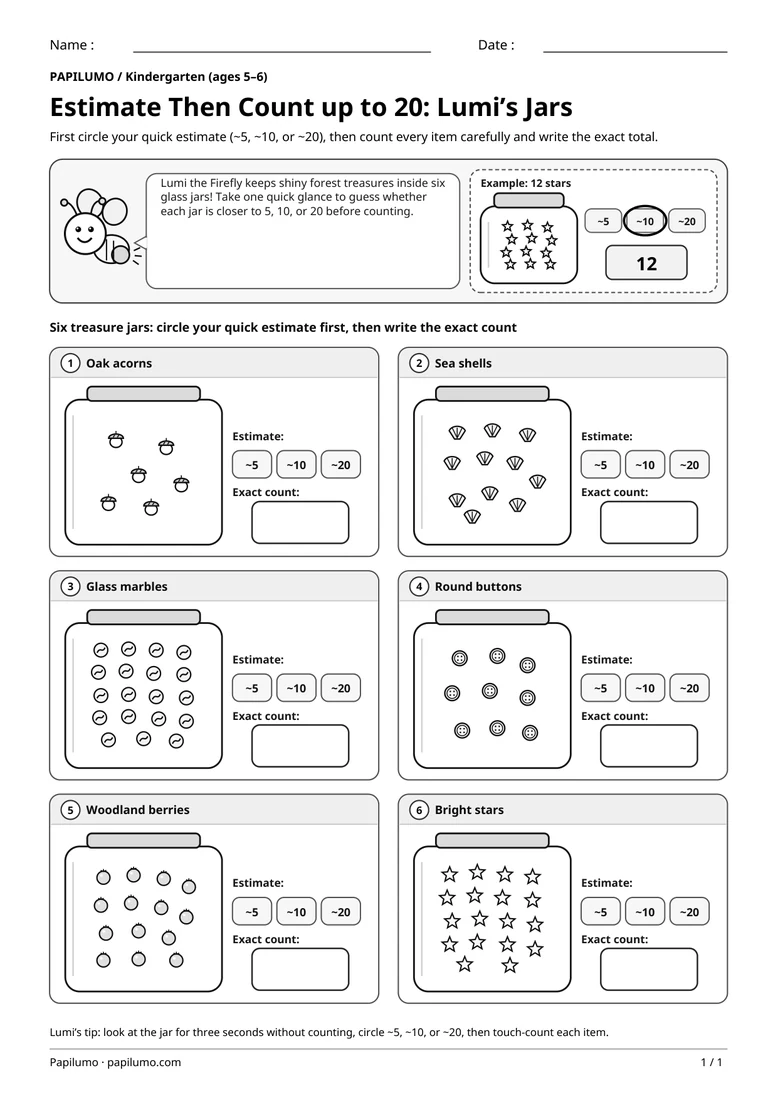
Producing an exact collection from a given numeral between 4 and 10 builds far deeper cardinality and number sense than simply counting objects already printed on a page. When a four- or five-year-old must draw precisely six petals or nine berries and stop right on the target number, they hold the target numeral actively in working memory while carefully coordinating pencil strokes with spoken number words. This hands-on construction task strengthens inhibitory control, fine-motor precision, numeral-to-quantity mapping, early self-monitoring, and confident counting through 10. For a related skill, use Estimate Then Count up to 20: Lumi’s Treasure Jars: First circle your quick estimate (~5, ~10, or ~20), then count every item carefully and write the exact total.
Preparing a short session
Print the student worksheet at actual size (100%) on crisp white A4 paper and sit together at a bright, uncluttered table with a sharpened pencil, fine crayon, or dark washable marker. Keep the separate one-page answer key PDF tucked neatly out of sight while your child draws independently at their own comfortable pace. Before tackling the first card, explore the 1–10 visual dot reference bar along the bottom edge together so your child sees clearly how each written numeral corresponds to a matching dot collection of 1 to 10.
A concrete example to get started
Inside the rounded top banner beside Biscotte the Squirrel and her cheerful speech bubble, a dashed worked-example box models the entire activity clearly with the target number 4. A birthday cake sits cleanly inside the frame topped with four simple vertical candles, each clearly labeled 1, 2, 3, and 4 right beside its bright flame. Pre-K learners grasp immediately that drawing simple, well-spaced shapes makes creating and recounting every single item effortless before starting the six main cards below.
Supporting the activity
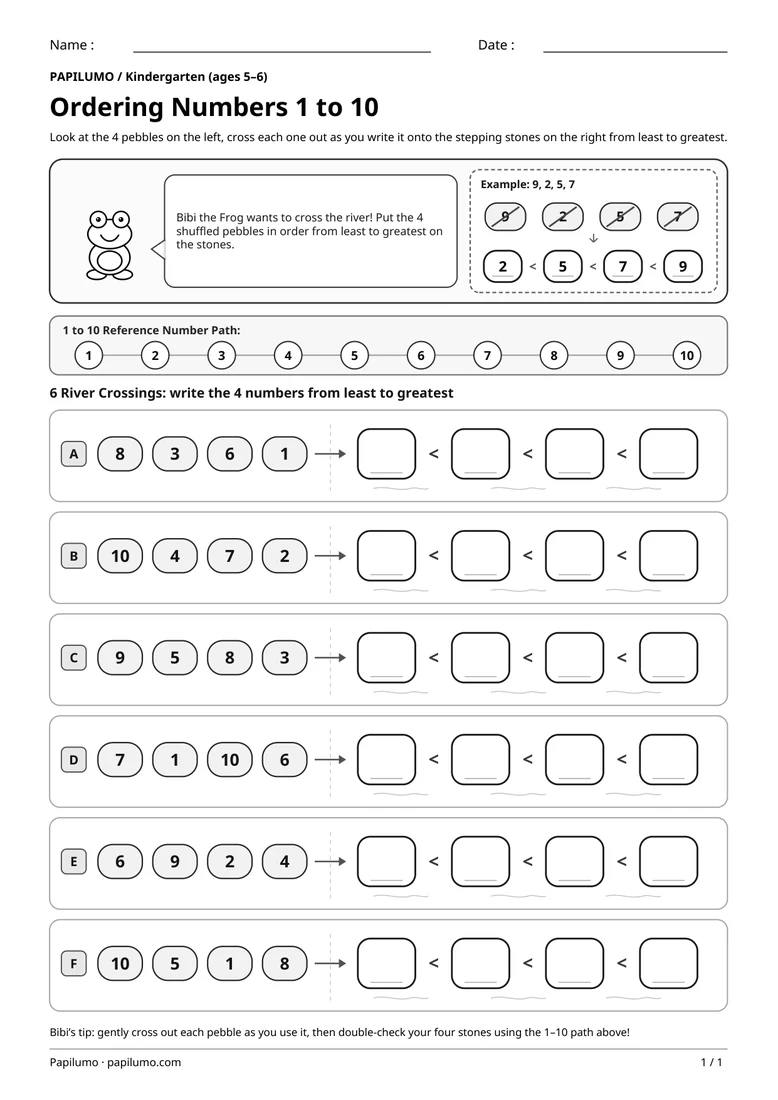
Six generous cards arranged neatly in two balanced columns give small hands wide-open room to draw clearly without crowding or cramped strokes: add 5 bold spots on a ladybug’s back, 6 petals around a flower center, 7 seeds on a watermelon slice, 8 chocolate chips on a giant cookie, 9 berries in an open woven basket, and 10 stars inside a tall night jar. Beneath the grid, the 1–10 visual dot reference bar helps children double-check any quantity at a quick glance. To vary the practice, try Ordering Numbers 1 to 10 (Least to Greatest) with Bibi the Frog: Look at the 4 pebbles on the left, cross each one out as you write it onto the stepping stones on the right from least to greatest.
What to notice and how to check
When all six creative drawings are finished, place the separate mirror answer key beside your child’s sheet to recount each collection calmly together and celebrate careful, steady work. On the answer key, every template shows the exact number of bold drawn elements labeled neatly from 1 to N: 5 spots, 6 petals, 7 seeds, 8 chips, 9 berries, and 10 stars. If any card has one extra or missing shape, touch and recount each drawn mark slowly together and gently adjust without rushing.
Making the task easier
Place 5, 6, or 7 dried beans or buttons onto the open template first, then swap each token for a drawn pencil mark.
Keep the learning aim, but reduce how much the child has to handle at once. Cover part of the page with another sheet and reveal one task at a time. Demonstrate a separate example, then leave a real opportunity to work something out. An answer reached with support is still a useful attempt; it does not yet show that the same task can be completed independently.
Taking the idea beyond the worksheet
Color your completed creations afterward, or draw a blank pizza on scrap paper with exactly 10 pepperoni slices.
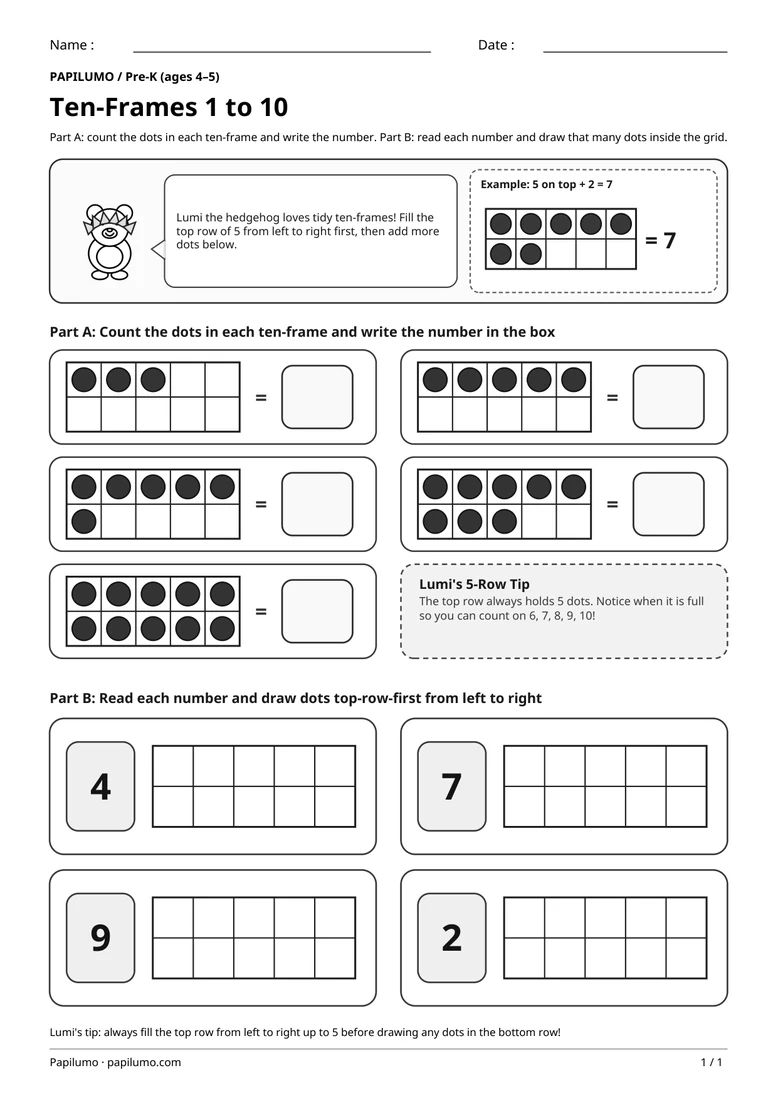
Use the follow-up to meet the same idea in a different setting. Offer it once the first task makes sense, without insisting that the whole page must be perfect. The child might explain a strategy, make an example or set a challenge for an adult. Return to the worksheet only when it helps connect the two situations. A short conversation or a practical activity can be enough to finish the session. To continue exploring, use Ten-Frames 1 to 10: Count and Draw Dots with Lumi: Part A: count the dots in each ten-frame and write the number. Part B: read each number and draw that many dots inside the grid.
Downloading and printing the PDF
This free PDF contains one worksheet designed for A4 paper. Download the file using the button on this page and open it in your PDF reader. Choose actual size or a 100% scale, check the orientation in the print preview and turn off any browser headers or footers. The illustrations use vector lines, so their outlines stay sharp when printed. Check the margins on one copy before preparing several sheets for a group. The level shown on the page is a guide, rather than a requirement to complete the activity at a particular age.