

What this worksheet helps children practise
When the top row is full, start counting from 5 right away and count on for the dots in the bottom row!
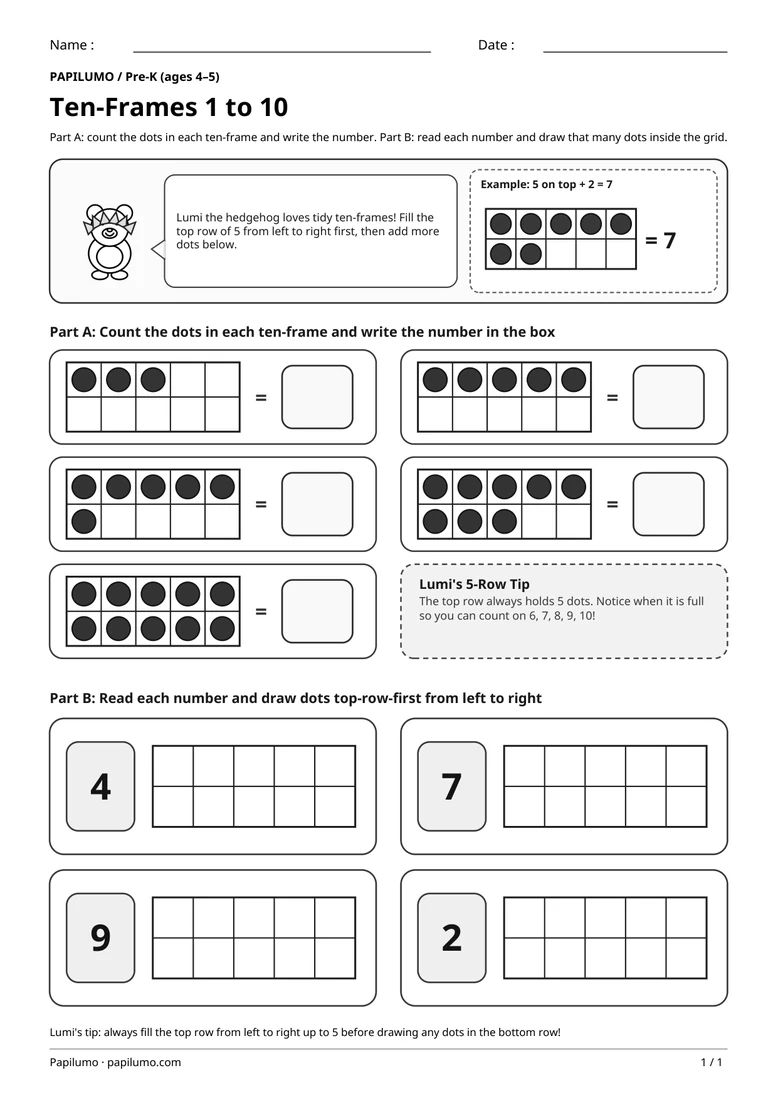
Using ten-frames in Pre-K builds visual subitizing, strong five-and-some-more thinking, and early base-ten number sense well before addition begins. Combining two opposite tasks—reading filled ten-frames (3, 5, 6, 8, and 10) in Part A and drawing dots into empty ten-frames (4, 7, 9, and 2) in Part B—teaches children to place counters systematically top-row-first from left to right. This organized habit helps kids instantly see 7 as five plus two more and 9 as one empty box short of ten without recounting every dot. For a related skill, use Understanding Zero (0) and Empty Sets to 5 with Biscotte: Part A: circle each empty basket showing 0. Part B: count the items in each jar and write 0 to 5. Part C: leave 0 empty and draw 4 berries.
Preparing a short session
Print the student worksheet at actual size (100%) without shrinking on plain white A4 paper and sit at a bright, uncluttered table with a sharpened graphite pencil or dark fine marker that draws clear round dots. Keep the separate one-page answer key PDF neatly tucked out of sight while your child works through the page. Before writing or drawing, point together across the five top boxes and five bottom boxes on a frame to check aloud why ten spaces always make one full ten-frame from top to bottom.
A concrete example to get started
Inside the framed top banner beside Lumi the hedgehog and his helpful advice bubble, a clear worked 5-plus-2 model shows the number 7 right away. The top row of the example ten-frame holds 5 solid dark counters across all five boxes, and the bottom row holds 2 more counters on the left, followed clearly by '= 7'. Pre-K learners see immediately how a full top row means 5 so they can count on '6, 7' smoothly without restarting from one every time.
Supporting the activity
Below the banner, two roomy, cleanly organized sections give four- and five-year-olds wide spaces for neat numeral writing and calm dot drawing. In Part A, five spacious 2x5 ten-frames show 3, 5, 6, 8, and 10 solid dark counters, each right beside a generous square writing box and a helpful reminder card clearly explaining the full top row of 5. In Part B, four large bold target numerals (4, 7, 9, and 2) stand beside blank ten-frames with oversized square cells ready for clean hand-drawn dots. To vary the practice, try Countdown from 10 to 0: Rocket Launch with Cosmo: Count backward by 1s to finish the 10-to-0 launchpad, then fill in the missing numbers on all four rocket tracks.
What to notice and how to check
When all five numerals in Part A are written cleanly and all four ten-frames in Part B are completely filled with dots, place the separate one-page answer key side by side for a calm and encouraging review together. Verify the Part A totals (3, 5, 6, 8, and 10) first, then confirm carefully that every Part B frame (4, 7, 9, and 2) fills the entire top row left to right before continuing onto the bottom row. Celebrate accurate counting, steady focus, strong five-anchor thinking, and tidy dot placement across the entire page.
Making the task easier
Place small counters, beans, or coins into the empty Part B boxes first, count them aloud, then draw each dot.
Keep the learning aim, but reduce how much the child has to handle at once. Cover part of the page with another sheet and reveal one task at a time. Demonstrate a separate example, then leave a real opportunity to work something out. An answer reached with support is still a useful attempt; it does not yet show that the same task can be completed independently.
Taking the idea beyond the worksheet
For each frame on the page, tell an adult how many empty boxes are still left to make 10.
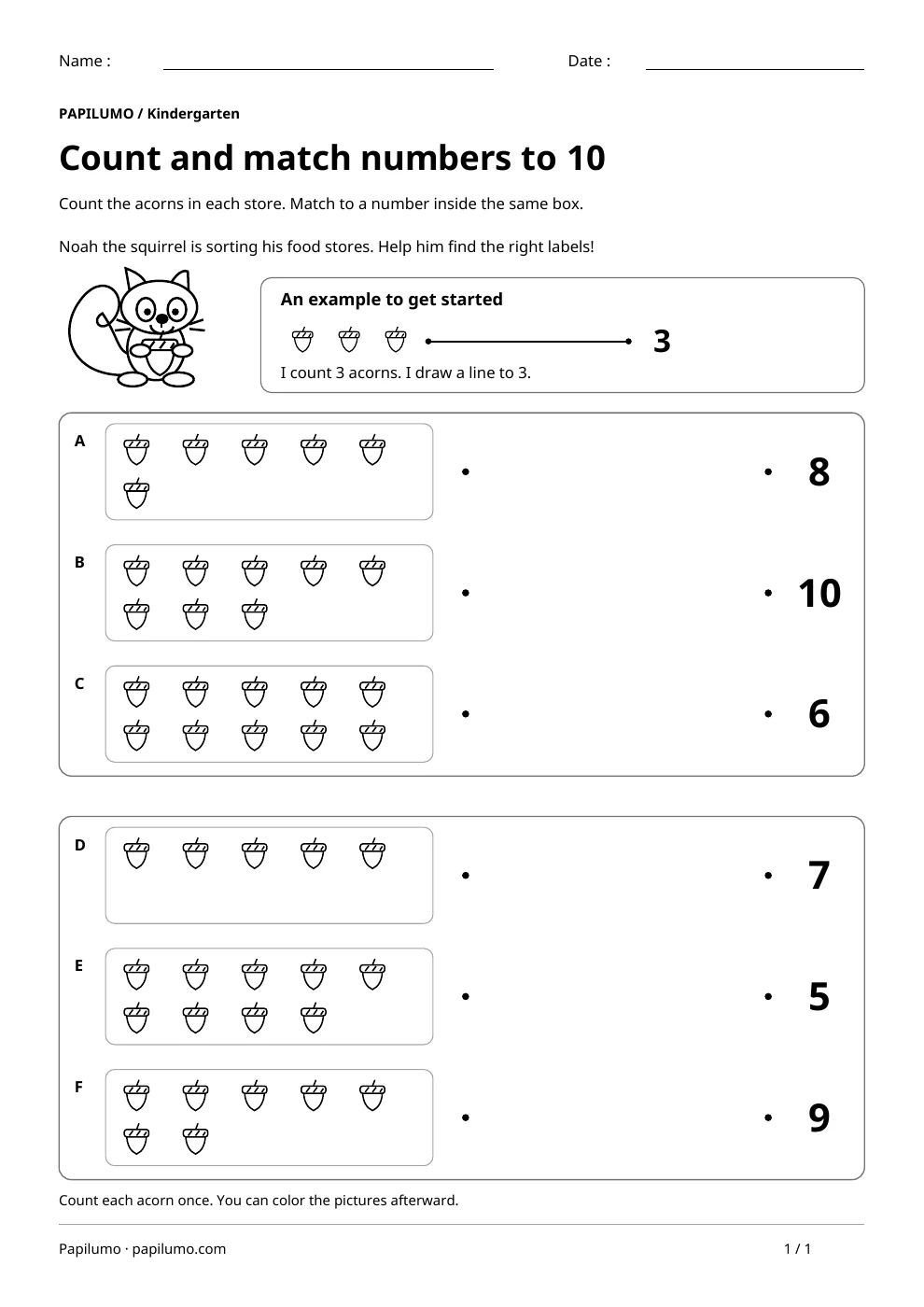
Use the follow-up to meet the same idea in a different setting. Offer it once the first task makes sense, without insisting that the whole page must be perfect. The child might explain a strategy, make an example or set a challenge for an adult. Return to the worksheet only when it helps connect the two situations. A short conversation or a practical activity can be enough to finish the session. To continue exploring, use Count and Match Numbers to 10: Count the acorns in each store. Match to a number inside the same box.
Downloading and printing the PDF
This free PDF contains one worksheet designed for A4 paper. Download the file using the button on this page and open it in your PDF reader. Choose actual size or a 100% scale, check the orientation in the print preview and turn off any browser headers or footers. The illustrations use vector lines, so their outlines stay sharp when printed. Check the margins on one copy before preparing several sheets for a group. The level shown on the page is a guide, rather than a requirement to complete the activity at a particular age.