

What this worksheet helps children practise
Say the next number aloud before moving your pencil tip so you never skip a dot!
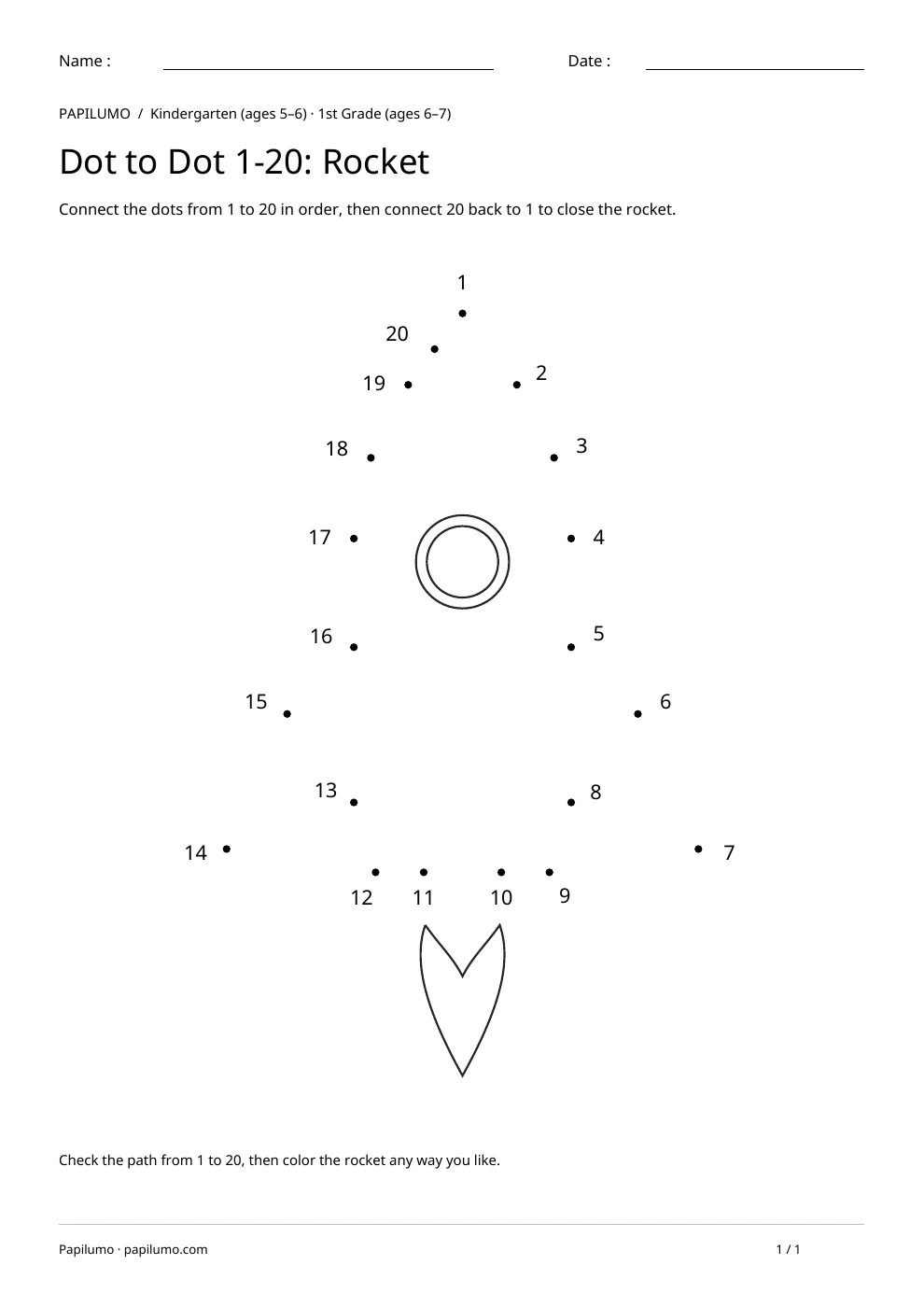
Connecting dots from 1 to 50 develops far more than steady pencil control: first graders must recognize two-digit numerals at a glance, predict what comes next, and cross every decade boundary cleanly after 9, 19, 29, 39, and 49. Because the fifty dots sit evenly spaced around the outer beachball rim with crisp outward labels, learners practice sustained visual scanning across a full circle without skipping ahead. The four mystery-number boxes at the bottom reinforce number order directly by asking for one more, one less, and a number between two given neighbors up to 50. For a related skill, use Dot to Dot 1-20: Rocket: Connect the dots from 1 to 20 in order, then connect 20 back to 1 to close the rocket.
Preparing a short session
Print the student worksheet at actual size (100%) on plain white letter or A4 paper without scaling down the margins, and hand your child a sharpened pencil and a soft eraser. Keep the separate answer key out of sight before beginning. Help your child locate the ringed starting dot 1 near the bottom of the beachball along with nearby dots 2 and 3, read the top instructions and Lulu the seagull’s worked example together, and remind them to save coloring until the entire 1–50 outline has been checked.
A concrete example to get started
In the top example panel beside Lulu the seagull, children see the exact opening sequence at a glance: start on the ringed dot 1, draw a neat straight segment to 2, and continue to 3 along the little directional arrow curving clockwise around the rim. Highlighting those first three steps prevents a classic dot-to-dot slip right at the start—connecting 1 straight over to neighboring 50 instead of moving clockwise toward 2—so young learners launch confidently in the right direction.
Supporting the activity
First, students travel steadily around the beachball rim from 1 up to 50, saying each number quietly before drawing each short segment, then close the circle with one final line from 50 back to 1. The six curved interior panel ribs remain pre-drawn so the finished shape looks like a classic beachball right away. Next, in Part 2’s Mystery numbers section, children apply the same counting sequence to complete four roomy check boxes: 30 after 29, 39 before 40, 50 after 49, and 19 between 18 and 20. To vary the practice, try Alphabet Dot to Dot A to Z: Lulu the Seagull’s Sailboat: Connect the uppercase letters from A to Z in order to draw the sailboat, then complete the three boxes.
What to notice and how to check
When reviewing with the separate PDF answer key, check the smooth circular outline first to ensure no chord cuts across the ball and no decade jump (19→20, 29→30, 39→40, 49→50) was missed. Confirm that dot 50 links cleanly back to dot 1, then verify the four mystery-number boxes at the bottom (30, 39, 50, and 19). If a child misread a decade transition, count forward together from five numbers earlier while pointing at each dot before erasing neatly and fixing the line.
Making the task easier
Lightly circle the tens landmarks 10, 20, 30, 40, and 50 first to split the beachball into five short sections.
Keep the learning aim, but reduce how much the child has to handle at once. Cover part of the page with another sheet and reveal one task at a time. Demonstrate a separate example, then leave a real opportunity to work something out. An answer reached with support is still a useful attempt; it does not yet show that the same task can be completed independently.
Taking the idea beyond the worksheet
After coloring the beachball, trace the rim backward with one finger and count down aloud from 50 to 1.
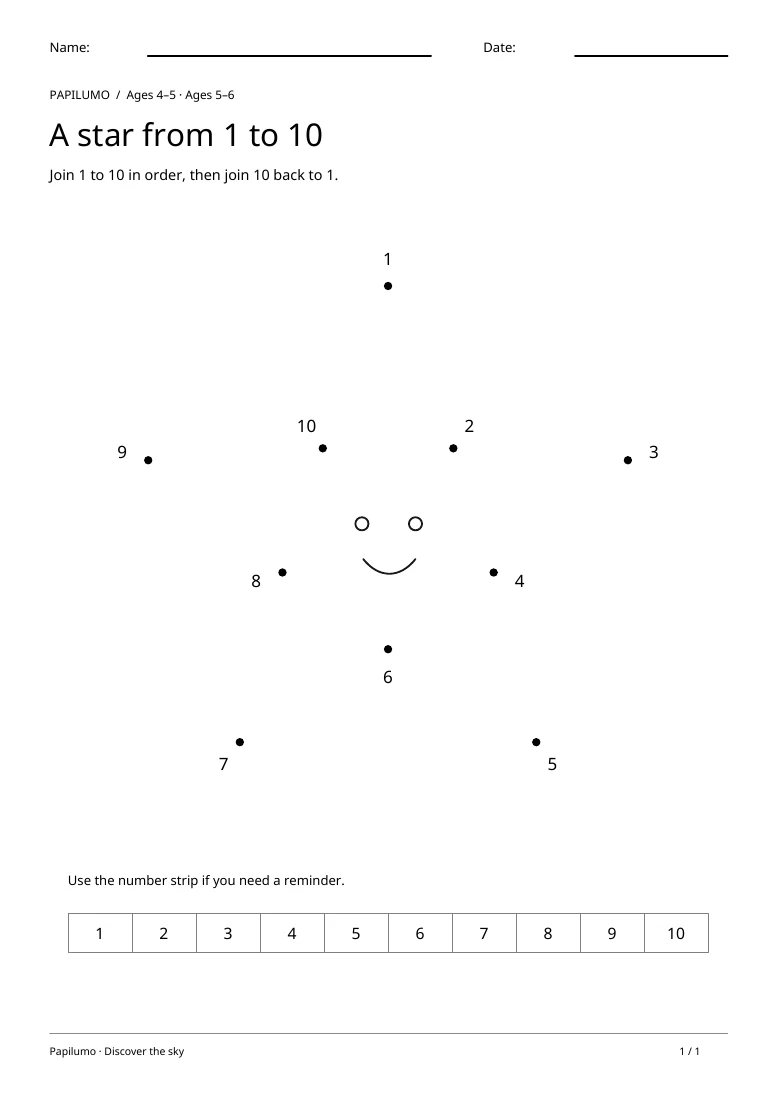
Use the follow-up to meet the same idea in a different setting. Offer it once the first task makes sense, without insisting that the whole page must be perfect. The child might explain a strategy, make an example or set a challenge for an adult. Return to the worksheet only when it helps connect the two situations. A short conversation or a practical activity can be enough to finish the session. To continue exploring, use Connect the Dots 1–10: Star Printable: Join 1 to 10 in order, then join 10 back to 1.
Downloading and printing the PDF
This free PDF contains one worksheet designed for A4 paper. Download the file using the button on this page and open it in your PDF reader. Choose actual size or a 100% scale, check the orientation in the print preview and turn off any browser headers or footers. The illustrations use vector lines, so their outlines stay sharp when printed. Check the margins on one copy before preparing several sheets for a group. The level shown on the page is a guide, rather than a requirement to complete the activity at a particular age.