


What this worksheet helps children practise
Keep your finger on the start flag, say each direction aloud, and hop one square for every arrow!
Reading a directional arrow sequence across a square grid builds foundational spatial awareness, reliable left-right and up-down discrimination, and sequential working memory. In Kindergarten, children learn to stay aligned along straight rows and columns, track exactly one square per arrow instruction without skipping ahead, and verify that their final landing position matches a specific visual target. These early unplugged coding skills prepare young learners smoothly for coordinate maps, two-way tables, and first-grade robotics or algorithmic thinking. For a related skill, use Hundred Chart Arrow Navigation Puzzles with Gaston: Find the start number on the 1 to 100 chart, follow each directional arrow in order, and write the final landing number in the box.
Preparing a short session
Print the student worksheet at actual size (100%) on plain white A4 or letter paper without cropping margins, and set out a sharpened pencil or marker for circling answers. Before tackling cards A through D, examine Pipo’s top banner together: trace the ice floe illustration, read his speech bubble aloud, and act out right, left, up, and down with simple hand gestures. Make sure your child connects one single arrow tile to one single square hop on the grid. Keep the separate answer key PDF completely hidden during independent work.
A concrete example to get started
Inside the worked example box beside Pipo, a mini 3×3 grid places the start flag in the bottom-left corner and a crisp star right in the center square. Right beside the grid, two clear vector arrows show right, then up. Sliding a finger one square right along the bottom row and then one square up leads directly onto the center star, which is circled right beside the arrow code so children immediately see both how the path moves and how to mark their answer.
Supporting the activity
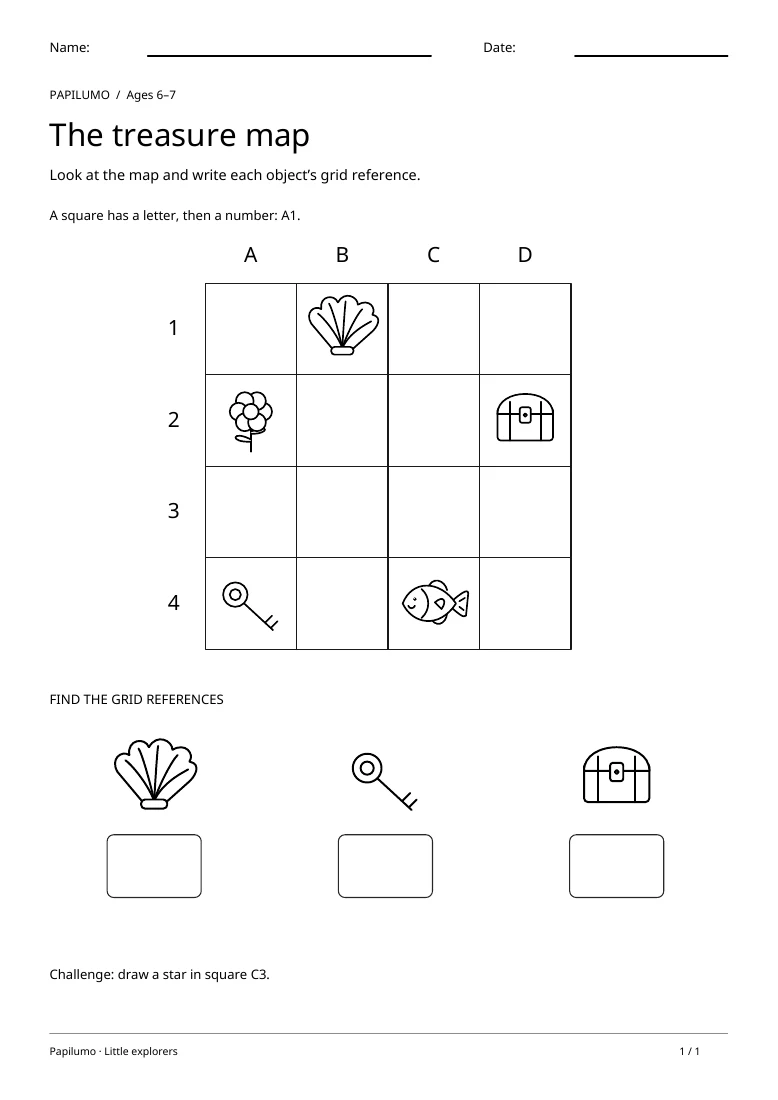
The four 4×4 grid puzzles step up smoothly from four to five directional moves without ever crossing a board border or passing through another picture early. On card A (apple, boat, bell), right, up, right, up reaches the boat; on card B (key, star, leaf), left, down, down, left lands squarely on the leaf; on card C (house, moon, fish), up, right, right, down, right arrives at the house; and on card D (kite, crown, mushroom), right, down, down, left, down finishes right on the crown. To vary the practice, try Grid Coordinates Worksheet: Treasure Map: Look at the map and write each object’s grid reference.
What to notice and how to check
Use the separate one-page answer key PDF, which traces the full bold path square by square inside every 4×4 grid and circles the winning destination icon at the bottom right, to check both reasoning process and final choice in seconds. If an answer misses the mark, have your child place a finger back on the start flag and count out each arrow slowly one at a time to catch whether a turn was flipped or two squares were skipped. Early finishers can invent a brand-new arrow route to one of the other two icons.
Making the task easier
Cover the later arrows with a small slip of paper so you only read and trace one arrow at a time.
Keep the learning aim, but reduce how much the child has to handle at once. Cover part of the page with another sheet and reveal one task at a time. Demonstrate a separate example, then leave a real opportunity to work something out. An answer reached with support is still a useful attempt; it does not yet show that the same task can be completed independently.
Taking the idea beyond the worksheet
Write a four-arrow path on card A that reaches the apple or the bell without touching the boat.
Use the follow-up to meet the same idea in a different setting. Offer it once the first task makes sense, without insisting that the whole page must be perfect. The child might explain a strategy, make an example or set a challenge for an adult. Return to the worksheet only when it helps connect the two situations. A short conversation or a practical activity can be enough to finish the session. To continue exploring, use Follow the Arrows Worksheet: Robot Grid Directions: Follow the arrows from the robot and circle the object it finds.
Downloading and printing the PDF
This free PDF contains one worksheet designed for A4 paper. Download the file using the button on this page and open it in your PDF reader. Choose actual size or a 100% scale, check the orientation in the print preview and turn off any browser headers or footers. The illustrations use vector lines, so their outlines stay sharp when printed. Check the margins on one copy before preparing several sheets for a group. The level shown on the page is a guide, rather than a requirement to complete the activity at a particular age.