
What this worksheet helps children practise
Ask children to say the total before drawing. If two lines reach the same dot, recount both additions involved.
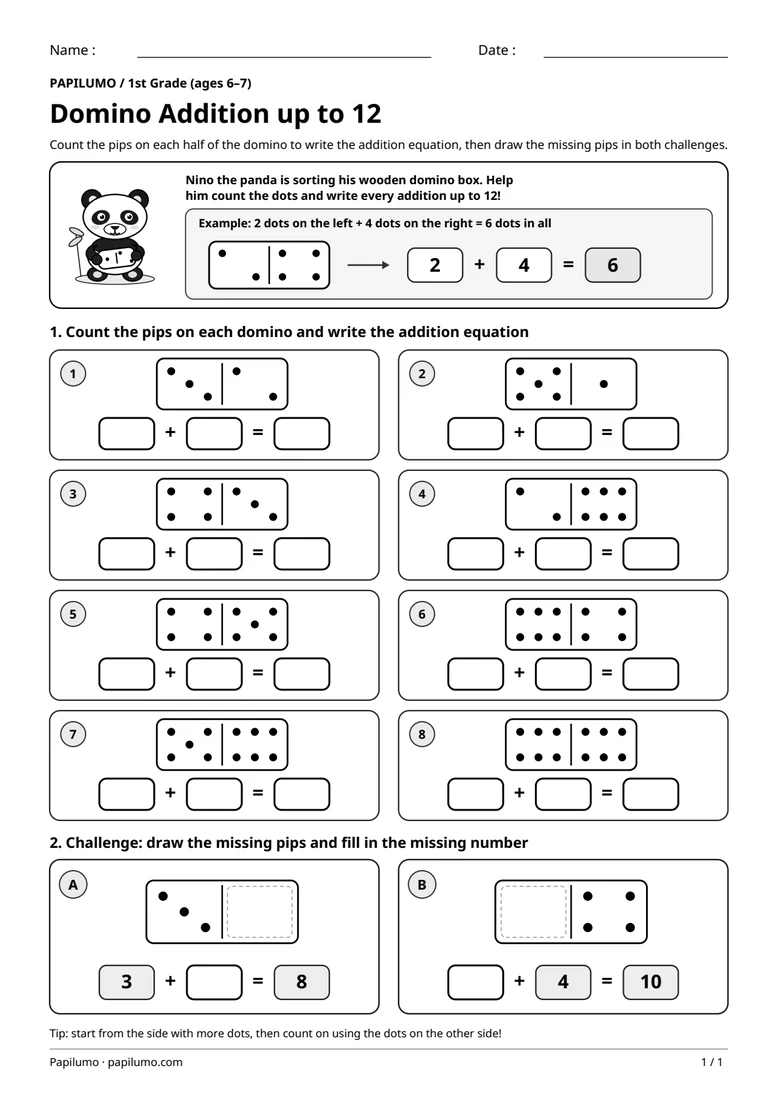
The activity connects a visible quantity to a written number through addition. The dice show two groups to combine, and the plus sign represents bringing them together. Children may count every dot or start with the first die and count on the dots of the second. Each game has three different totals, so every pair has just one possible destination. Children do not need to roll real dice or copy an equation into boxes; the central task is adding and matching. For a related skill, use Domino Addition up to 12 with Nino the Panda: Count the pips on each half of the domino to write the addition equation, then draw the missing pips in both challenges.
Preparing a short session
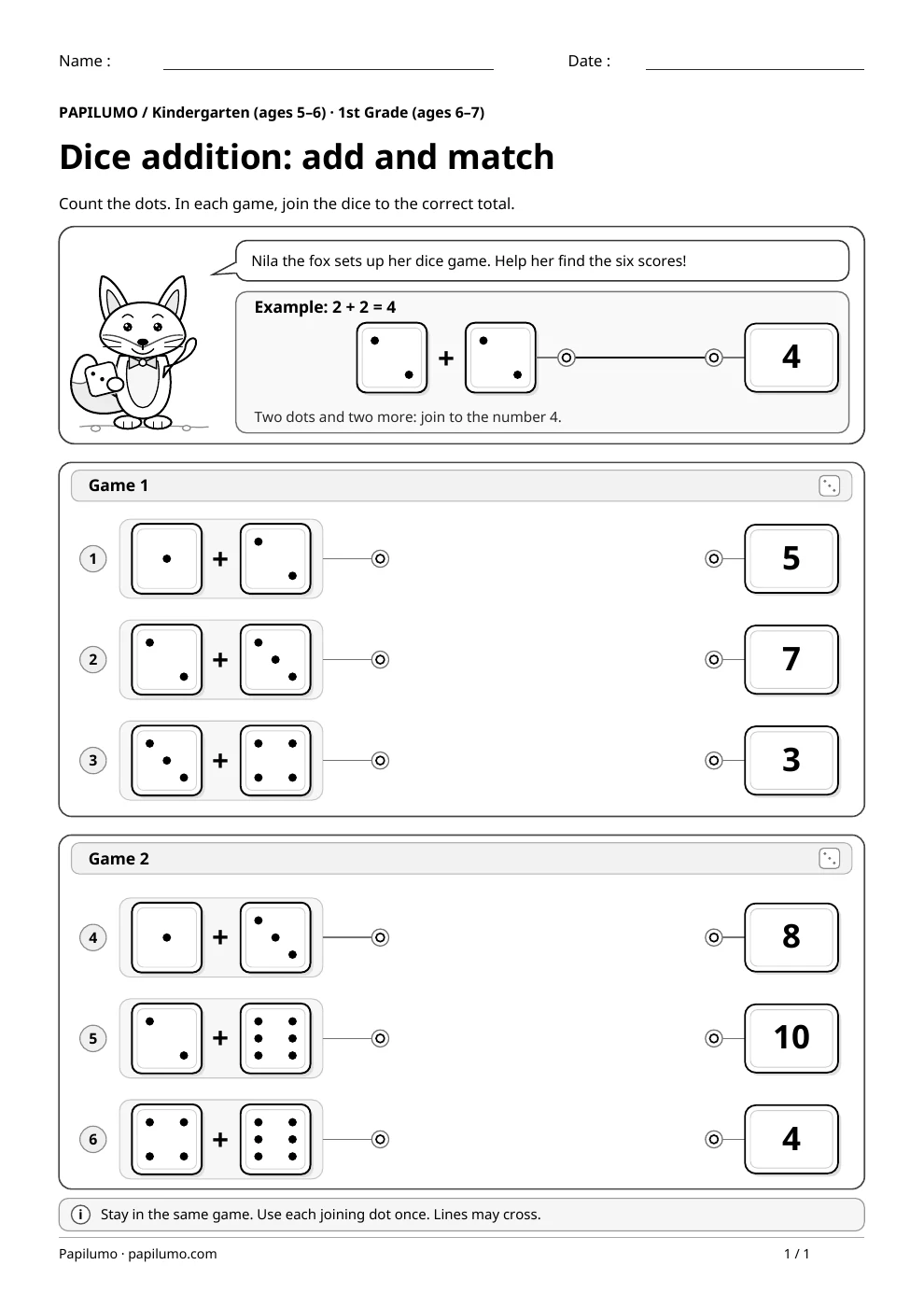
Print at actual size and provide a pencil. No scissors or color code are needed. Look at Nila holding her die, then identify the two game panels. Each panel has three pairs of dice on the left and three scores on the right. Small joining dots show where each line should start and end. Children can point out a route before drawing it. Keep the answer key aside, work through the model together and then allow time for an independent attempt.
A concrete example to get started
The example has two dots on each die. Count two and then two more to make four. The worked line therefore reaches the joining dot beside 4. Ask children to follow the line and explain why it is correct. They can check by touching each of the four dots once. The answer connects the total of the two groups to a printed numeral. There is no need to draw another die or write a number in this activity.
Supporting the activity
The first game contains 1 + 2, 2 + 3 and 3 + 4. Its score choices, from top to bottom, are 5, 7 and 3. The second game contains 1 + 3, 2 + 6 and 4 + 6, with score choices 8, 10 and 4. Stay inside the same panel when matching. Encourage children to look at both dice before searching for a score instead of selecting whichever number happens to be directly opposite. To vary the practice, try Dice Subtraction: Higher Minus Lower with Nila the Panda: Count the dots on both dice, write the greater number first, and find the difference.
What to notice and how to check
The first three totals are 3, 5 and 7; the second three are 4, 8 and 10. Each line should run from a dot beside a dice pair to the dot beside its total. Lines may cross, and each joining dot is used once within its game. Recount the pictured dots to check each addition, then make sure no pair has been missed. The key shows the actual matching lines rather than only giving a list of answers to copy.
Making the task easier
Begin with the first game and cover the second. Let children touch each dot or use counters to combine the two groups.
Keep the learning aim, but reduce how much the child has to handle at once. Cover part of the page with another sheet and reveal one task at a time. Demonstrate a separate example, then leave a real opportunity to work something out. An answer reached with support is still a useful attempt; it does not yet show that the same task can be completed independently.
Taking the idea beyond the worksheet
Imagine another dice pair and find its total aloud. Children can also explain two ways of counting the same pair by starting with a different die.
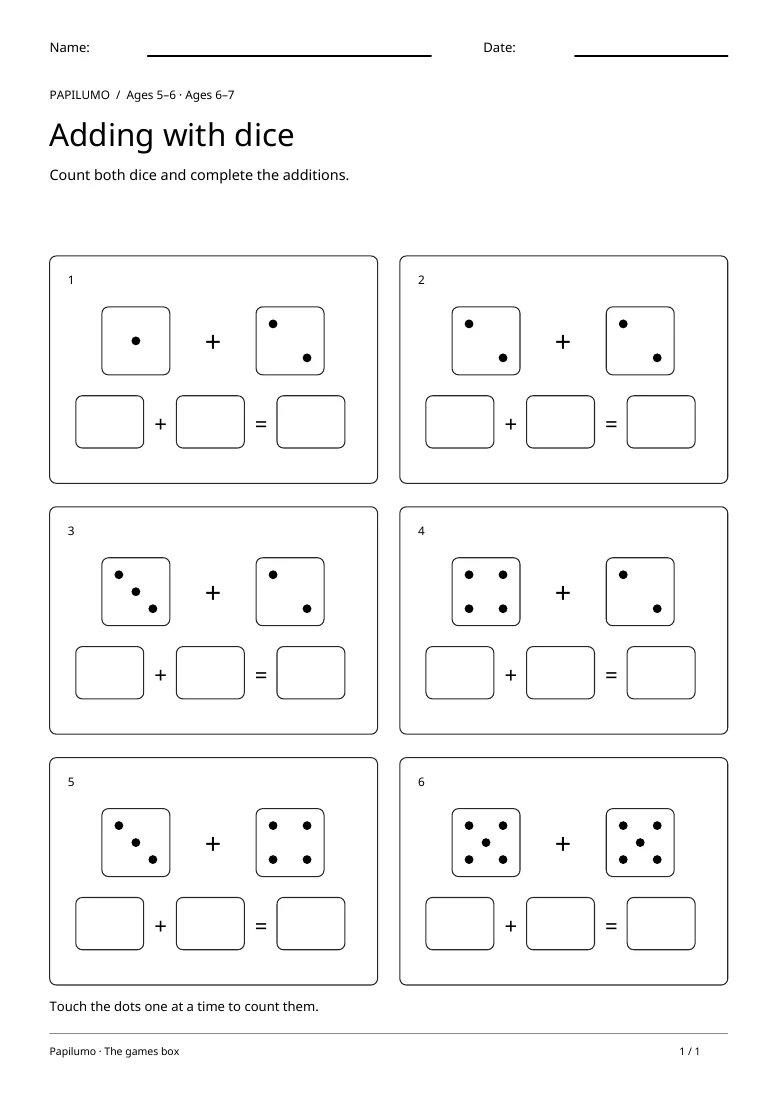
Use the follow-up to meet the same idea in a different setting. Offer it once the first task makes sense, without insisting that the whole page must be perfect. The child might explain a strategy, make an example or set a challenge for an adult. Return to the worksheet only when it helps connect the two situations. A short conversation or a practical activity can be enough to finish the session. To continue exploring, use Dice Addition Worksheet: Count the Dots: Count both dice and complete the additions.
Downloading and printing the PDF
This free PDF contains one worksheet designed for A4 paper. Download the file using the button on this page and open it in your PDF reader. Choose actual size or a 100% scale, check the orientation in the print preview and turn off any browser headers or footers. The illustrations use vector lines, so their outlines stay sharp when printed. Check the margins on one copy before preparing several sheets for a group. The level shown on the page is a guide, rather than a requirement to complete the activity at a particular age.