

What this worksheet helps children practise
Always start on the right with the tenths: as soon as you reach 10, carry 1 up to the ones box!
Adding decimals with regrouping builds genuine place-value fluency in 4th grade. Whenever the tenths column totals ten or more, students trade ten tenths for one whole unit in the exact same way they regroup ten ones into one ten with whole numbers. Seeing the decimal point stay fixed between the ones column (O) and the tenths column (t) confirms that regrouping crosses smoothly across the decimal point without shifting digits out of place. Problems ending in 7.0 or 9.0 reinforce holding the tenths place with a visible zero, while 10.3 naturally introduces a two-digit whole part. For a related skill, use Adding decimals: tenths without regrouping: Add the lengths. Write one digit in each answer box.
Preparing a short session
Print the student worksheet at actual size (100%) on plain white letter or A4 paper without shrinking margins, and provide a sharpened pencil with a clean eraser. Before tackling the eight grid items, read the worked box beside Oli the owl chef together at an unhurried pace: trace from right to left (tenths first, then ones) and point out the small carry box tucked directly above the ones digit. Keep the separate answer key PDF completely out of sight while your child completes all eight additions independently on the page.
A concrete example to get started
In the top example 4.8 + 3.6 = 8.4, begin on the right in the tenths column: 8 + 6 = 14 tenths. Because 14 tenths equal 1 whole unit and 4 extra tenths, write 4 in the tenths box and carry 1 up into the carry box above the ones column. Next, add the ones column including that carried unit: 1 + 4 + 3 = 8 ones. Because the decimal point remains anchored right between 8 and 4, the final combined total reads 8.4 clearly.
Supporting the activity
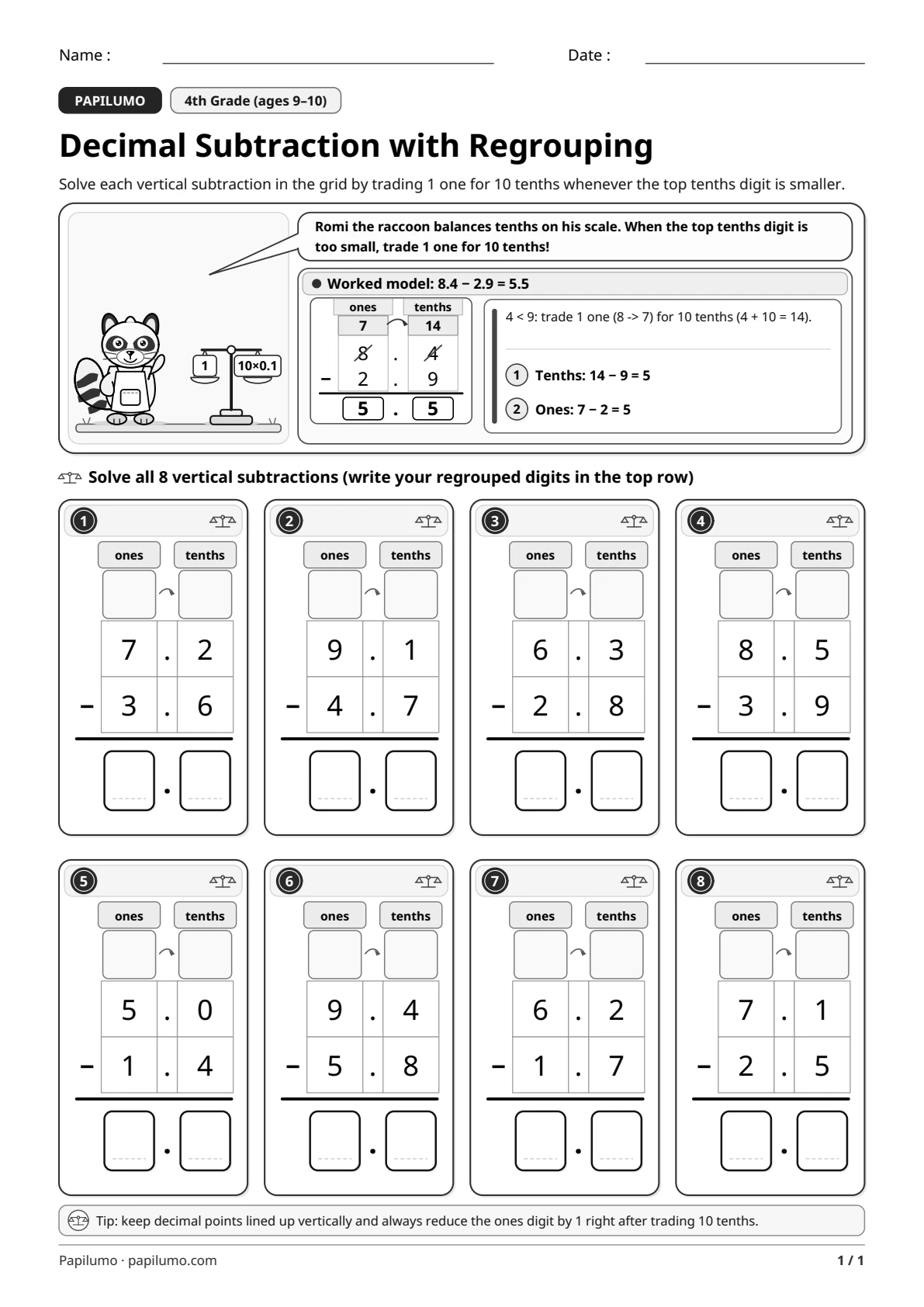
The eight grid additions are arranged in two neat rows of four varied items designed for steady progression: 4.2 + 2.8 = 7.0 and 2.3 + 6.7 = 9.0 highlight exact wholes with a zero in the tenths column; 1.5 + 5.6 = 7.1, 4.5 + 3.9 = 8.4, 2.9 + 5.4 = 8.3, 6.2 + 2.9 = 9.1, and 1.8 + 7.4 = 9.2 practice carries from 11 to 14 tenths; and 5.6 + 4.7 = 10.3 steps neatly into the tens column on the left. To vary the practice, try Decimal Subtraction with Regrouping with Romi the Raccoon: Solve each vertical subtraction in the grid by trading 1 one for 10 tenths whenever the top tenths digit is smaller.
What to notice and how to check
When reviewing with the separate answer key PDF, check two key habits closely: verify that the carried 1 is clearly recorded above the ones column and confirm that trailing zeros are written in 7.0 and 9.0 rather than left blank. If a child writes 84 instead of 8.4, omits the decimal point, or forgets the carry on 5.6 + 4.7 = 10.3, revisit Step 1 in the model together and recount the ones column aloud with the carried 1 included.
Making the task easier
Lightly shade or circle the tenths column on the first two cards as a reminder to add tenths before ones.
Keep the learning aim, but reduce how much the child has to handle at once. Cover part of the page with another sheet and reveal one task at a time. Demonstrate a separate example, then leave a real opportunity to work something out. An answer reached with support is still a useful attempt; it does not yet show that the same task can be completed independently.
Taking the idea beyond the worksheet
Estimate each sum mentally before writing: for instance, 4.8 + 3.6 is close to 5 + 3.5 = 8.5.
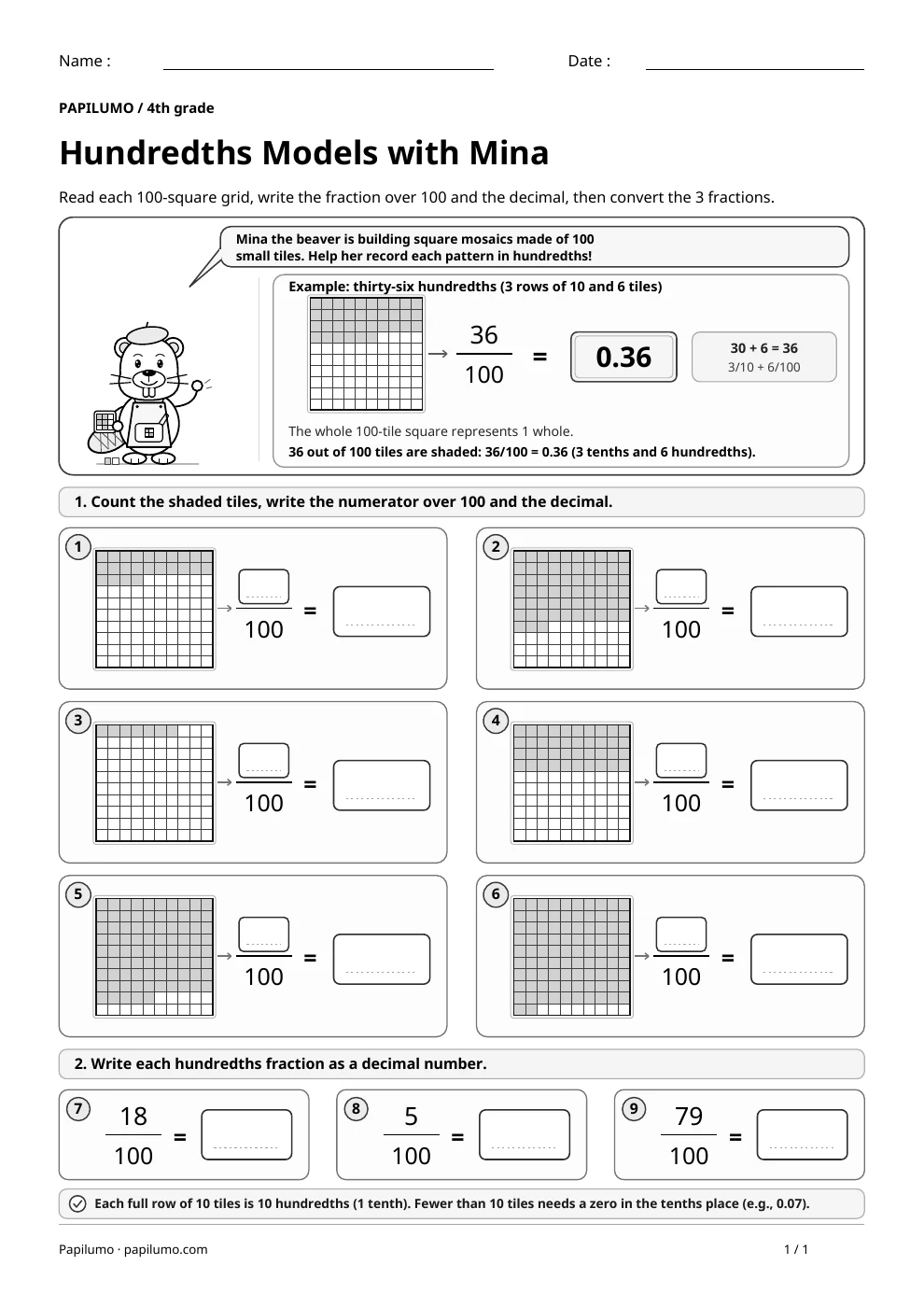
Use the follow-up to meet the same idea in a different setting. Offer it once the first task makes sense, without insisting that the whole page must be perfect. The child might explain a strategy, make an example or set a challenge for an adult. Return to the worksheet only when it helps connect the two situations. A short conversation or a practical activity can be enough to finish the session. To continue exploring, use Hundredths Models: 100-Grids, Fractions and Decimals: Read each 100-square grid, write the fraction over 100 and the decimal, then convert the 3 fractions.
Downloading and printing the PDF
This free PDF contains one worksheet designed for A4 paper. Download the file using the button on this page and open it in your PDF reader. Choose actual size or a 100% scale, check the orientation in the print preview and turn off any browser headers or footers. The illustrations use vector lines, so their outlines stay sharp when printed. Check the margins on one copy before preparing several sheets for a group. The level shown on the page is a guide, rather than a requirement to complete the activity at a particular age.