

Talking About the Three Uncolored Stars in Tico's Model
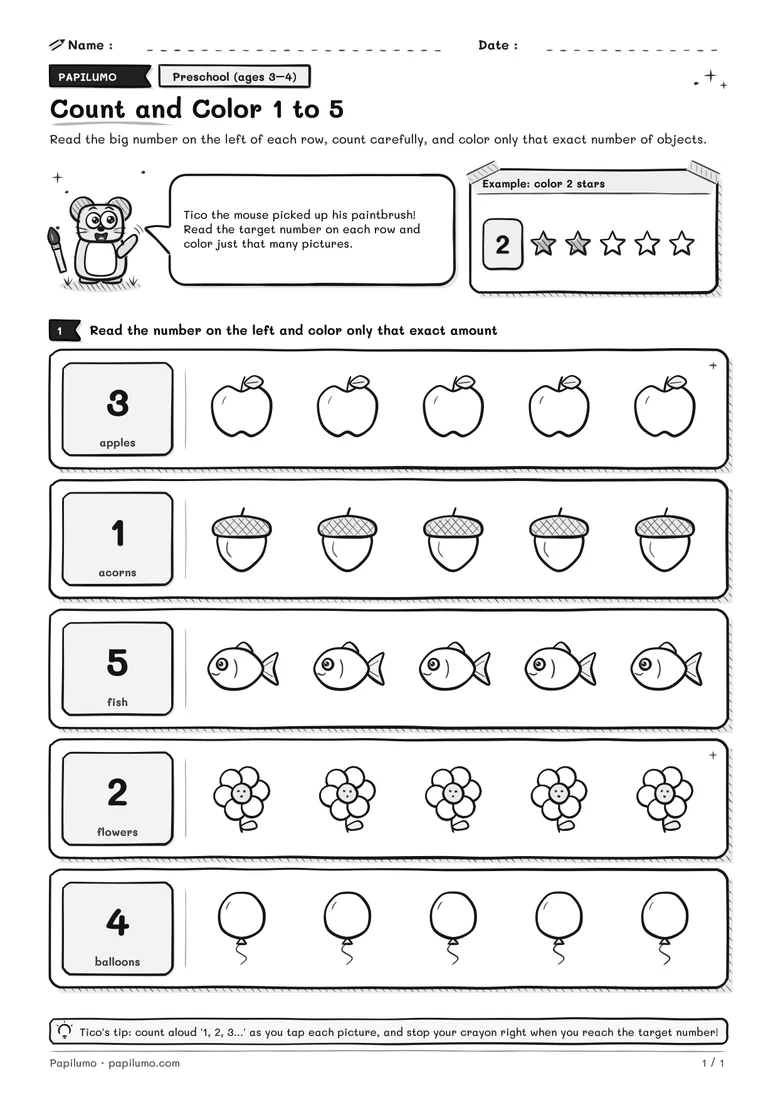
Before passing out crayons, look closely at Tico's top banner together: beside the bold numeral 2 sit five outlined stars, with only the first two on the left shaded dark gray while the remaining three stay completely white. Ask your child, "Why did Tico leave those three stars white instead of coloring the whole line?" Spotting those uncolored extras up front sets clear expectations for every row below.
To warm up each new line, have learners touch the big number on the left, say its name out loud, and practice counting one to five on fingers before touching a crayon. Popping up three or four fingers gives young minds a physical checkpoint they can glance back at while working.
Taming Runaway Coloring Momentum at Ages Three and Four
The real challenge on preschool count-and-color pages isn't reciting numbers out loud; it is motor impulse control! A three-year-old will accurately announce "three," start coloring the first object, move happily to the second and third, and keep right on coloring the fourth and fifth because the soothing back-and-forth rhythm of coloring pushes the target number right out of working memory.
Separate the counting step from the coloring step with the "dot, gate, then color" trick at your kitchen or center table. Have your child tap from left to right and place one tiny crayon dot inside each counted picture: "One, two, three, freeze!" Immediately cover the extra blank objects on the right with their free hand or an index card like a parking gate, then let them color only the dotted shapes at their own relaxed pace.
Why Building a Set Beats Just Counting a Finished Group
Pulling an exact subset of 2, 3, or 4 items out of a row of 5 stretches cardinality much further than counting an isolated cluster where running out of pictures automatically stops your voice. Rotating this page with matching counted groups to numerals ensures preschoolers can travel flexibly from picture group to written digit and from digit back to group.
Children ready for an extra nudge can write tiny check numbers 1, 2, 3 beneath the objects they colored on each row to double-check their total, then peek at the row for 5 where zero white pictures remain uncolored, a terrific segue into exploring zero and empty sets in pre-K.