
What this worksheet helps children practise
Tap every picture once while counting out loud, then draw one neat circle around the matching big number!
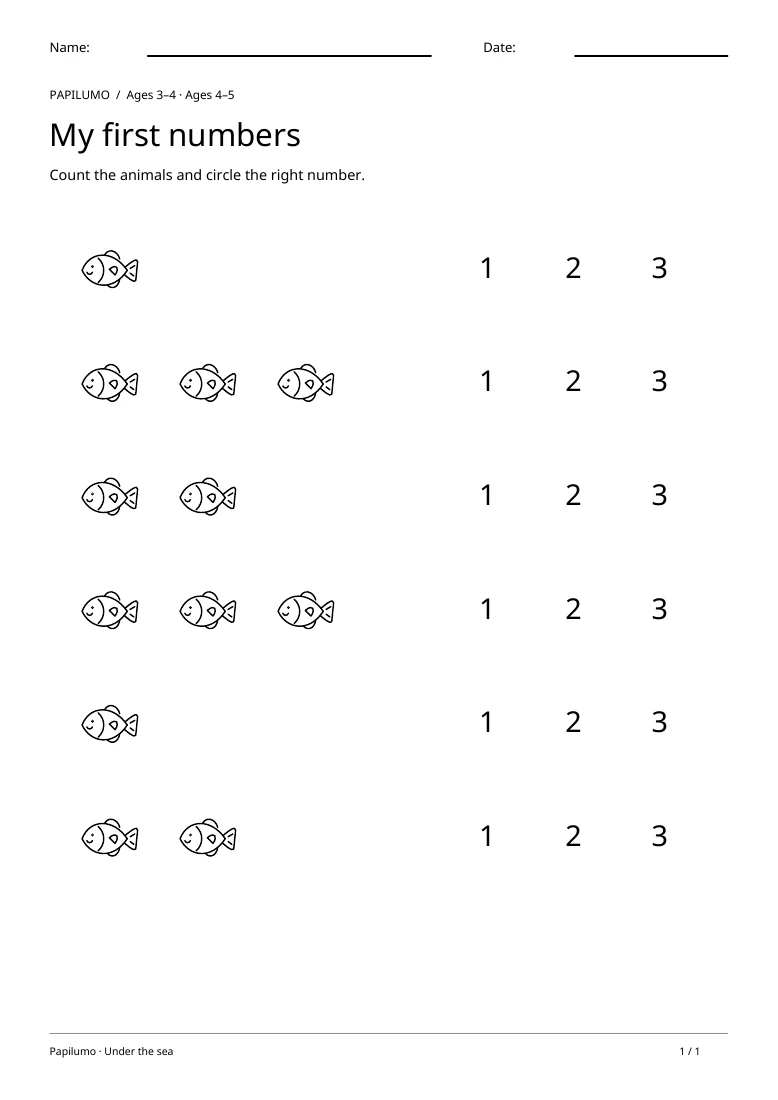
Counting small sets up to 5 in preschool lays the essential groundwork for number sense well before addition or subtraction. By touching each sun, sailboat, apple, duck, or ladybug once while saying the counting words in order, young learners master one-to-one correspondence and the cardinal principle—the final number spoken tells how many objects are in the whole group. Linking that counted amount immediately to one of three oversized numeral choices also builds fast numeral recognition and steady circular pencil control. For a related skill, use Counting to 3 Worksheet with Animals: Count the animals and circle the right number.
Preparing a short session
Print the student worksheet at actual size (100%) on plain white letter or A4 paper without shrinking margins, and offer a chunky pencil, washable marker, or thick crayon. Keep the separate one-page PDF answer key out of sight while your child works independently. Before picking up the marker, gather five small wooden blocks or buttons on the table and practice touching and counting each piece slowly together. Then trace Nilo’s top banner with one finger while reading the simple direction aloud.
A concrete example to get started
Inside the framed banner at the top of the page, Nilo the little bear points cheerfully toward his speech bubble and the worked two-star mini example. On the left side of the small arrow sit two clean five-pointed stars; on the right sit three rounded number pills showing 1, 2, and 3. A bold closed loop circles the middle 2 pill to model the exact action needed below. Because the picture and number choice speak visually, pre-readers understand the task right away.
Supporting the activity
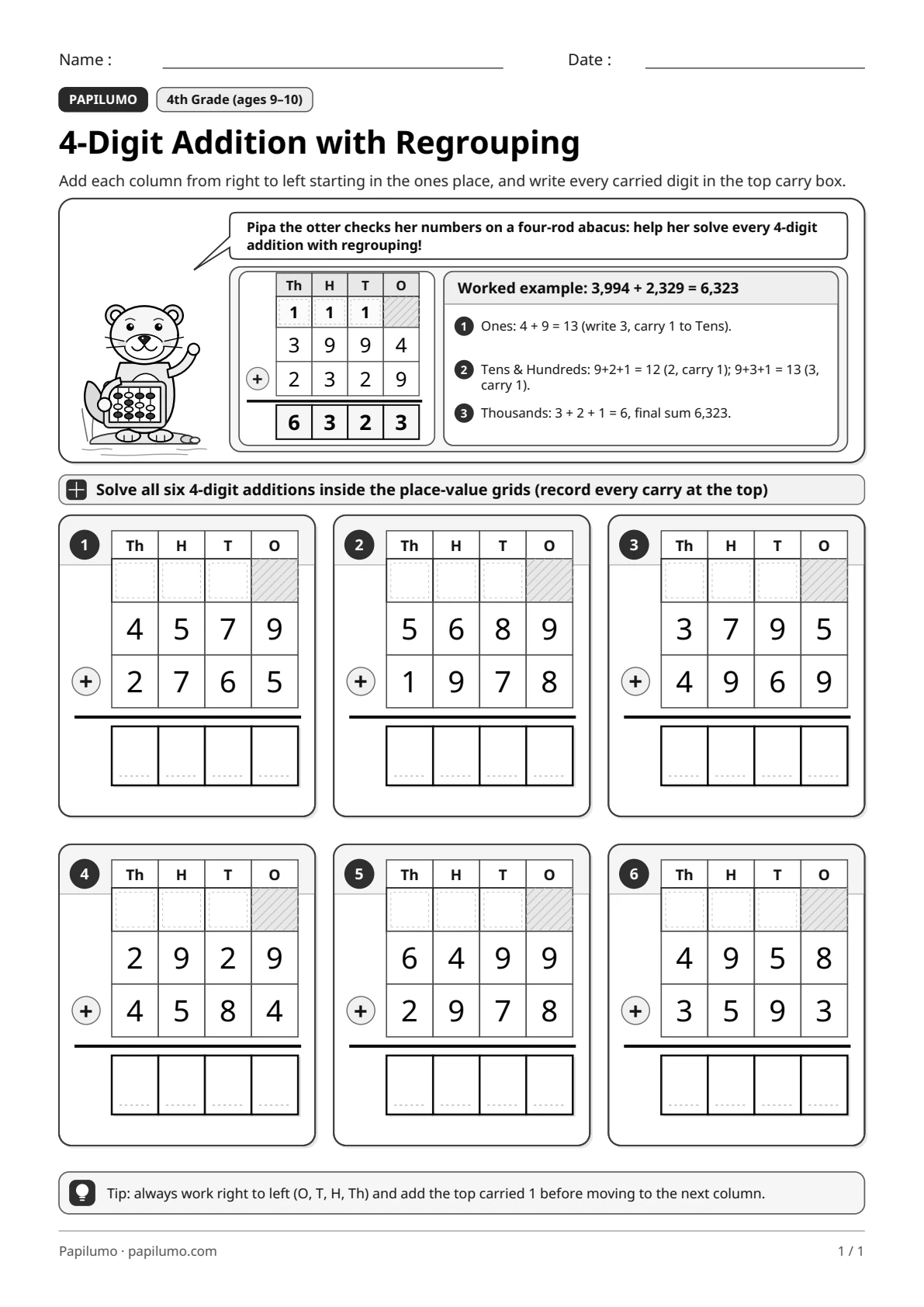
Move smoothly down the five roomy rows from 1 to 5. In Row 1, one joyful smiling sun matches pill 1 on the left among 1, 2, and 3. In Row 2, two bobbing sailboats match pill 2 in the middle of 3, 2, and 4. In Row 3, three stemmed apples match pill 3 on the right among 2, 4, and 3. In Row 4, four swimming pond ducks match pill 4 on the left among 4, 5, and 2. Finally, in Row 5, five spotted ladybugs match pill 5 in the center among 3, 5, and 4. To vary the practice, try 4-Digit Addition with Regrouping with Pipa the Otter: Add each column from right to left starting in the ones place, and write every carried digit in the top carry box.
What to notice and how to check
When reviewing finished work with the separate PDF answer key, check first that only one big number pill is circled per row in sequence: 1 on the left, 2 in the middle, 3 on the right, 4 on the left, and 5 in the middle. If a preschooler double-counts a spotted ladybug or skips a duck, place a small dry bean or coin right on top of each drawn object as they count, or slide a blank card below the current row to keep eyes focused on one clean line at a time.
Making the task easier
Cover the lower rows with a blank sheet of paper and set one small counter on each picture as you count.
Keep the learning aim, but reduce how much the child has to handle at once. Cover part of the page with another sheet and reveal one task at a time. Demonstrate a separate example, then leave a real opportunity to work something out. An answer reached with support is still a useful attempt; it does not yet show that the same task can be completed independently.
Taking the idea beyond the worksheet
Ask your child to fetch 1 to 5 real household items, such as spoons or socks, and match each pile to a row on the page.
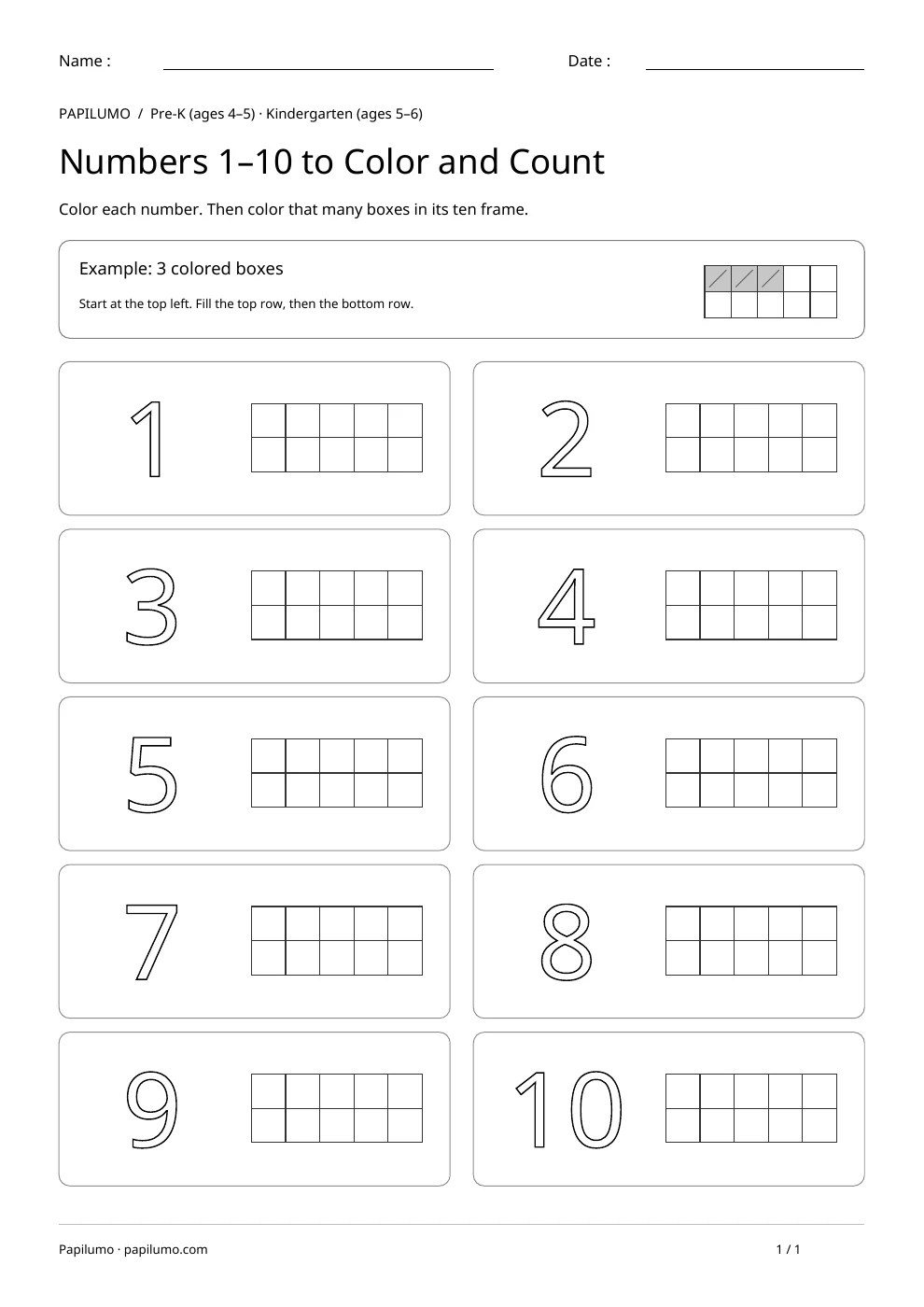
Use the follow-up to meet the same idea in a different setting. Offer it once the first task makes sense, without insisting that the whole page must be perfect. The child might explain a strategy, make an example or set a challenge for an adult. Return to the worksheet only when it helps connect the two situations. A short conversation or a practical activity can be enough to finish the session. To continue exploring, use Numbers 1–10 to Color and Count: Color each number. Then color that many boxes in its ten frame.
Downloading and printing the PDF
This free PDF contains one worksheet designed for A4 paper. Download the file using the button on this page and open it in your PDF reader. Choose actual size or a 100% scale, check the orientation in the print preview and turn off any browser headers or footers. The illustrations use vector lines, so their outlines stay sharp when printed. Check the margins on one copy before preparing several sheets for a group. The level shown on the page is a guide, rather than a requirement to complete the activity at a particular age.