

What this worksheet helps children practise
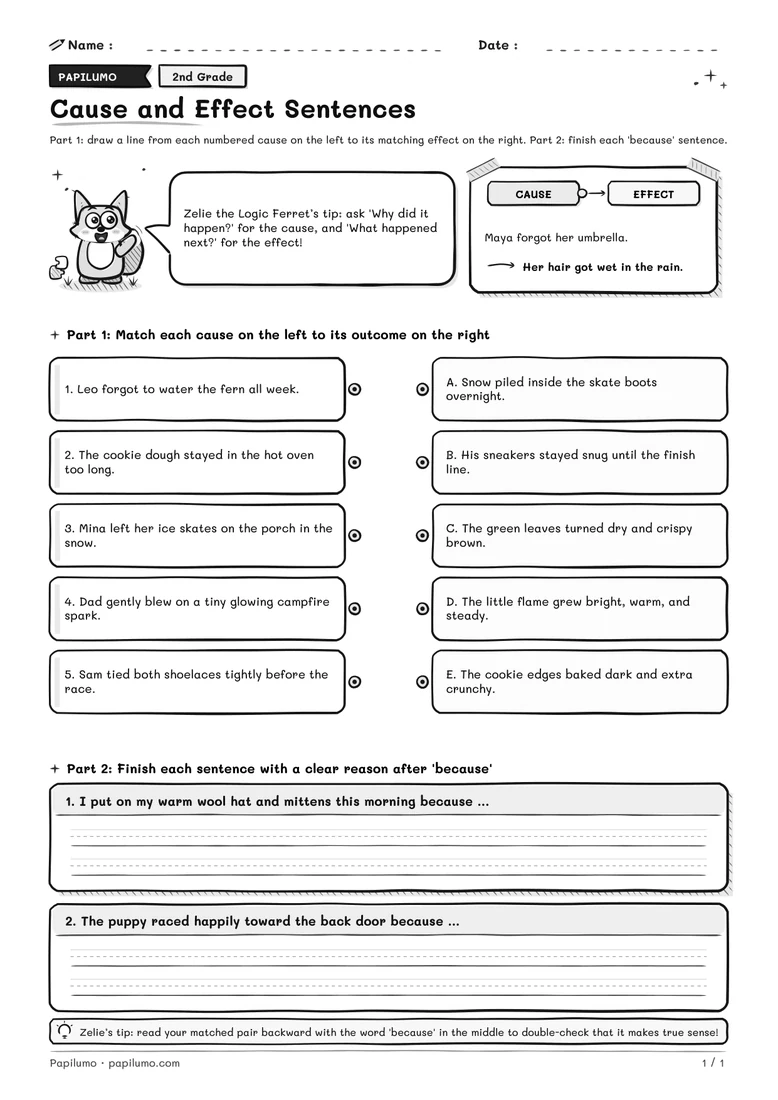
Test each matched line by reading the effect first, saying 'because', and reading the cause—if it sounds logical, your match is right!
Understanding cause-and-effect relationships inside single sentences in 2nd Grade builds logical reasoning, attentive reading comprehension, and confident command of explanatory connecting words. By distinguishing the reason something happens first from the result that follows right after, young readers learn to track real meaning across clauses rather than skimming surface words quickly. Moving smoothly from matching familiar everyday scenarios to writing their own original reasons after 'because' strengthens both reading inference and early explanatory writing for stories, nature notes, and classroom discussions alike. For a related skill, use Frog Life Cycle: Observe, Read and Order the 4 Stages with Bibi: Look at the 4 pond cards: write numbers 1 to 4, copy each name onto the lines, then finish the cycle and sentences.
Preparing a short session
Print the student worksheet at actual size (100%) on plain white A4 paper and place a sharp pencil, soft eraser, and short straightedge on a bright, tidy table. Keep the separate one-page answer key PDF neatly out of sight until both parts are fully complete. Before drawing any connecting lines in Part 1, encourage your second grader to read all five causes aloud slowly first and then read every shuffled effect on the right so they match ideas thoughtfully by full sentence meaning rather than guessing.
A concrete example to get started
Inside the rounded banner across the top of the page, Zelie the Logic Ferret links two interlocking puzzle blocks labeled CAUSE and EFFECT right next to her speech bubble and a dashed worked-example frame. Inside that worked-example box, the sample cause ('Maya forgot her umbrella.') connects via a clean vector arrow directly to its clear outcome ('Her hair got wet in the rain.'). With just one quick glance, children immediately grasp how the first action directly explains what happened right afterward.
Supporting the activity
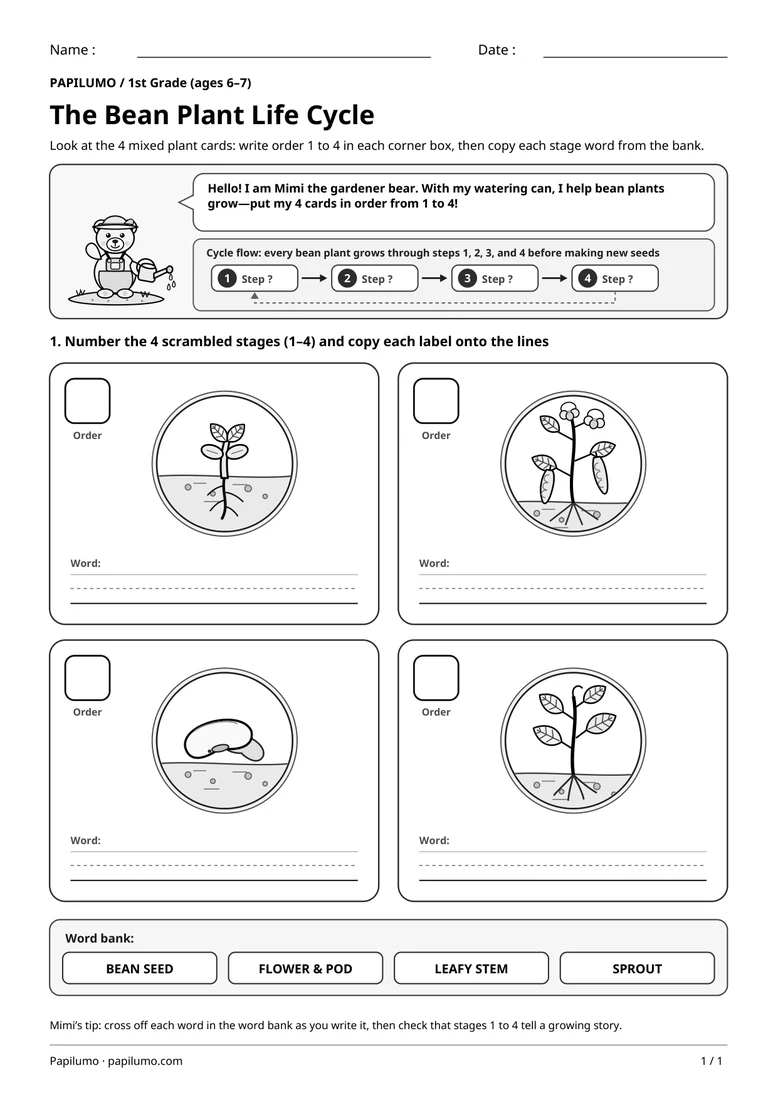
Below the banner, Part 1 features five relatable 2nd-grade scenarios inside crisp left-hand cards—forgetting to water a fern all week, baking cookie dough too long, leaving ice skates on a snowy porch, blowing gently on a tiny campfire spark, and tying shoelaces tightly before a race—matched via clear anchor dots to five shuffled results on the right. Underneath, Part 2 offers two open sentence prompts ending with 'because' ('I put on my warm wool hat...' and 'The puppy raced happily...') above generous double primary writing lines for handwriting. To vary the practice, try Bean Plant Life Cycle: Order and Label the 4 Stages with Mimi: Look at the 4 mixed plant cards: write order 1 to 4 in each corner box, then copy each stage word from the bank.
What to notice and how to check
When both sections are completely finished, lay the separate one-page answer key PDF right beside your child’s sheet to check every logical connection calmly step by step together. The answer key displays all five completed cause-to-effect matching lines in Part 1 alongside clear sample written reasons printed neatly on both Part 2 double lines. Because several sensible real-world reasons can work well in Part 2, praise any clear sentence completion that gives a logical explanation after 'because' and gently check capitalization, word spacing, and end punctuation together.
Making the task easier
Put a finger on Cause 1 first, then read down all five right-hand sentences one by one until you hear the outcome that fits.
Keep the learning aim, but reduce how much the child has to handle at once. Cover part of the page with another sheet and reveal one task at a time. Demonstrate a separate example, then leave a real opportunity to work something out. An answer reached with support is still a useful attempt; it does not yet show that the same task can be completed independently.
Taking the idea beyond the worksheet
Write one new cause-and-effect sentence of your own on the back using the word 'because' to explain something that happened today.
Use the follow-up to meet the same idea in a different setting. Offer it once the first task makes sense, without insisting that the whole page must be perfect. The child might explain a strategy, make an example or set a challenge for an adult. Return to the worksheet only when it helps connect the two situations. A short conversation or a practical activity can be enough to finish the session. To continue exploring, use Fact or Opinion? Sort Short Reading Sentences with Zelie (2nd Grade): Read each sentence and circle Fact or Opinion, then look at the library scene to write one fact and one opinion.
Downloading and printing the PDF
This free PDF contains one worksheet designed for A4 paper. Download the file using the button on this page and open it in your PDF reader. Choose actual size or a 100% scale, check the orientation in the print preview and turn off any browser headers or footers. The illustrations use vector lines, so their outlines stay sharp when printed. Check the margins on one copy before preparing several sheets for a group. The level shown on the page is a guide, rather than a requirement to complete the activity at a particular age.