What this worksheet helps children practise
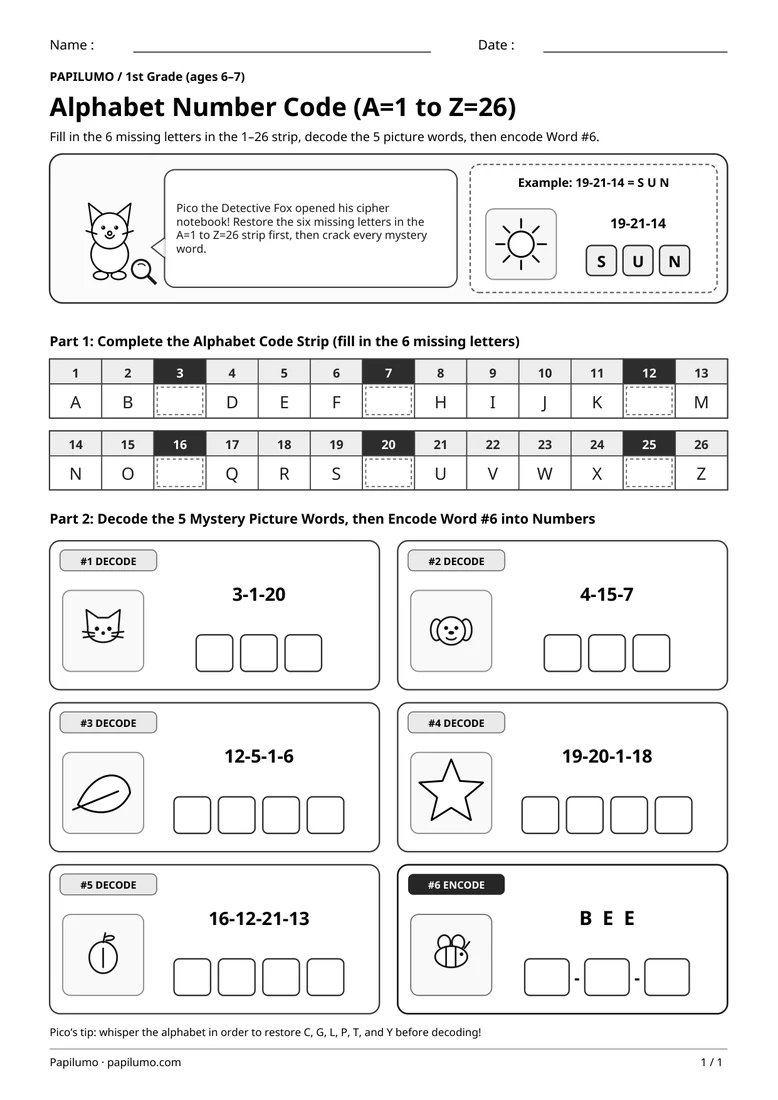
Restore all six missing letters in the 1–26 strip first, then trace each code number carefully to its letter cell.
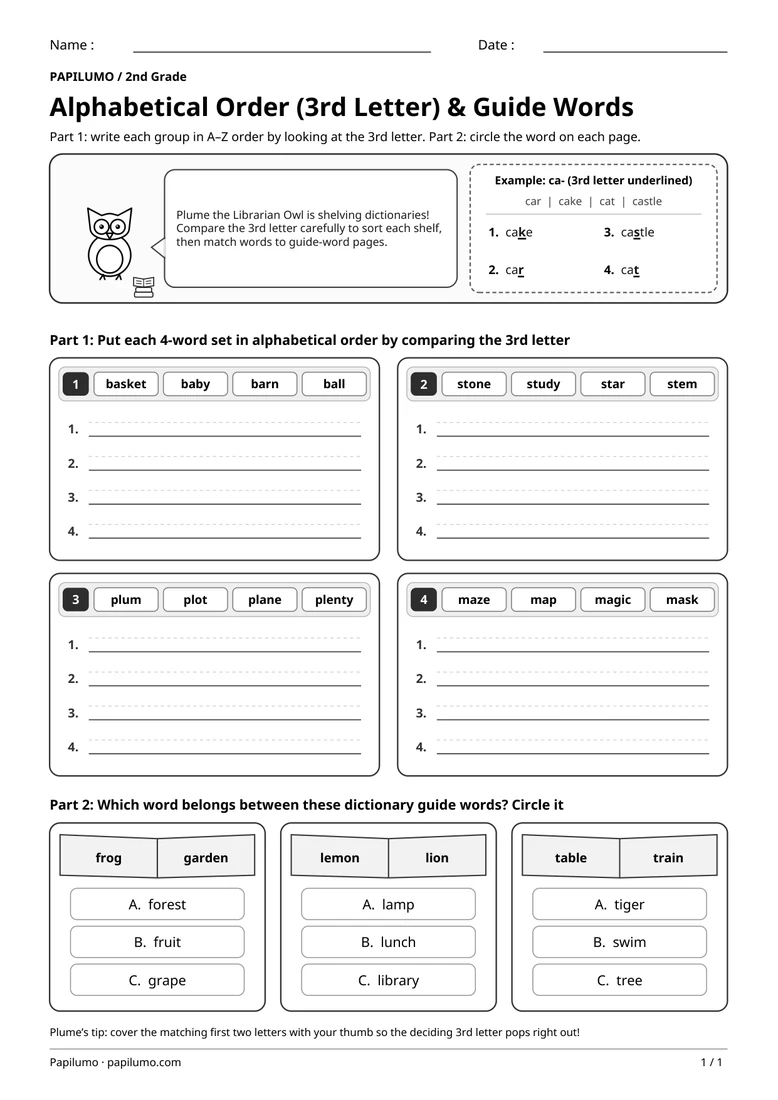
Connecting every letter from A to Z with its numbered rank from 1 to 26 in 1st grade builds true alphabetical order fluency alongside careful counting and table lookup skills. Rather than singing the alphabet song passively, filling in empty cells at positions 3, 7, 12, 16, 20, and 25 trains learners to pinpoint letter neighbors mentally. Translating number strings back into three- and four-letter words—and reversing the cipher to encode a short word—sharpens attention to detail, spelling accuracy, and joyful logical reasoning every step. For a related skill, use Alphabetical Order to the 3rd Letter & Dictionary Guide Words with Plume (2nd Grade): Part 1: write each group in A–Z order by looking at the 3rd letter. Part 2: circle the word on each page.
Preparing a short session
Print the student worksheet at actual size (100%) on plain white A4 paper so all twenty-six numbered alphabet cells and mystery letter boxes stay crisp and spacious. Seat your child at a calm, well-lit table with a sharpened pencil and soft eraser while keeping the separate one-page answer key PDF neatly out of sight. Before picking up the pencil, point across the two thirteen-cell rows (1–13 and 14–26) together and chant A through Z gently so your child spots the six missing spots immediately.
A concrete example to get started
Inside the framed banner across the top of the sheet, Pico the Detective Fox displays his cipher notebook next to a clearly worked mini example: the number code 19-21-14 sitting right above three filled letter squares spelling S, U, and N for SUN beside a smiling sun icon. One quick glance teaches young detectives how each hyphenated number points directly to a matching letter in the 1–26 key before they tackle Part 1 and Part 2 below on the page together.
Supporting the activity
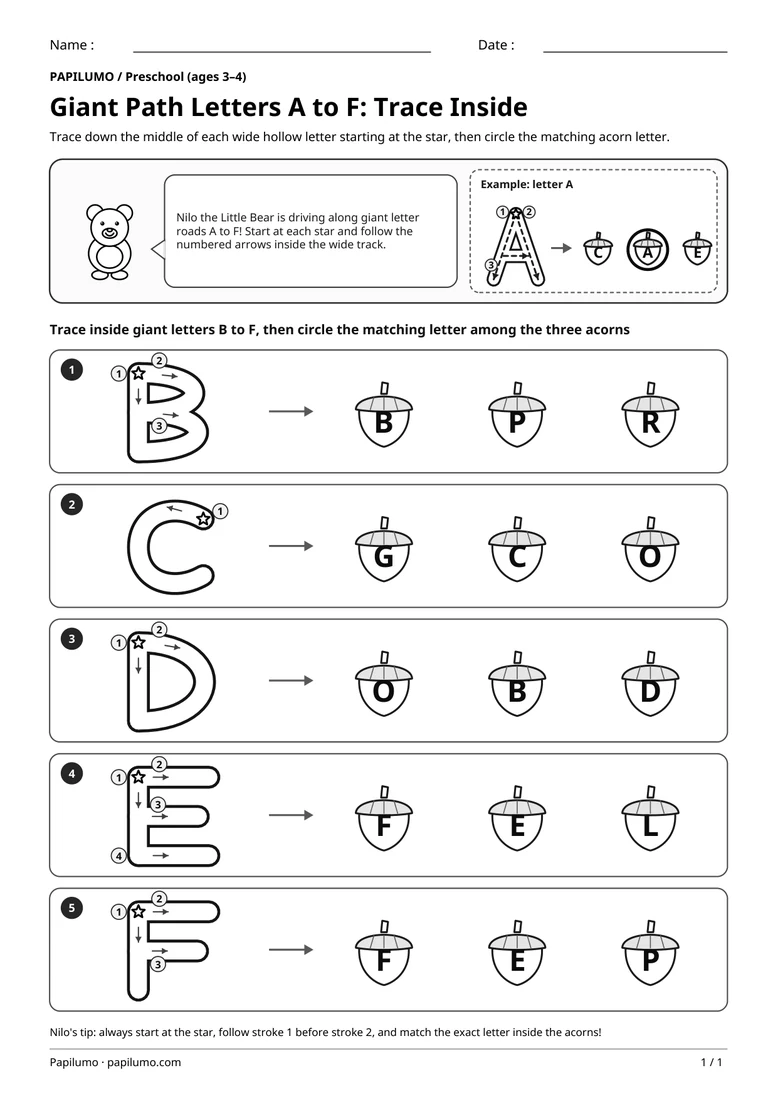
In Part 1, students scan the two-row key strip carefully and fill in C at 3, G at 7, L at 12, P at 16, T at 20, and Y at 25. Notice how those very restored letters reappear inside Part 2, rewarding accurate setup! Five illustrated mystery cards invite children to decode 3-1-20 (CAT), 4-15-7 (DOG), 12-5-1-6 (LEAF), 19-20-1-18 (STAR), and 16-12-21-13 (PLUM) neatly inside square letter boxes, while Card 6 flips the cipher challenge to encode BEE into three numbers. To vary the practice, try Giant Path Letters A to F: Trace Inside with Nilo (PS): Trace down the middle of each wide hollow letter starting at the star, then circle the matching acorn letter.
What to notice and how to check
Once all six missing alphabet letters, five decoded picture words, and the closing number sequence are filled in cleanly, place the separate one-page answer key PDF right beside the completed worksheet to inspect every single clue calmly together. Confirm first that C=3, G=7, L=12, P=16, T=20, and Y=25 sit in their exact cells, verify each decoded word matches its picture illustration, check that BEE maps cleanly to 2-5-5, and read every mystery word aloud clearly. Celebrate your sharp-eyed young codebreaker for staying focused and enjoy coloring all six black-and-white drawings together afterward.
Making the task easier
Tap each cell from A=1 upward while saying the alphabet quietly whenever you need to double-check a missing position.
Keep the learning aim, but reduce how much the child has to handle at once. Cover part of the page with another sheet and reveal one task at a time. Demonstrate a separate example, then leave a real opportunity to work something out. An answer reached with support is still a useful attempt; it does not yet show that the same task can be completed independently.
Taking the idea beyond the worksheet
Write your own first name in A=1 to Z=26 secret numbers on a scrap sheet and challenge someone at home to decode it.
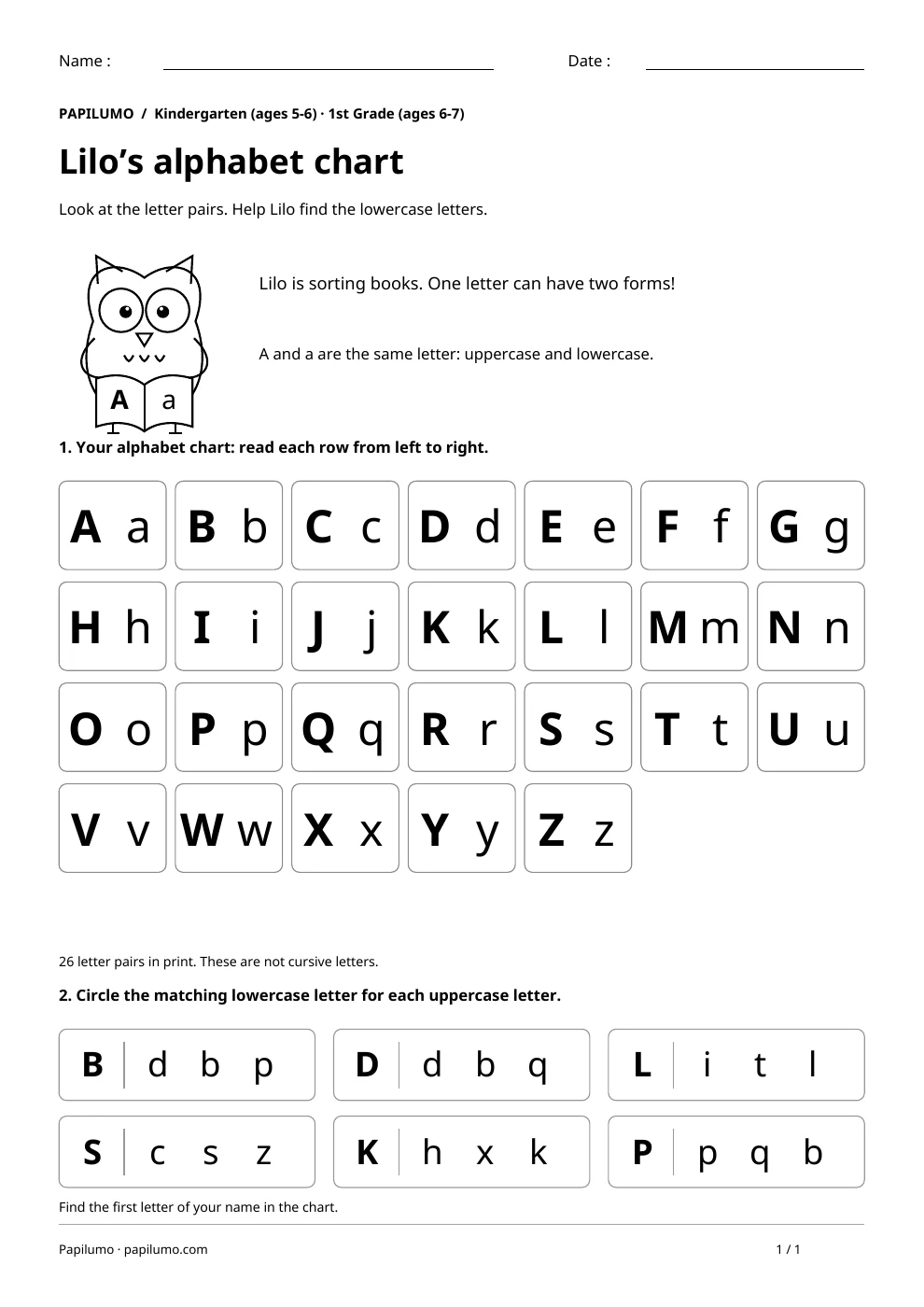
Use the follow-up to meet the same idea in a different setting. Offer it once the first task makes sense, without insisting that the whole page must be perfect. The child might explain a strategy, make an example or set a challenge for an adult. Return to the worksheet only when it helps connect the two situations. A short conversation or a practical activity can be enough to finish the session. To continue exploring, use Uppercase and lowercase alphabet chart with Lilo: Use the alphabet chart, then circle the lowercase match for each uppercase letter.
Downloading and printing the PDF
This free PDF contains one worksheet designed for A4 paper. Download the file using the button on this page and open it in your PDF reader. Choose actual size or a 100% scale, check the orientation in the print preview and turn off any browser headers or footers. The illustrations use vector lines, so their outlines stay sharp when printed. Check the margins on one copy before preparing several sheets for a group. The level shown on the page is a guide, rather than a requirement to complete the activity at a particular age.