
What this worksheet helps children practise
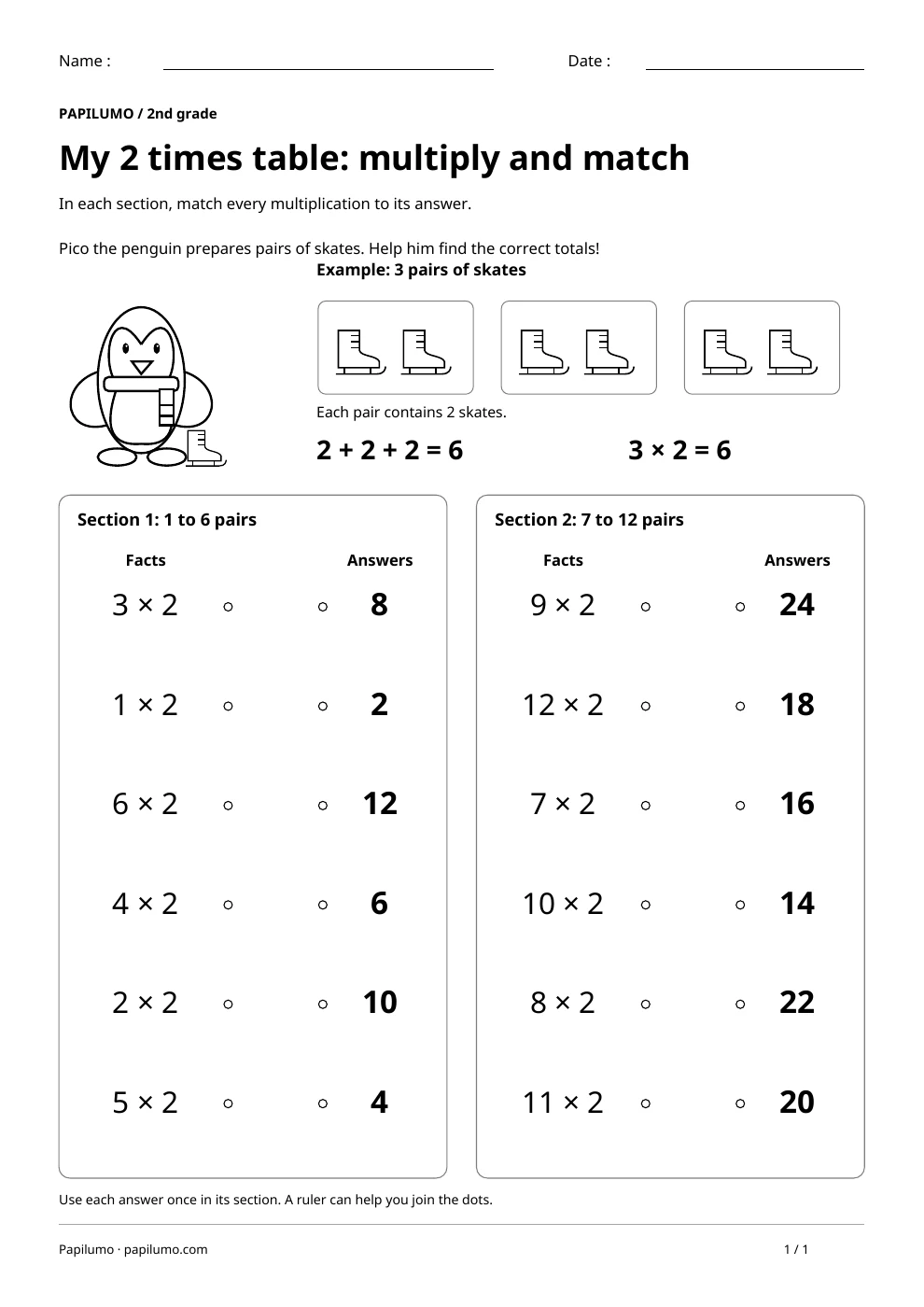
Ask what each factor represents. Counting individual skates gives a total, while counting pairs makes the equal groups in multiplication easier to see.
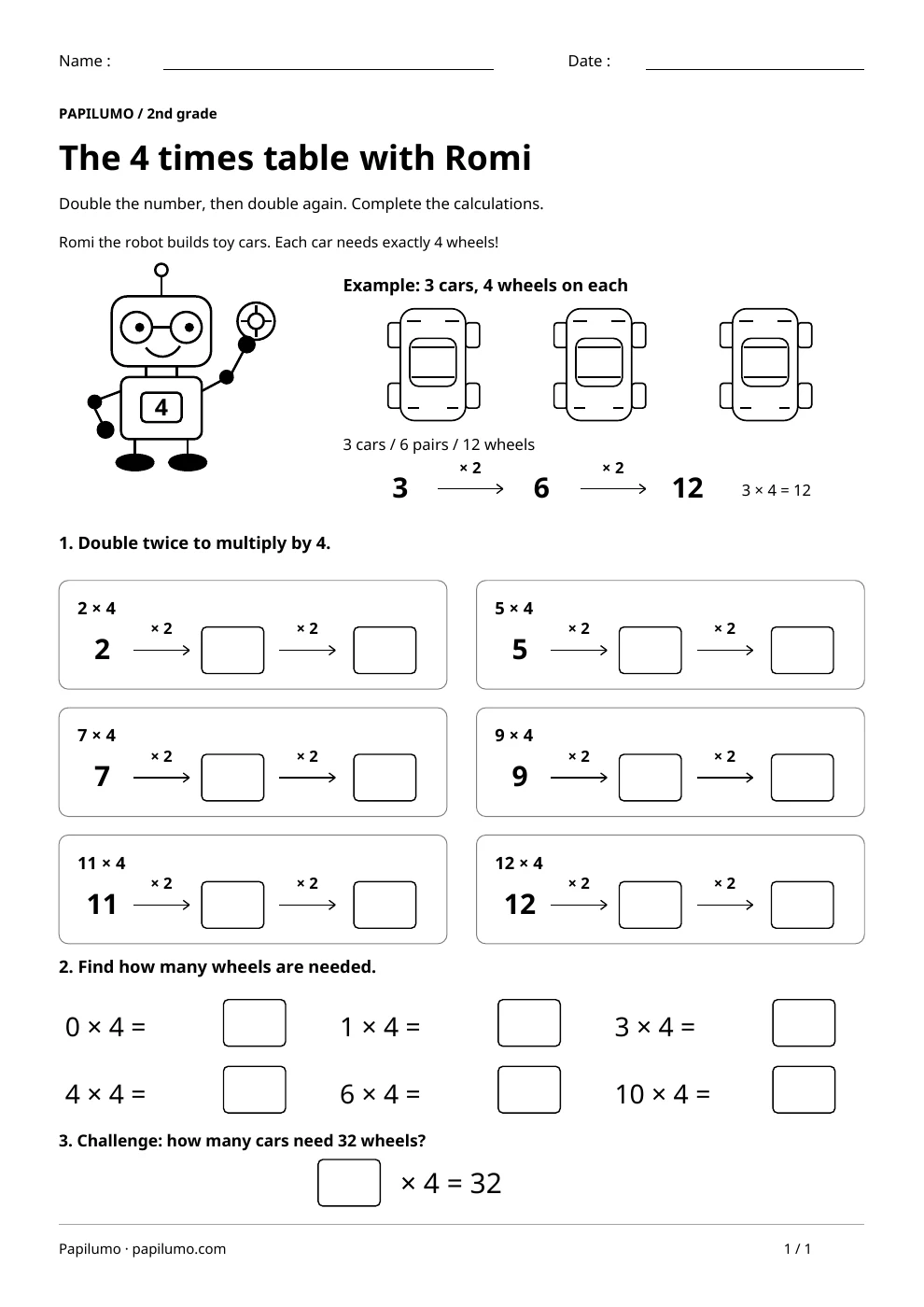
Children connect multiplication with equal groups. The first factor tells how many pairs there are; the second tells that each pair has two skates. Counting in twos can help them find a product before recalling it from memory. The largest answer is 24, and all the facts belong to the 2 times table. This is guided second grade practice for children who understand pairs, numbers to 24 and the multiplication sign. For a related skill, use 4 times table: double twice with Romi: Double the number, then double again. Complete the calculations.
Preparing a short session
Print at actual size and provide a pencil, with a ruler if helpful. Put the key aside. Count the six skates in the example as three groups of two. Show that each fact matches an answer inside its own section. Cover the second section while working on the first if necessary. Counters arranged in pairs can support a calculation without giving away the answer.
A concrete example to get started
Three pairs give 2 + 2 + 2 = 6, so 3 × 2 = 6. The 3 counts the pairs and the 2 counts the skates in each pair. For four pairs, add one more pair to the model: 6 + 2 = 8. Say “four groups of two” before matching 4 × 2 with 8. This keeps the written fact connected to its meaning.
Supporting the activity
Read a fact, work out its product and draw a line between the matching dots. Use every answer once in the same section. The answers are shuffled, so a line is chosen by calculation rather than by position. For factors from 7 to 12, start from a known fact and add two for each extra pair. Lines may cross; a crossing does not make a match incorrect. To vary the practice, try 3 times table: count Teo’s equal groups: Look at the groups of 3 carrots, then complete the facts.
What to notice and how to check
The first section’s products, in fact order, are 6, 2, 12, 8, 4 and 10. The second section’s products are 18, 24, 14, 20, 16 and 22. Check the values at both ends of a line rather than its shape. If two lines reach the same answer, revisit those facts. The separate key shows all twelve matches. Invite the child to explain a product using counters when needed.
Making the task easier
Work only on section 1 and build pairs with counters. An adult may help draw the lines if fine motor demands distract from the arithmetic.
Keep the learning aim, but reduce how much the child has to handle at once. Cover part of the page with another sheet and reveal one task at a time. Demonstrate a separate example, then leave a real opportunity to work something out. An answer reached with support is still a useful attempt; it does not yet show that the same task can be completed independently.
Taking the idea beyond the worksheet
Hide the answers and name a number of pairs. Ask for the number of skates, then reverse the question: how many pairs can be made from 18 skates?
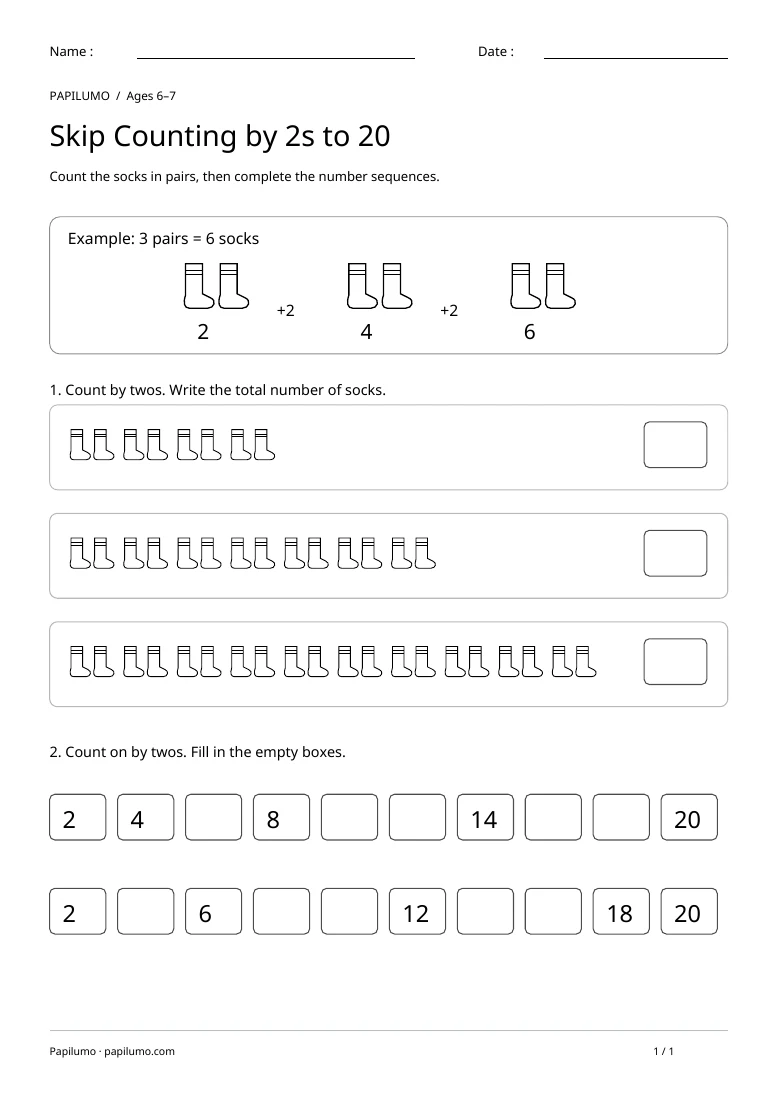
Use the follow-up to meet the same idea in a different setting. Offer it once the first task makes sense, without insisting that the whole page must be perfect. The child might explain a strategy, make an example or set a challenge for an adult. Return to the worksheet only when it helps connect the two situations. A short conversation or a practical activity can be enough to finish the session. To continue exploring, use Skip Counting by 2s to 20: Count the socks in pairs, then complete the number sequences.
Downloading and printing the PDF
This free PDF contains one worksheet designed for A4 paper. Download the file using the button on this page and open it in your PDF reader. Choose actual size or a 100% scale, check the orientation in the print preview and turn off any browser headers or footers. The illustrations use vector lines, so their outlines stay sharp when printed. Check the margins on one copy before preparing several sheets for a group. The level shown on the page is a guide, rather than a requirement to complete the activity at a particular age.