

What this worksheet helps children practise
Ask learners to explain what each number means in Ben’s stamp story: for 95 ÷ 6, 15 is the number of stamps in each of the 6 groups, 90 is the total placed in groups, and 5 is the number of leftover stamps. In the first three cards, point out that the leading zero in 07, 08, and 09 simply holds the tens column after an exact subtraction—it is not added to the quotient. Focus on neat column alignment and careful verification rather than speed.
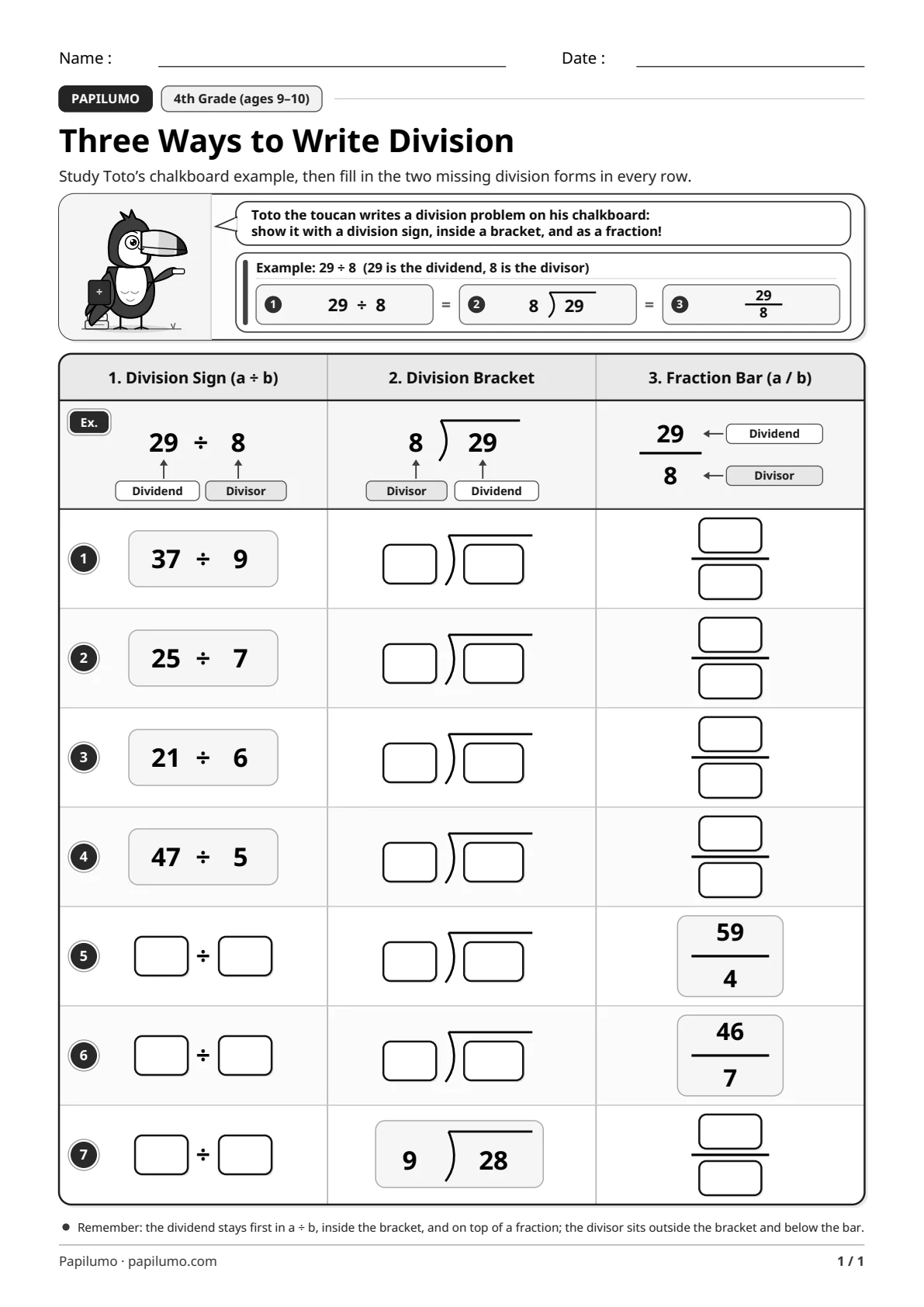
Once students understand exact division, they learn that sharing equally often leaves a remainder. Dividing 74 by 3 means making 3 equal groups of 24 stamps with 2 stamps left over that cannot form another full group of 3. This activity builds fluency with the standard long division algorithm—divide, multiply, subtract, and bring down—while emphasizing two core rules: the final remainder must always be strictly smaller than the divisor, and the result can be checked using (quotient × divisor) + remainder = dividend. For a related skill, use Three Ways to Write Division with Toto the Toucan: Study Toto’s chalkboard example, then fill in the two missing division forms in every row.
Preparing a short session
Print the page at 100% actual size so every digit box stays roomy and clear. Provide a sharp pencil, an eraser, and a multiplication chart if your learner still needs support recalling basic facts while focusing on multi-step layout. Introduce Ben the badger and walk through the worked example 74 ÷ 3 together before starting the six practice boxes. Keep the answer key separate during independent work so students can compare every line afterward.
A concrete example to get started
In the worked example 74 ÷ 3, start with the tens column: 7 tens divided by 3 gives 2 tens per group because 2 × 3 = 6. Write 2 in the tens place of the quotient and subtract 6 from 7, leaving 1 ten. Next, bring down the 4 ones to form 14 ones. Divide 14 by 3 to get 4 ones because 4 × 3 = 12. Write 4 in the ones place of the quotient and subtract 12 from 14, leaving a final remainder of 2. Since 2 is smaller than the divisor 3, the division is complete, and 24 × 3 + 2 = 74 confirms the answer.
Supporting the activity
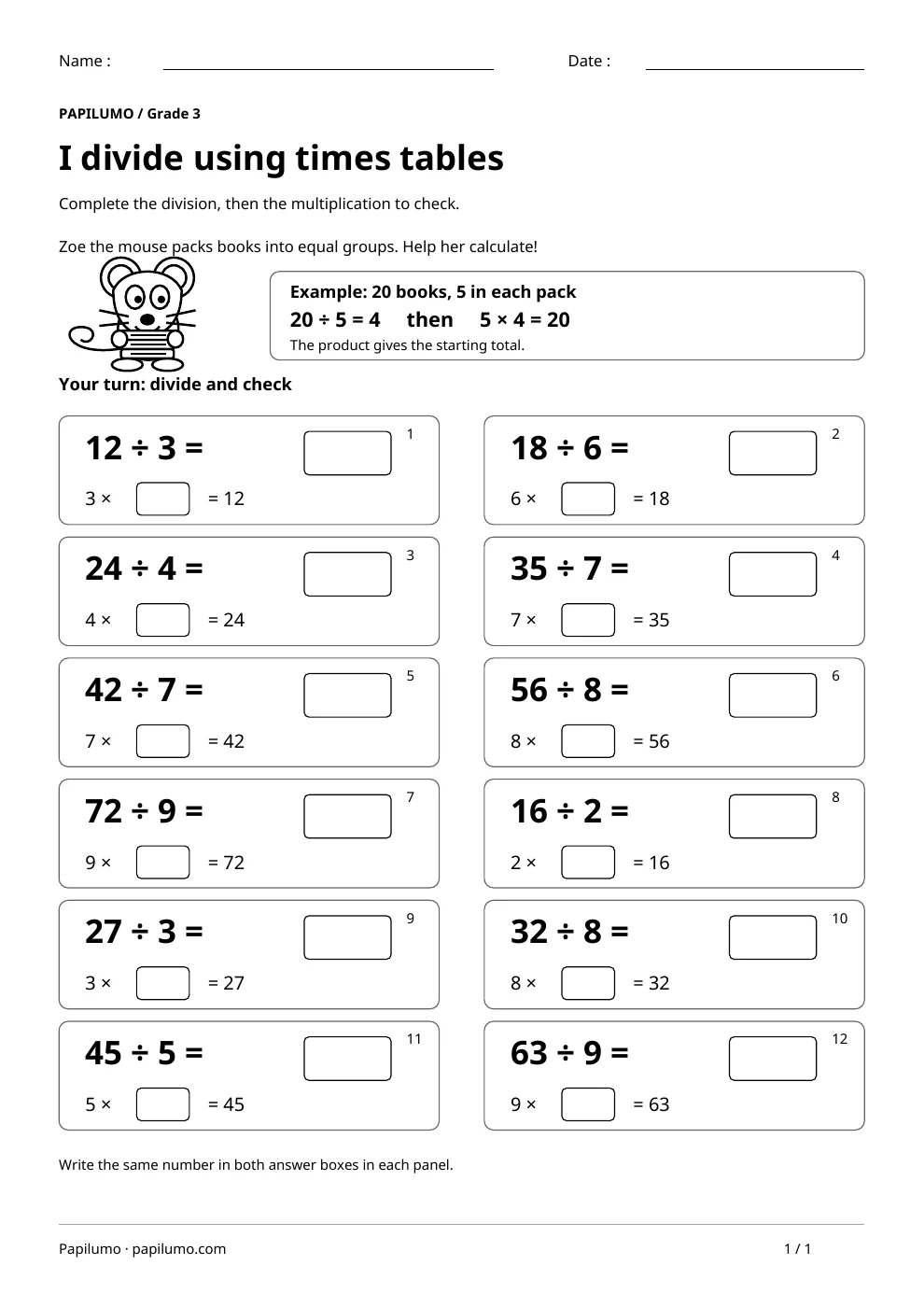
The six problems are arranged in two gentle stages. In the first three problems—47 ÷ 2, 68 ÷ 3, and 89 ÷ 4—the tens digit divides evenly with no ten left over, so the remainder only appears in the ones step (remainders of 1, 2, and 1). In the last three problems—77 ÷ 5, 95 ÷ 6, and 86 ÷ 7—students must regroup leftover tens with the ones digit before completing the second subtraction and finding the final remainder (remainders of 2, 5, and 2). This structure lets learners master one hurdle at a time. To vary the practice, try Division Facts: Check with Multiplication: Complete the division, then the multiplication to check.
What to notice and how to check
After each problem, ask the student to compare the bottom remainder with the divisor on the left: in 95 ÷ 6, the remainder 5 is less than 6. If a remainder is ever equal to or greater than the divisor, the chosen quotient digit was too small. Also check that when tens remain after the first subtraction, bringing down the ones digit forms a two-digit number (such as 27 in 77 ÷ 5). Finally, have the child multiply the quotient by the divisor and add the remainder to verify that it matches the dividend.
Making the task easier
Start with just the first two problems (47 ÷ 2 and 68 ÷ 3) where the tens divide evenly, and let the student use a multiplication table to find the closest multiple.
Keep the learning aim, but reduce how much the child has to handle at once. Cover part of the page with another sheet and reveal one task at a time. Demonstrate a separate example, then leave a real opportunity to work something out. An answer reached with support is still a useful attempt; it does not yet show that the same task can be completed independently.
Taking the idea beyond the worksheet
On the back of the sheet, ask the student to write the full check equation (quotient × divisor) + remainder = dividend for 77 ÷ 5, 95 ÷ 6, and 86 ÷ 7.
Use the follow-up to meet the same idea in a different setting. Offer it once the first task makes sense, without insisting that the whole page must be perfect. The child might explain a strategy, make an example or set a challenge for an adult. Return to the worksheet only when it helps connect the two situations. A short conversation or a practical activity can be enough to finish the session. To continue exploring, use 3-Digit by 1-Digit Long Division With Remainders (with Paco): Complete each long-division bracket step by step, then fill in the quotient, remainder (less than divisor), and check equation.
Downloading and printing the PDF
This free PDF contains one worksheet designed for A4 paper. Download the file using the button on this page and open it in your PDF reader. Choose actual size or a 100% scale, check the orientation in the print preview and turn off any browser headers or footers. The illustrations use vector lines, so their outlines stay sharp when printed. Check the margins on one copy before preparing several sheets for a group. The level shown on the page is a guide, rather than a requirement to complete the activity at a particular age.