What this worksheet helps children practise
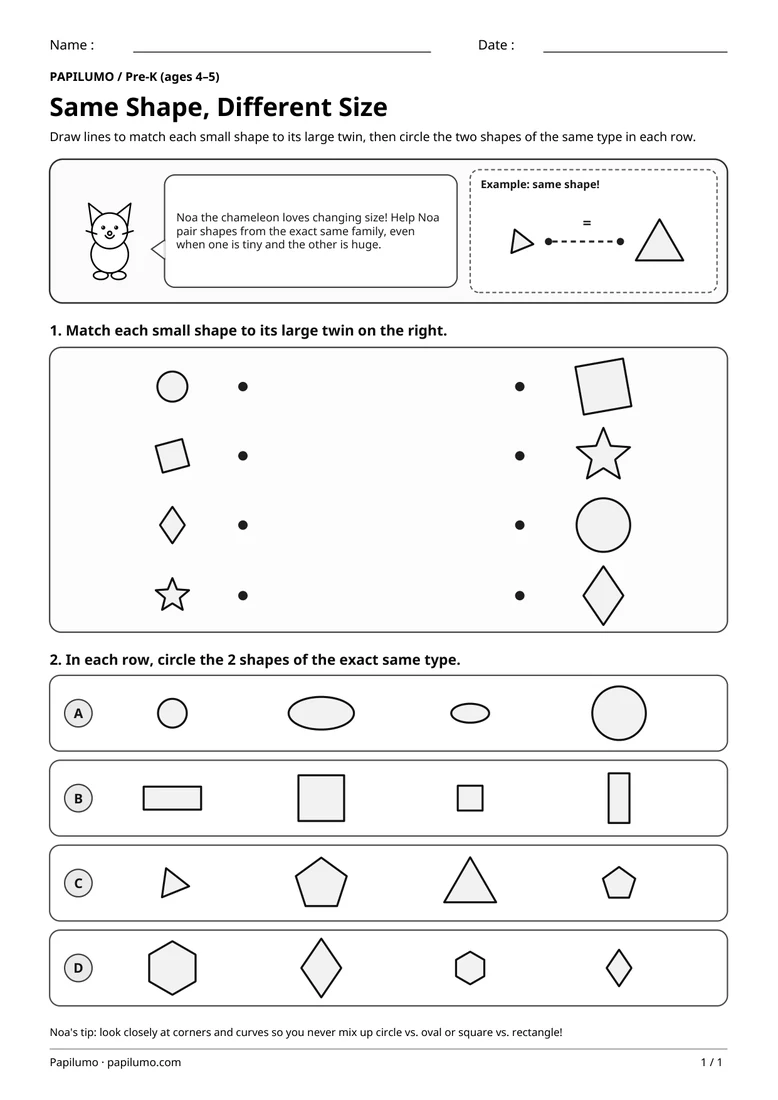
Count the corners and check the sides to spot the true matching shape pair, big or small.
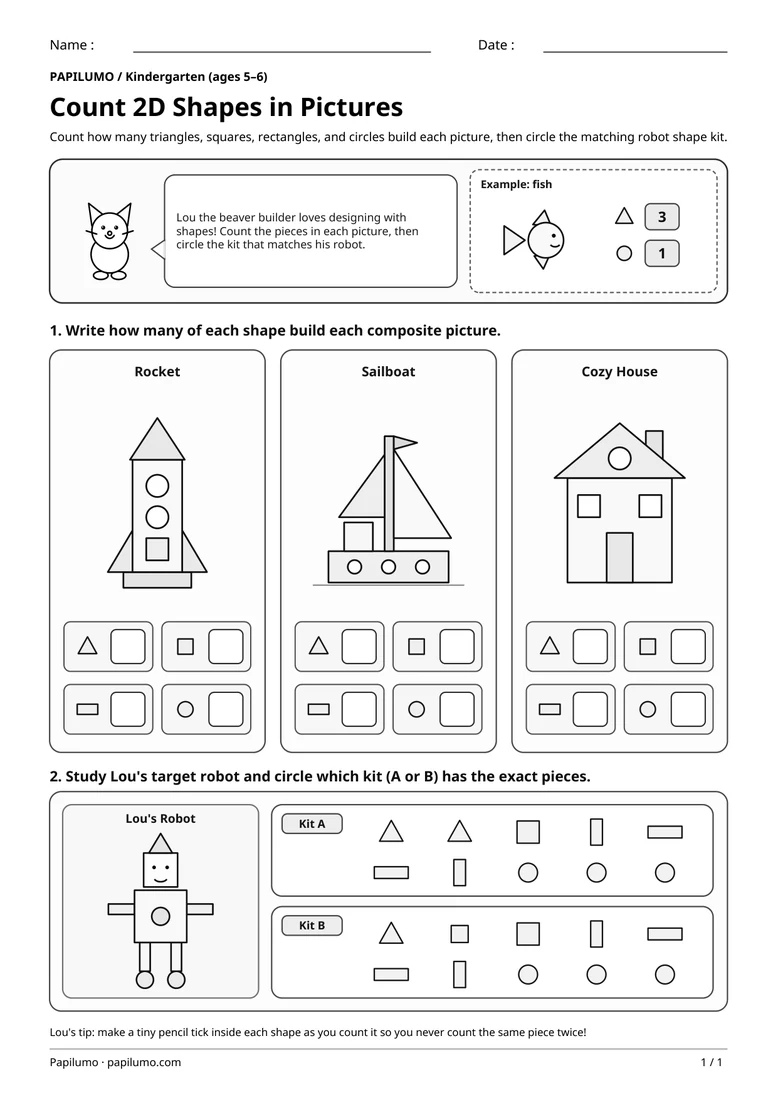
Recognizing shape invariance across changes in scale and rotation is a key milestone in Pre-K math before formal polygon names and independent drawing. Young children learn to look past overall size and focus on defining geometric properties: an evenly round circle versus a stretched oval, four equal square sides versus a long rectangle, three crisp triangle corners versus a five-sided pentagon, and a four-pointed diamond versus a six-sided hexagon. This builds visual discrimination, precise geometry vocabulary, and careful comparison habits. For a related skill, use Count 2D Shapes in Composite Pictures with Lou: Count how many triangles, squares, rectangles, and circles build each picture, then circle the matching robot shape kit.
Preparing a short session
Print the student worksheet at actual size (100%) on plain white A4 paper and sit together at a calm, bright, uncluttered table with a standard sharpened pencil, wax crayon, or fine black marker. Keep the separate one-page answer key PDF tucked neatly out of sight until every pair is matched and circled. Before drawing the very first line, invite your child to trace one small shape and one large shape with a fingertip while naming circle, square, diamond, star, triangle, rectangle, oval, pentagon, and hexagon clearly aloud together.
A concrete example to get started
Inside the framed top banner right next to smiling Noa and the story speech bubble, a clearly worked example demonstrates the rule at a single glance. On the left, a small tilted triangle sits beside a starting dot connected straight across to a tall, upright large triangle on the right, marked clearly as an exact matching pair. Four- and five-year-olds immediately grasp that shrinking, enlarging, or turning a shape never changes its shape family, building instant confidence before starting the two exercises below.
Supporting the activity
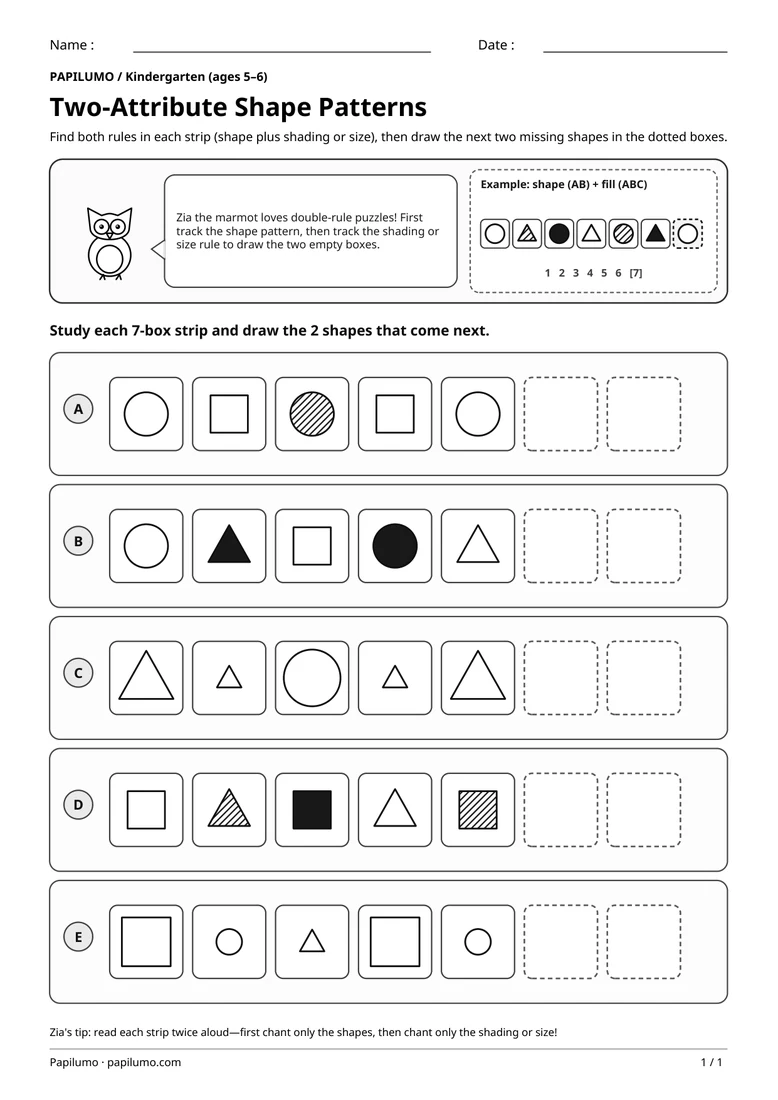
Below the banner, two well-spaced sections guide children smoothly from direct pairing to careful visual discrimination across the page. In Part 1, four small shapes on the left—a circle, slightly tilted square, diamond, and five-pointed star—connect via straight pencil lines to their shuffled large counterparts on the right. In Part 2, rows A through D each display four clear shapes where learners circle strictly the two matching shapes: circle versus oval in A, square versus rectangle in B, triangle versus pentagon in C, and diamond versus hexagon in D. To vary the practice, try Two-Attribute Shape Patterns (Shape + Shading/Size) with Zia: Find both rules in each strip (shape plus shading or size), then draw the next two missing shapes in the dotted boxes.
What to notice and how to check
When all four connection lines are drawn and all four matching pairs are circled, bring out the separate answer key PDF to celebrate careful thinking and steady observation together. Check each Part 1 line from left dot to right dot first, making sure lines connect the true small-to-large twins cleanly without guessing. Then review rows A, B, C, and D side by side, counting sides or checking corners with a fingertip to explain clearly why the oval, rectangle, pentagon, and hexagon stay uncircled. Finish with warm praise for sharp geometric observation.
Making the task easier
Trace around two shapes with your finger first to feel whether they have the same corners and equal sides.
Keep the learning aim, but reduce how much the child has to handle at once. Cover part of the page with another sheet and reveal one task at a time. Demonstrate a separate example, then leave a real opportunity to work something out. An answer reached with support is still a useful attempt; it does not yet show that the same task can be completed independently.
Taking the idea beyond the worksheet
Color each matched pair in Part 1 and Part 2 with matching colors once your work is checked.
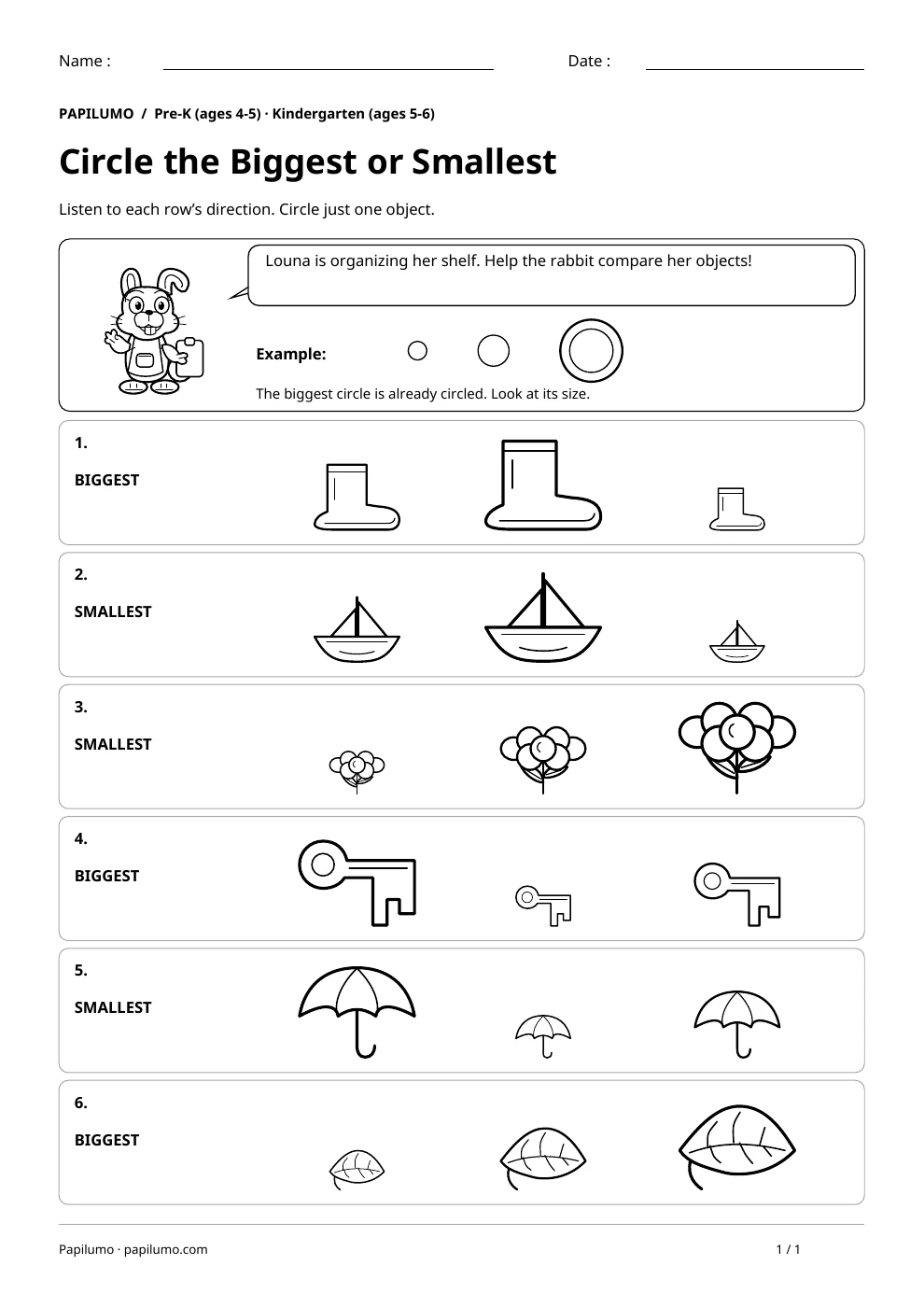
Use the follow-up to meet the same idea in a different setting. Offer it once the first task makes sense, without insisting that the whole page must be perfect. The child might explain a strategy, make an example or set a challenge for an adult. Return to the worksheet only when it helps connect the two situations. A short conversation or a practical activity can be enough to finish the session. To continue exploring, use Biggest and Smallest Objects: Compare Sizes: Listen to each row’s direction. Circle just one object.
Downloading and printing the PDF
This free PDF contains one worksheet designed for A4 paper. Download the file using the button on this page and open it in your PDF reader. Choose actual size or a 100% scale, check the orientation in the print preview and turn off any browser headers or footers. The illustrations use vector lines, so their outlines stay sharp when printed. Check the margins on one copy before preparing several sheets for a group. The level shown on the page is a guide, rather than a requirement to complete the activity at a particular age.