

What this worksheet helps children practise
Keep the bottom of each cup round like a smile and meet sharply at every top point without lifting!
Practicing continuous cup garlands in Kindergarten builds relaxed wrist flow, smooth directional transitions, and consistent stroke height before connected handwriting begins. Young children often flatten bottoms or round off top joins like arches; swinging softly through a wide U-curve and stopping sharply at each upper cusp develops exact finger-and-wrist control. Alternating narrow and wide cup chains between soft baseline and midline guides trains rhythmic spacing, visual tracking from left to right, and continuous pencil movement without unnecessary stops across multi-letter strokes. For a related skill, use Dotted Symmetry Tracing: Complete the Mirror Half with Leo (Kindergarten): Look closely at the bold left half of each picture, then carefully trace the light dotted right half across the vertical mirror line.
Preparing a short session
Print the pupil sheet at actual size (100%) on plain white A4 paper and prepare a bright, tidy desk with a sharpened graphite pencil or smooth fine-tip felt marker. Keep the separate one-page answer key PDF out of sight until all tracing rows and tent garlands are neatly finished. Before writing, point out how a hanging cup dips downward like a cheerful smile and meets at a sharp top point, then invite your child to trace the first big garland by finger while chanting aloud: dip down, curve smoothly, point straight up.
A concrete example to get started
Inside the top banner right beside Eli the Robin perched on his festive garland, a worked model demonstrates two connected cup strokes clearly. On the left, a solid black U-cup shows gentle downward and upward directional arrows emphasizing the smooth rounded curve and crisp top point; on the right, a light dotted cup continues cleanly to the ending dot inside soft baseline guides. Young children grasp the flowing rhythm in seconds before starting the four full practice rows below.
Supporting the activity
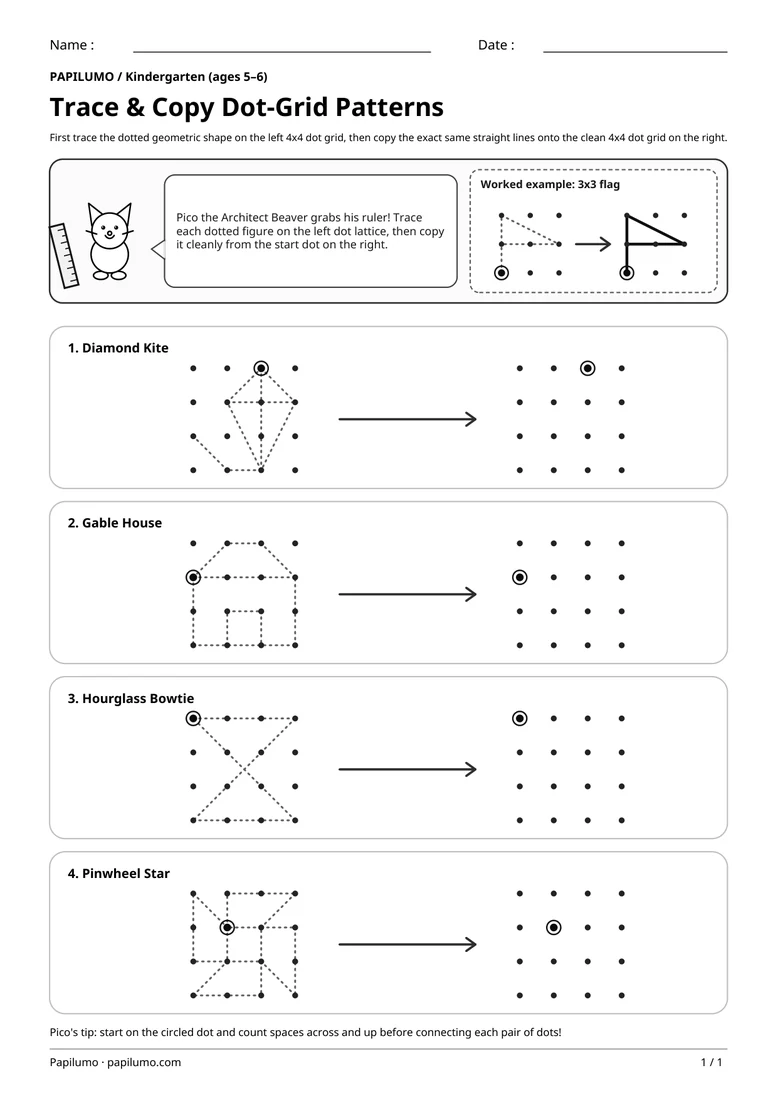
Three engaging sections build handwriting fluency step by step down the page. Section 1 presents two wide rows of large hanging U-shaped garlands featuring bold start dots and small upward cusp arrows to loosen arm and wrist motion gently. Section 2 shifts into two narrower ruled rows combining alternating narrow and wide pre-cursive cup chains—echoing linked cursive u, i, t, and w strokes—from dotted left models to light guide dots across the line. Section 3 invites young artists to decorate a festive garden party tent with two continuous scalloped garlands. To vary the practice, try Trace and Copy Dot-Grid Geometric Patterns with Pico (Kindergarten): First trace the dotted geometric shape on the left 4x4 dot grid, then copy the exact same straight lines onto the clean 4x4 dot grid on the right.
What to notice and how to check
When all four practice rows and both party-tent garlands are traced completely, place the separate answer key PDF beside the worksheet to inspect all the curved strokes warmly together. Check carefully that every cup has a rounded U-shaped base rather than a flat bottom or sharp V-point, that upper cusps meet neatly in crisp points along the top line, and that narrow and wide cups stay balanced and smooth between guidelines. If strokes felt stiff, practice one slow garland in the air before coloring Eli's cheerful party tent.
Making the task easier
Trace the two wide top rows twice with your pointer finger first to feel the smooth swinging rhythm.
Keep the learning aim, but reduce how much the child has to handle at once. Cover part of the page with another sheet and reveal one task at a time. Demonstrate a separate example, then leave a real opportunity to work something out. An answer reached with support is still a useful attempt; it does not yet show that the same task can be completed independently.
Taking the idea beyond the worksheet
Color the festive party tent and pennants, then try writing linked cursive u and i patterns on scrap paper.
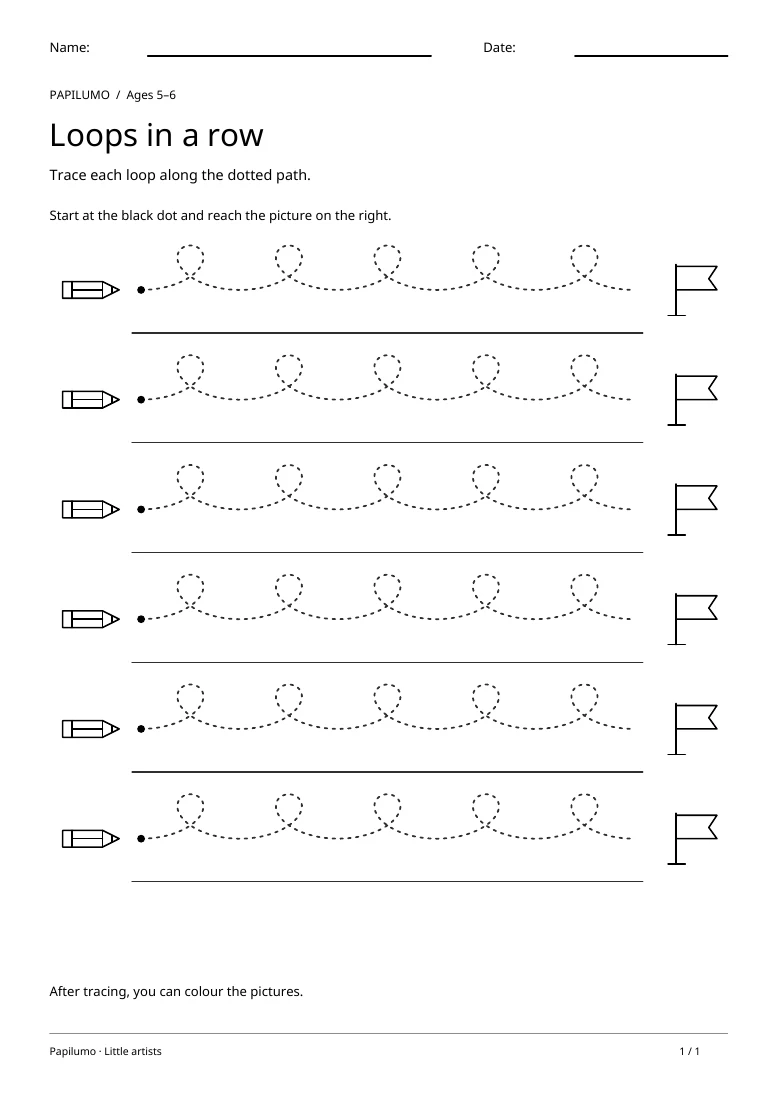
Use the follow-up to meet the same idea in a different setting. Offer it once the first task makes sense, without insisting that the whole page must be perfect. The child might explain a strategy, make an example or set a challenge for an adult. Return to the worksheet only when it helps connect the two situations. A short conversation or a practical activity can be enough to finish the session. To continue exploring, use Loop Tracing Worksheet for Kindergarten: Trace each loop along the dotted path.
Downloading and printing the PDF
This free PDF contains one worksheet designed for A4 paper. Download the file using the button on this page and open it in your PDF reader. Choose actual size or a 100% scale, check the orientation in the print preview and turn off any browser headers or footers. The illustrations use vector lines, so their outlines stay sharp when printed. Check the margins on one copy before preparing several sheets for a group. The level shown on the page is a guide, rather than a requirement to complete the activity at a particular age.