What this worksheet helps children practise
Ask for 100 times the factor first, then cut it in half: for 14, half of 1,400 is 700!
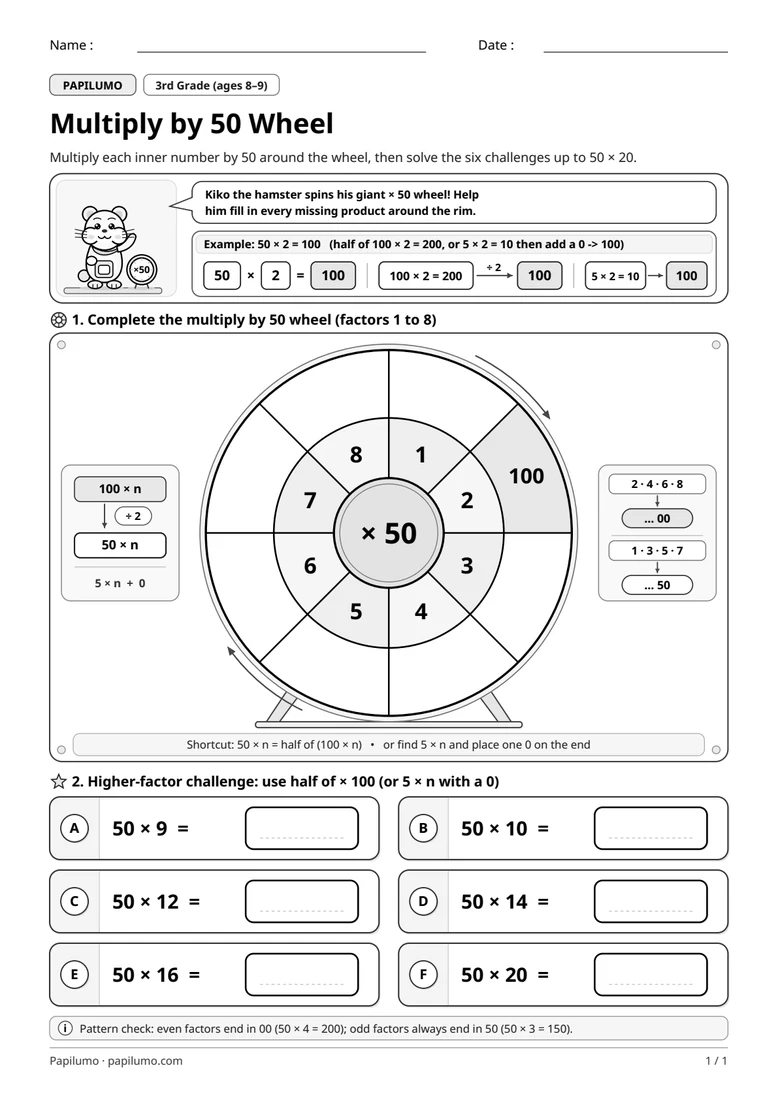
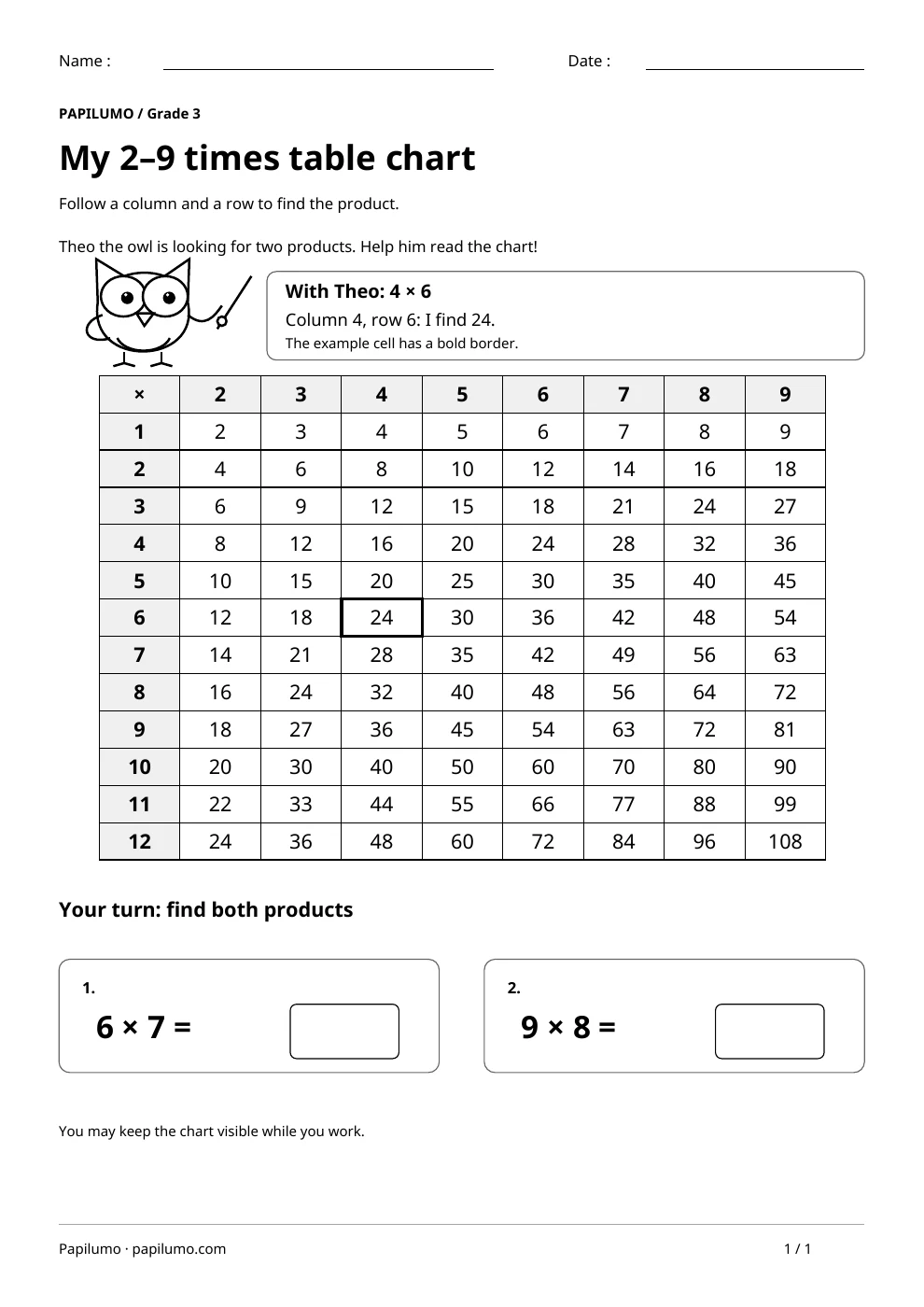
Multiplying by 50 in 3rd grade builds flexible mental math by linking the 5 times table, doubles, and halves directly to familiar hundreds landmarks. Because 50 is exactly half of 100, students can reach every single product in two reliable ways: take half of 100 × n, or multiply 5 × n and annex one trailing zero on the right. Working around the wheel also highlights a handy parity pattern: every even factor yields an exact hundred ending in 00, while every odd factor always ends cleanly in 50. For a related skill, use Multiplication Chart for Times Tables 2–9: Follow a column and a row to find the product.
Preparing a short session
Print the student worksheet at actual size (100%) on plain white A4 or letter paper without shrinking margins, and set out a sharpened pencil with an eraser. Before filling any spaces, inspect the worked example beside Kiko the hamster at the top of the page and talk through both mental shortcuts for 50 × 2 = 100 aloud together. Keep the separate answer key PDF out of sight during practice so your learner tests their own calculation strategies independently on both the wheel and challenge grid.
A concrete example to get started
In the top example box and the shaded wedge on the wheel, learners see 50 × 2 = 100 broken down clearly two ways: multiplying 100 × 2 gives 200 and half of 200 is 100, or multiplying 5 × 2 gives 10 and annexing one zero makes 100. That central anchor immediately unlocks the even spokes around the rim—if two fifties make 100, then four fifties double smoothly to 200, six fifties make 300, and eight fifties reach 400 with zero tedious finger counting.
Supporting the activity
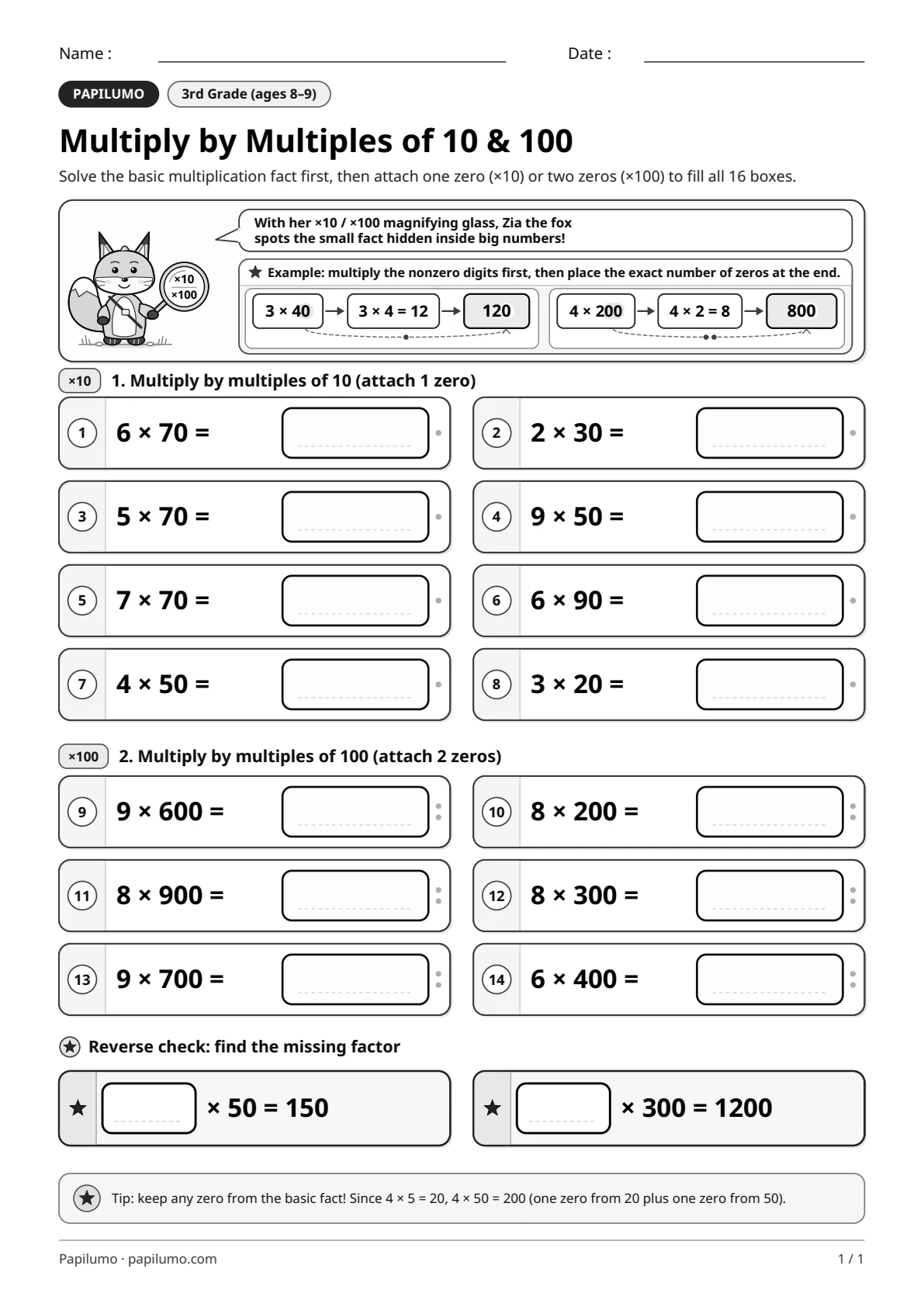
In Part 1, students move clockwise around the × 50 hub from 1 to 8, writing seven missing products in the outer ring: 50 (for 1), 150 (3), 200 (4), 250 (5), 300 (6), 350 (7), and 400 (8), using the pre-filled 100 opposite 2 as a built-in checkpoint. In Part 2, they tackle six larger factors: 50 × 9 = [450], 50 × 10 = [500], 50 × 12 = [600], 50 × 14 = [700], 50 × 16 = [800], and 50 × 20 = [1000], reinforcing the half-of-100 shortcut on bigger numbers. To vary the practice, try Multiply by Multiples of 10 and 100 with Zia the Fox: Solve the basic multiplication fact first, then attach one zero (×10) or two zeros (×100) to fill all 16 boxes.
What to notice and how to check
When checking finished work with the separate PDF answer key, look first at the alternating 50 and 00 endings and watch carefully for place-value slips on 50 × 20 = 1000 (sometimes written as 100 or 10000 by mistake). If a larger item such as 50 × 14 or 50 × 9 stalls, calmly ask what 100 times that factor equals, then split it in half together—half of 1,400 is 700, and 400 plus 50 gives 450—before writing the verified product in the box.
Making the task easier
Lightly shade the even inner numbers (2, 4, 6, 8) first—they land right on 100, 200, 300, and 400.
Keep the learning aim, but reduce how much the child has to handle at once. Cover part of the page with another sheet and reveal one task at a time. Demonstrate a separate example, then leave a real opportunity to work something out. An answer reached with support is still a useful attempt; it does not yet show that the same task can be completed independently.
Taking the idea beyond the worksheet
Try four bonus problems aloud using the same trick: 50 × 11, 50 × 15, 50 × 18, and 50 × 30.
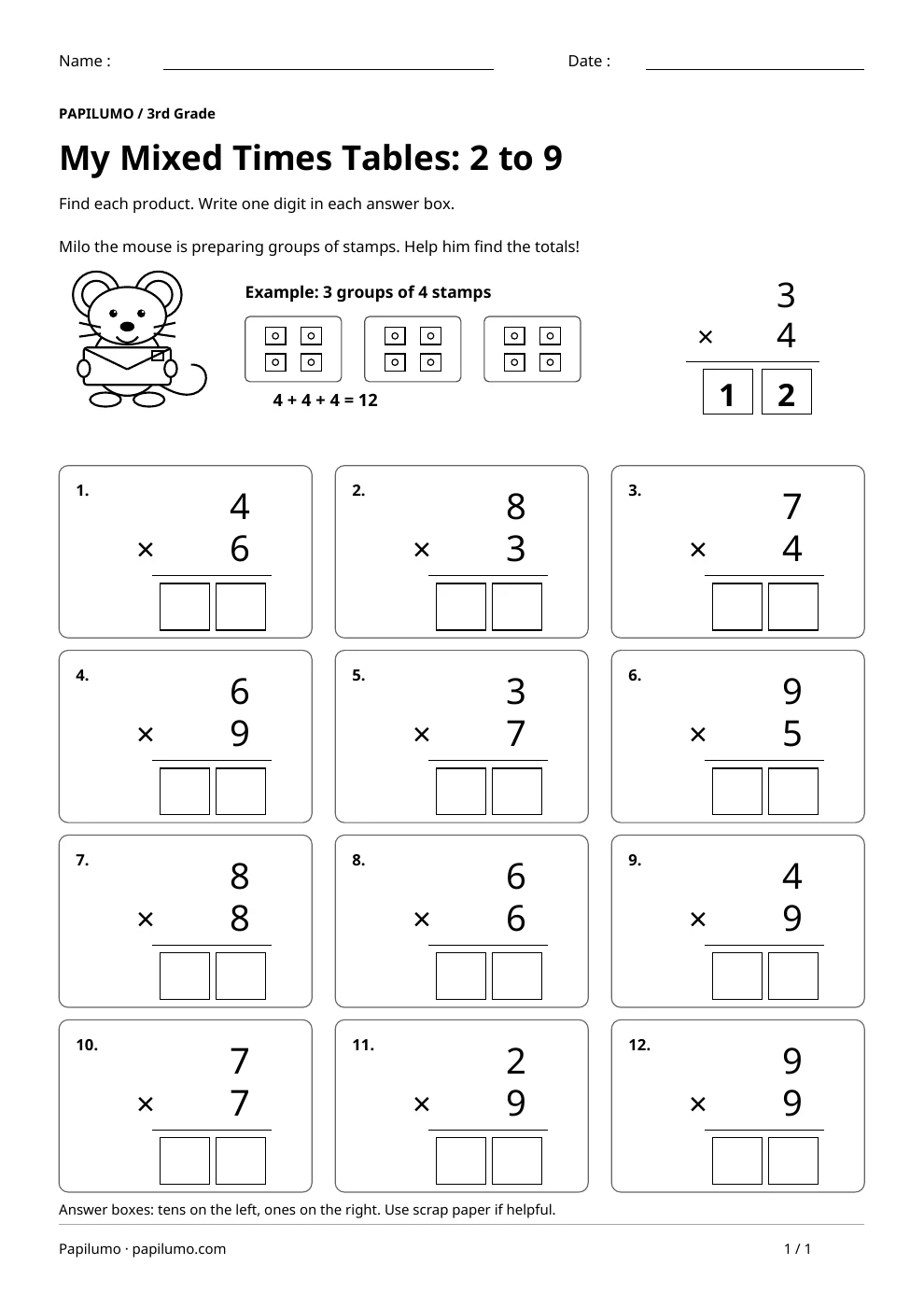
Use the follow-up to meet the same idea in a different setting. Offer it once the first task makes sense, without insisting that the whole page must be perfect. The child might explain a strategy, make an example or set a challenge for an adult. Return to the worksheet only when it helps connect the two situations. A short conversation or a practical activity can be enough to finish the session. To continue exploring, use Mixed Multiplication Facts: Times Tables 2–9: Find each product. Write one digit in each answer box.
Downloading and printing the PDF
This free PDF contains one worksheet designed for A4 paper. Download the file using the button on this page and open it in your PDF reader. Choose actual size or a 100% scale, check the orientation in the print preview and turn off any browser headers or footers. The illustrations use vector lines, so their outlines stay sharp when printed. Check the margins on one copy before preparing several sheets for a group. The level shown on the page is a guide, rather than a requirement to complete the activity at a particular age.