
What this worksheet helps children practise
Start each target with easy anchor wedges like ×2, ×4, or ×5, then build upward to unlock the larger wedges!
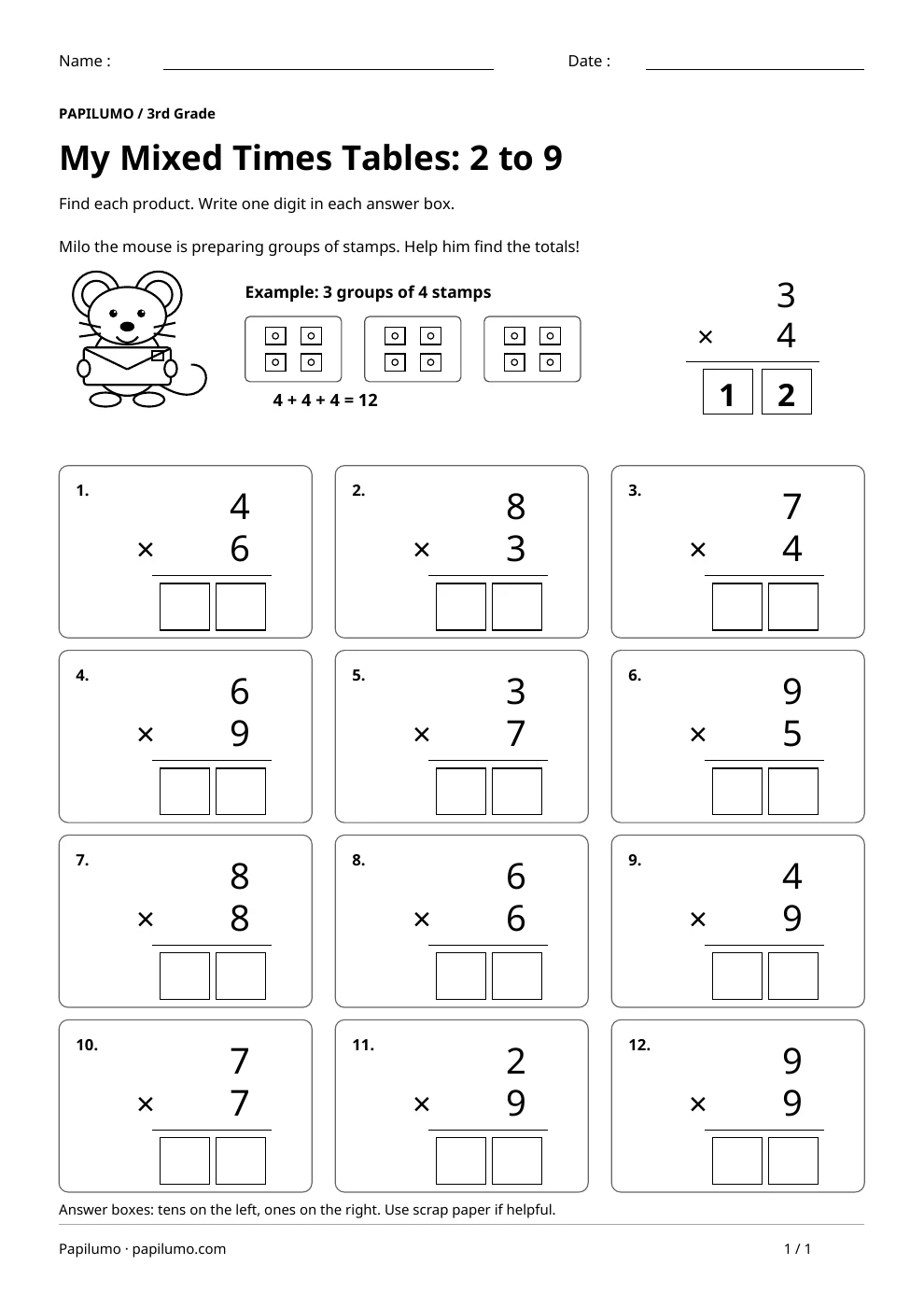
Practicing multiplication facts inside concentric target rings builds automatic recall and flexible inverse reasoning in 3rd grade. Rather than reciting an ordered list from ×1 to ×10, students jump between varied middle-ring factors to compute outer products and switch to missing-factor division thinking whenever the outer product appears first. This two-way habit deepens number sense, strengthens upper facts (×6, ×7, ×8, and ×9), and supports multi-digit multiplication fluency. For a related skill, use Mixed Multiplication Facts: Times Tables 2–9: Find each product. Write one digit in each answer box.
Preparing a short session
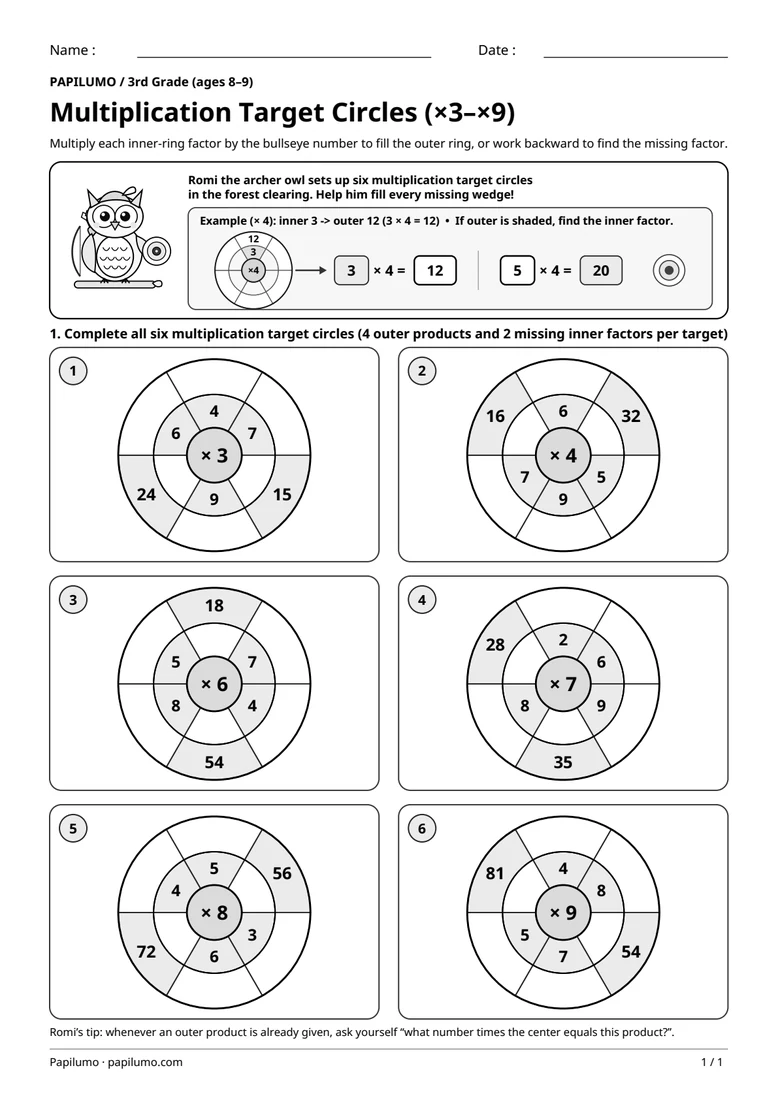
Print the student worksheet at actual size (100%) on plain white A4 or letter paper without scaling down margins, and set out a sharpened pencil with an eraser. Keep the separate PDF answer key out of sight while working. Read the instructions aloud together and inspect the worked model beside Romi the archer owl, tracing one finger from the × 4 bullseye through inner 3 out to 12. Point out that shaded wedges hold given clues while all thirty-six bright white wedges are ready for student answers.
A concrete example to get started
In the top worked-example panel next to Romi the archer owl, the sample target displays × 4 in its center bullseye. Starting at 3 in the middle ring and following the radial arrow into the outer ring yields 3 × 4 = 12, so 12 sits neatly outside. Beside the mini target, the callout summarizes both directions clearly: moving outward multiplies the inner factor by the center number, while a shaded outer product cues students to ask which middle-ring factor multiplies with the center to hit that exact product.
Supporting the activity
Students then complete the six independent targets at their own pace. Target 1 (×3) uses inner 4, 7, 9, 6 to give [12], [21], [27], [18] and outer 15, 24 to reveal [5] and [8]. Target 2 (×4) uses 6, 5, 9, 7 for [24], [20], [36], [28] and outer 32, 16 for [8] and [4]. Target 3 (×6) pairs 7, 4, 8, 5 with [42], [24], [48], [30] plus outer 18, 54 for [3] and [9]. Target 4 (×7) pairs 2, 6, 9, 8 with [14], [42], [63], [56] plus outer 35, 28 for [5] and [4]. Target 5 (×8) yields [40], [24], [48], [32] and missing [7], [9] from 56, 72. Target 6 (×9) yields [36], [72], [63], [45] and missing [6], [9] from 54, 81. To vary the practice, try 8 Times Table Practice: Octopus Wheel & Missing Factors with Oli: Complete the × 8 octopus wheel, solve the six direct multiplication facts, and find the six missing factors.
What to notice and how to check
When reviewing with the separate PDF answer key, check the twelve reverse missing inner factors first—especially upper facts like 54 = 9 × 6, 56 = 7 × 8, and 72 = 9 × 8—because inverse recall typically takes a bit more thought than direct multiplication. If any wedge stalls a learner, encourage using a friendly anchor fact such as ×5 or doubling a known product (for instance, finding 6 × 8 by doubling 3 × 8 = 24), then read the full multiplication fact aloud together.
Making the task easier
To solve 7 × 8, combine 5 × 8 = 40 and 2 × 8 = 16; for a missing inner factor, skip-count by the center number until you hit the outer product.
Keep the learning aim, but reduce how much the child has to handle at once. Cover part of the page with another sheet and reveal one task at a time. Demonstrate a separate example, then leave a real opportunity to work something out. An answer reached with support is still a useful attempt; it does not yet show that the same task can be completed independently.
Taking the idea beyond the worksheet
Draw a seventh bonus target for Romi with × 12 in the bullseye on scratch paper, choosing four forward wedges and two reverse wedges.
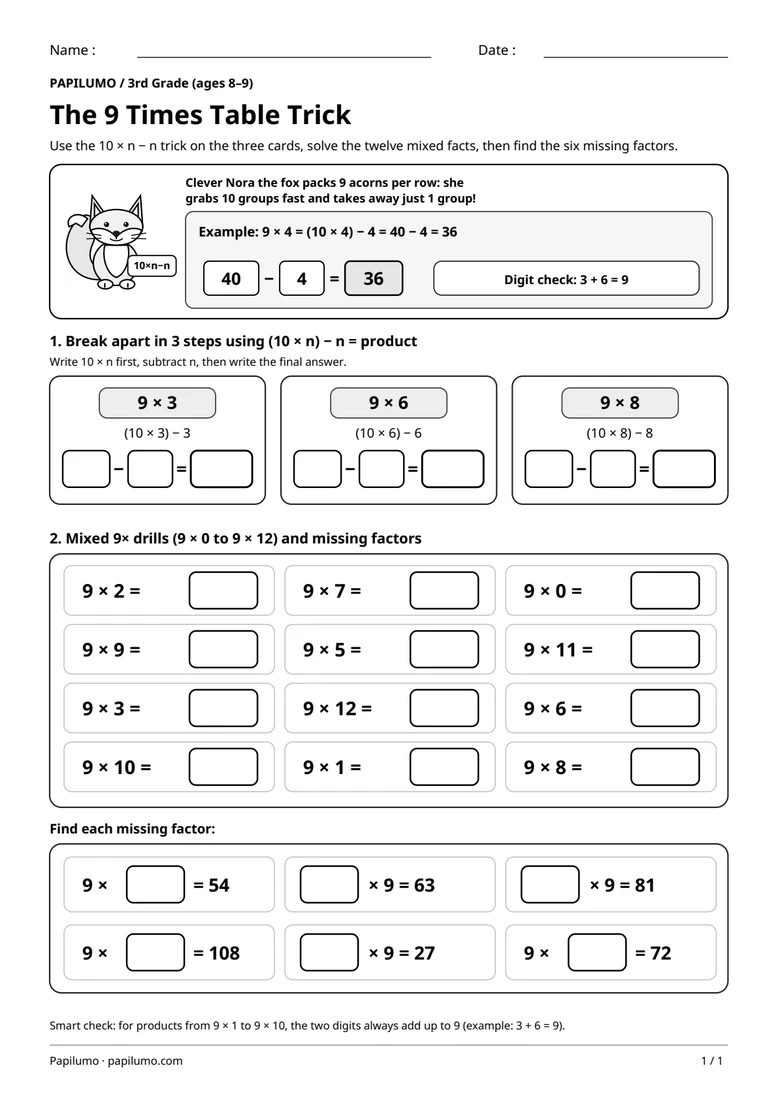
Use the follow-up to meet the same idea in a different setting. Offer it once the first task makes sense, without insisting that the whole page must be perfect. The child might explain a strategy, make an example or set a challenge for an adult. Return to the worksheet only when it helps connect the two situations. A short conversation or a practical activity can be enough to finish the session. To continue exploring, use 9 Times Table Tricks & Practice with Nora the Fox: Use the 10 × n − n trick on the three cards, solve the twelve mixed facts, then find the six missing factors.
Downloading and printing the PDF
This free PDF contains one worksheet designed for A4 paper. Download the file using the button on this page and open it in your PDF reader. Choose actual size or a 100% scale, check the orientation in the print preview and turn off any browser headers or footers. The illustrations use vector lines, so their outlines stay sharp when printed. Check the margins on one copy before preparing several sheets for a group. The level shown on the page is a guide, rather than a requirement to complete the activity at a particular age.