What this worksheet helps children practise
Say the ABCs quietly up to the blank box, name the missing letter, and write it neatly in lowercase.
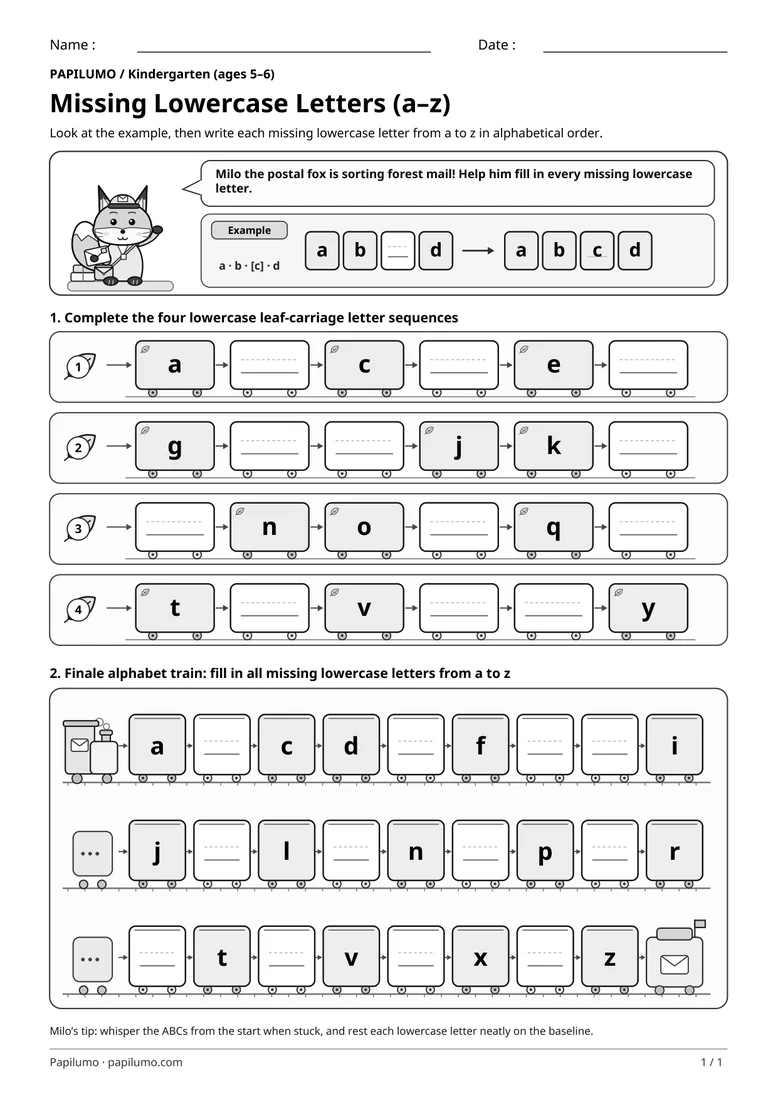
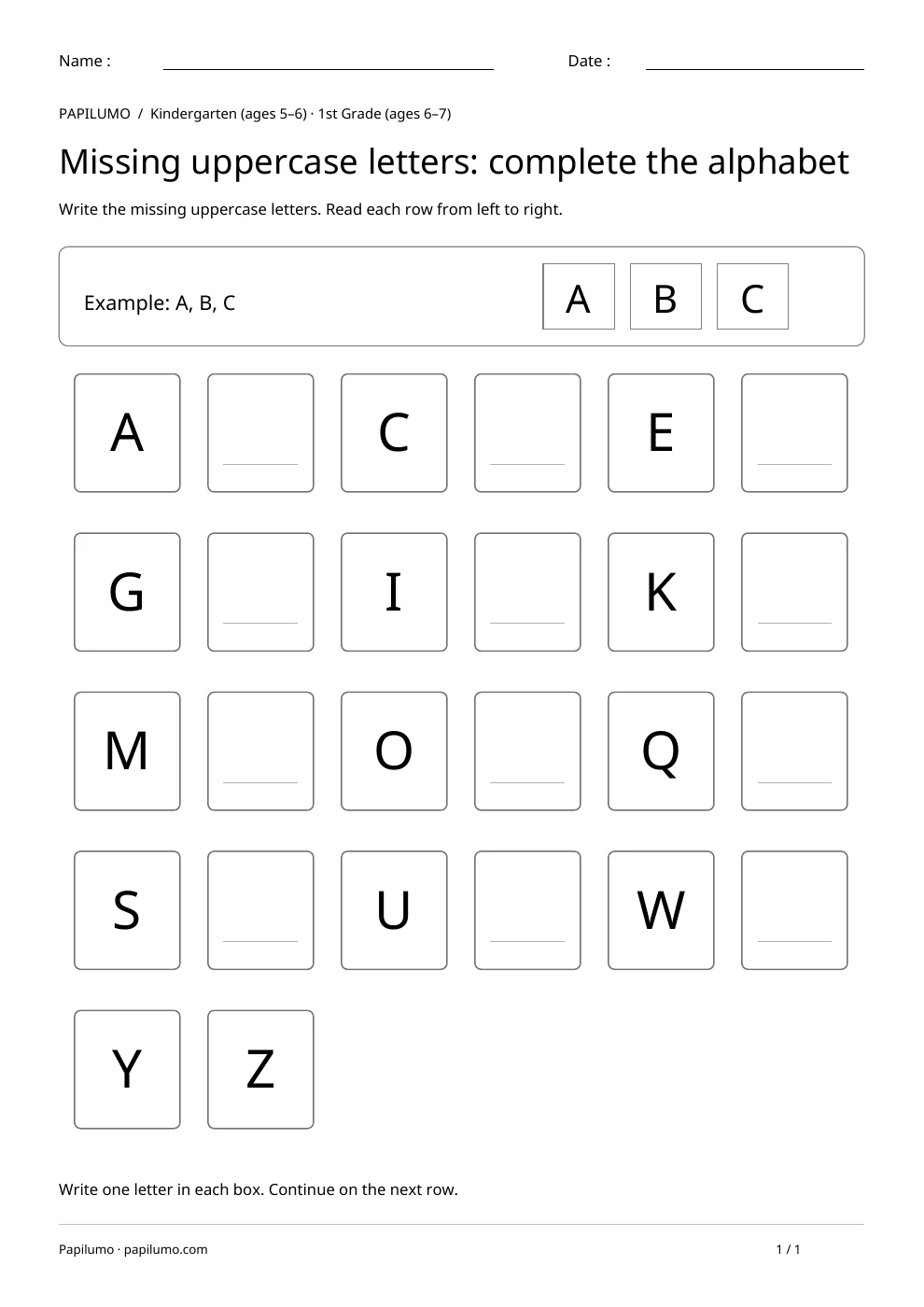
Finding and writing missing lowercase letters from a to z builds three essential Kindergarten literacy skills at once: recalling the exact alphabetical sequence without relying solely on singing the ABC song from start to finish, visually distinguishing look-alike lowercase letters such as b and d or p and q, and identifying which letter comes immediately before or after a given anchor clue. Unlike all-caps exercises, lowercase print introduces tall ascenders and descending tails that train steady spatial placement on primary writing lines. For a related skill, use Missing uppercase letters: complete the alphabet: Write the missing uppercase letters. Read each row from left to right.
Preparing a short session
Print the student worksheet at actual size (100%) on plain white A4 or letter paper without shrinking the margins, and set out a sharpened pencil along with a soft eraser. Keep the separate one-page answer key PDF tucked out of sight while your child works through the page independently. Before starting the first sequence, point out the solid baseline and dashed midline inside every blank box so the child sees exactly where rounded letter bodies rest and where tall stems or tails extend.
A concrete example to get started
Inside the top banner next to Milo the postal fox, the worked example shows four miniature letter tiles: a, b, an empty guided box, and d. A crisp vector arrow connects that prompt directly to the solved sequence a, b, c, d, with the missing lowercase c written neatly inside the third tile. In one quick glance, young learners grasp the rule for the entire page: read from left to right, say the missing letter aloud, and write strictly lowercase print.
Supporting the activity
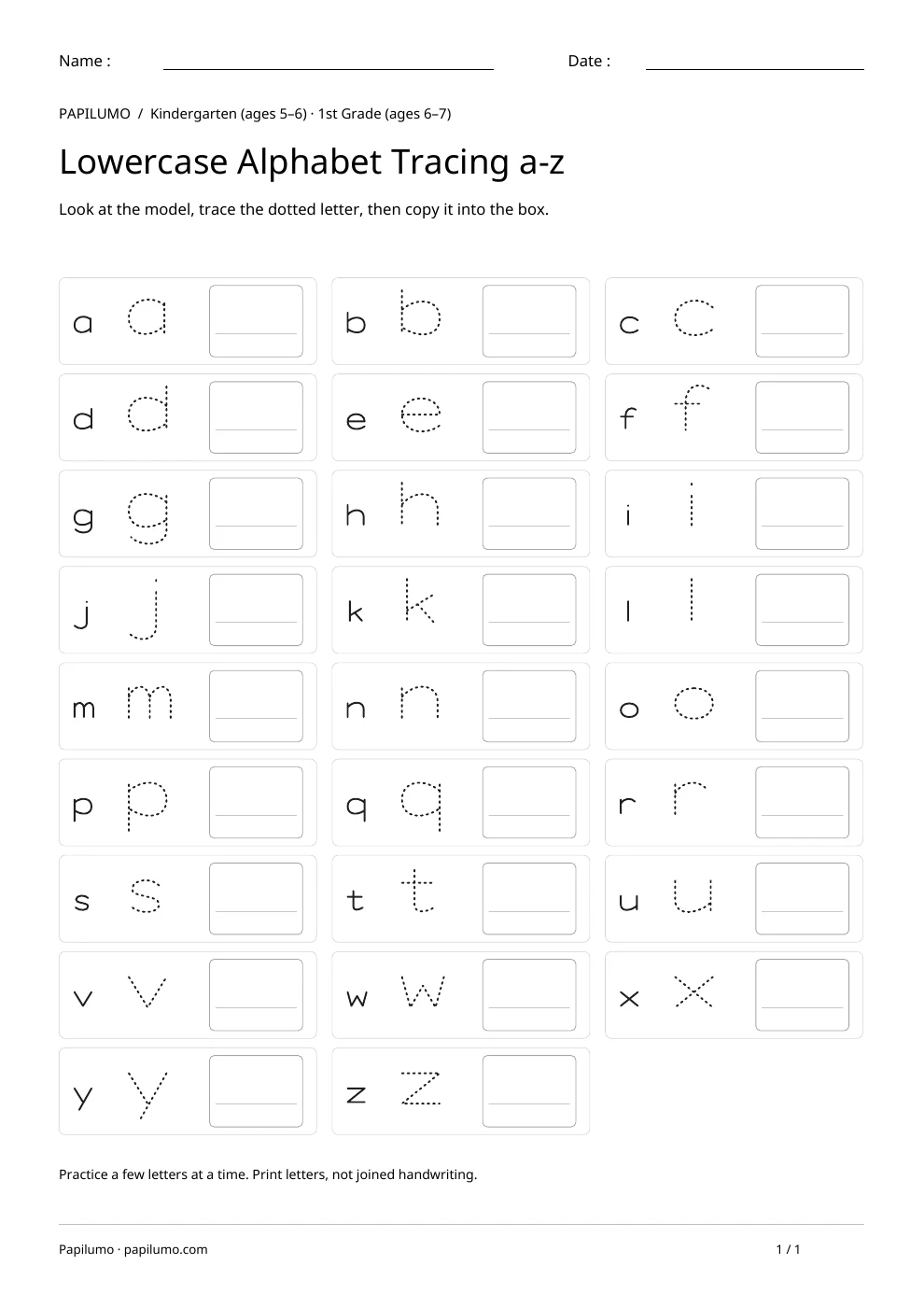
Part 1 presents four six-letter leaf-carriage sequences spaced across the alphabet: row 1 (a to f) asks for b, d, and f; row 2 (g to l) asks for h, i, and l; row 3 (m to r) begins with a blank box for m before continuing to p and r; and row 4 (t to y) practices u, w, and x. In Part 2, the three-tier finale train spans every letter from a to z, inviting students to fill in twelve missing lowercase letters: b, e, g, h, then k, m, o, q, and finally s, u, w, y. To vary the practice, try Lowercase Alphabet Tracing a-z: Look at the model, trace the dotted letter, then copy it into the box.
What to notice and how to check
When reviewing the finished page against the separate one-page answer key PDF, ask your child to touch each carriage from left to right and read every completed sequence aloud to catch any skipped or swapped letters. Check common Kindergarten reversals carefully, especially b versus d, p versus q, and upright j or g tails dropping cleanly below the solid baseline. If an uppercase letter slips into a blank box, compare its height against the neighboring lowercase clues and rewrite it cleanly in lowercase.
Making the task easier
Start with sequences 1 and 2 while keeping a lowercase a–z strip nearby so the child can spot each letter shape.
Keep the learning aim, but reduce how much the child has to handle at once. Cover part of the page with another sheet and reveal one task at a time. Demonstrate a separate example, then leave a real opportunity to work something out. An answer reached with support is still a useful attempt; it does not yet show that the same task can be completed independently.
Taking the idea beyond the worksheet
Point to any letter on the finale train and ask your child to name the lowercase letter just before and just after it.
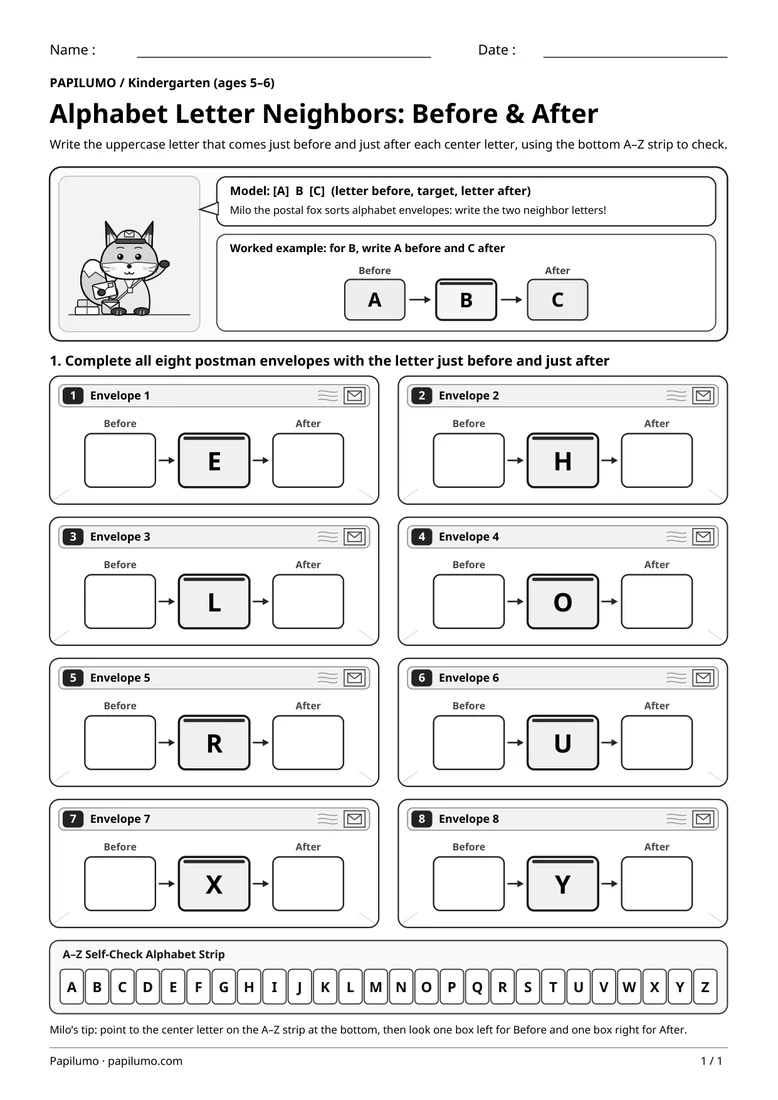
Use the follow-up to meet the same idea in a different setting. Offer it once the first task makes sense, without insisting that the whole page must be perfect. The child might explain a strategy, make an example or set a challenge for an adult. Return to the worksheet only when it helps connect the two situations. A short conversation or a practical activity can be enough to finish the session. To continue exploring, use Alphabet Letter Neighbors (Before and After) with Milo: Write the uppercase letter that comes just before and just after each center letter, using the bottom A–Z strip to check.
Downloading and printing the PDF
This free PDF contains one worksheet designed for A4 paper. Download the file using the button on this page and open it in your PDF reader. Choose actual size or a 100% scale, check the orientation in the print preview and turn off any browser headers or footers. The illustrations use vector lines, so their outlines stay sharp when printed. Check the margins on one copy before preparing several sheets for a group. The level shown on the page is a guide, rather than a requirement to complete the activity at a particular age.