
What this worksheet helps children practise
Remind children that they may shade any of the three equal parts—what matters is shading the exact number of thirds requested.
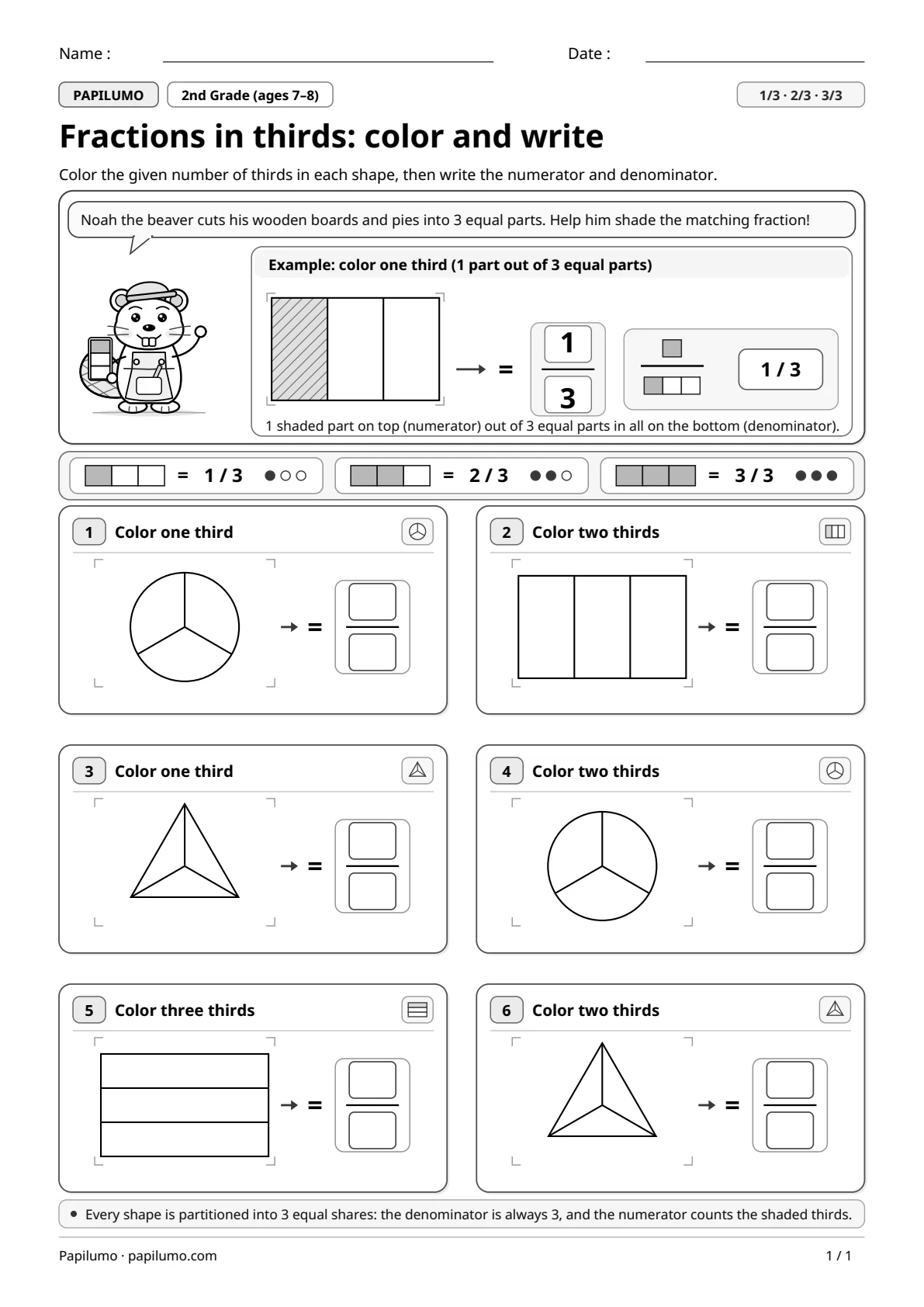
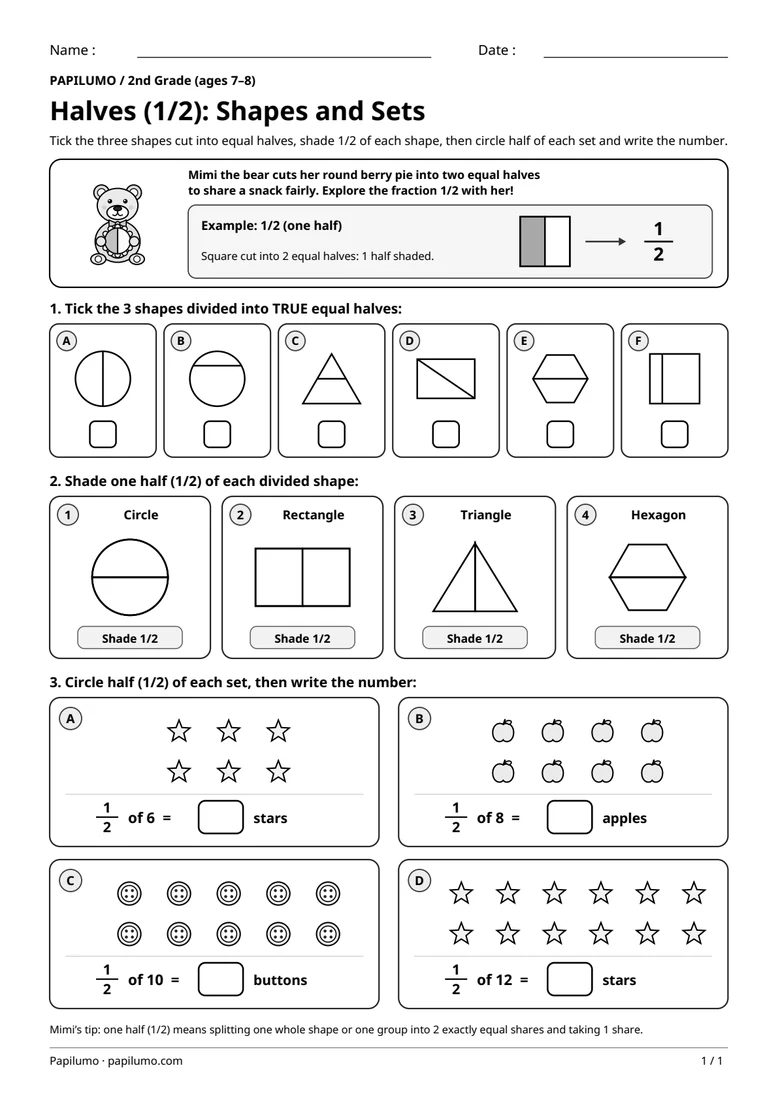
Understanding thirds combines geometry, fraction vocabulary and symbolic notation. Rather than only naming pre-shaded diagrams, actively shading one third, two thirds or three thirds requires students to check that the whole is partitioned into three equal shares (setting the denominator to 3) and then select 1, 2 or 3 of those shares (setting the numerator). Working across circles split into 120° sectors, vertical rectangles, horizontal strips and equilateral triangles partitioned from the center shows learners that a third depends on three equal-area parts, regardless of the shape’s outer contour. For a related skill, use Fractions: Halves (1/2) on Shapes and Sets with Mimi the Bear: Tick the three shapes cut into equal halves, shade 1/2 of each shape, then circle half of each set and write the number.
Preparing a short session
Print the student page at 100% scale on standard paper and provide a graphite pencil along with a light colored pencil or crayon for neat shading. No cutting or gluing is required. Before starting the six exercises, look at Noah the beaver and review the worked model together: the rectangular bar is divided into 3 equal boxes, 1 box is shaded and hatched, and the fraction 1/3 is written beside it with clear labels explaining the role of the numerator on top and the denominator on the bottom.
A concrete example to get started
In the worked model at the top of the page, the prompt asks to color one third. Noah counts 3 equal parts in the rectangular bar, shades 1 part, writes 1 above the fraction bar and 3 below it: 1/3. In Exercise 1, “Color one third” next to a circle divided into three equal sectors, the child shades any 1 sector and writes 1 in the top box and 3 in the bottom box.
Supporting the activity
Have students complete the six cards in order from 1 to 6. For each card, ask them first to count the total number of equal parts in the shape aloud: because every figure is split into 3 equal shares, 3 goes in the bottom box every single time. Next, read the word prompt together: “one third” means shade 1 part, “two thirds” means shade 2 parts, and “three thirds” on Card 5 means shade all 3 parts to make one complete whole (3/3 = 1 whole). Alternating between circles, rectangles and triangles keeps visual attention sharp. To vary the practice, try Color and Write Fifths & Eighths Fractions with Mina: Shade the matching parts in shapes A–D, then count the shaded parts in E–F and write each fraction.
What to notice and how to check
The answer key shows clean hatched shading and all twelve numbers: 1) 1/3 (1 of 3 circle sectors shaded); 2) 2/3 (2 of 3 vertical strips shaded); 3) 1/3 (1 of 3 inner triangles shaded); 4) 2/3 (2 of 3 circle sectors shaded); 5) 3/3 (all 3 horizontal strips shaded, making the whole rectangle); 6) 2/3 (2 of 3 inner triangles shaded). On the student sheet, any choice of 1 or 2 equal parts is completely correct as long as the count matches the numerator.
Making the task easier
Fold a paper strip into three equal sections: color one section to model one third, then color a second section to show two thirds.
Keep the learning aim, but reduce how much the child has to handle at once. Cover part of the page with another sheet and reveal one task at a time. Demonstrate a separate example, then leave a real opportunity to work something out. An answer reached with support is still a useful attempt; it does not yet show that the same task can be completed independently.
Taking the idea beyond the worksheet
After shading each shape, ask your child what fraction of the shape remains unshaded (for example, when 1/3 is shaded, 2/3 is left white).
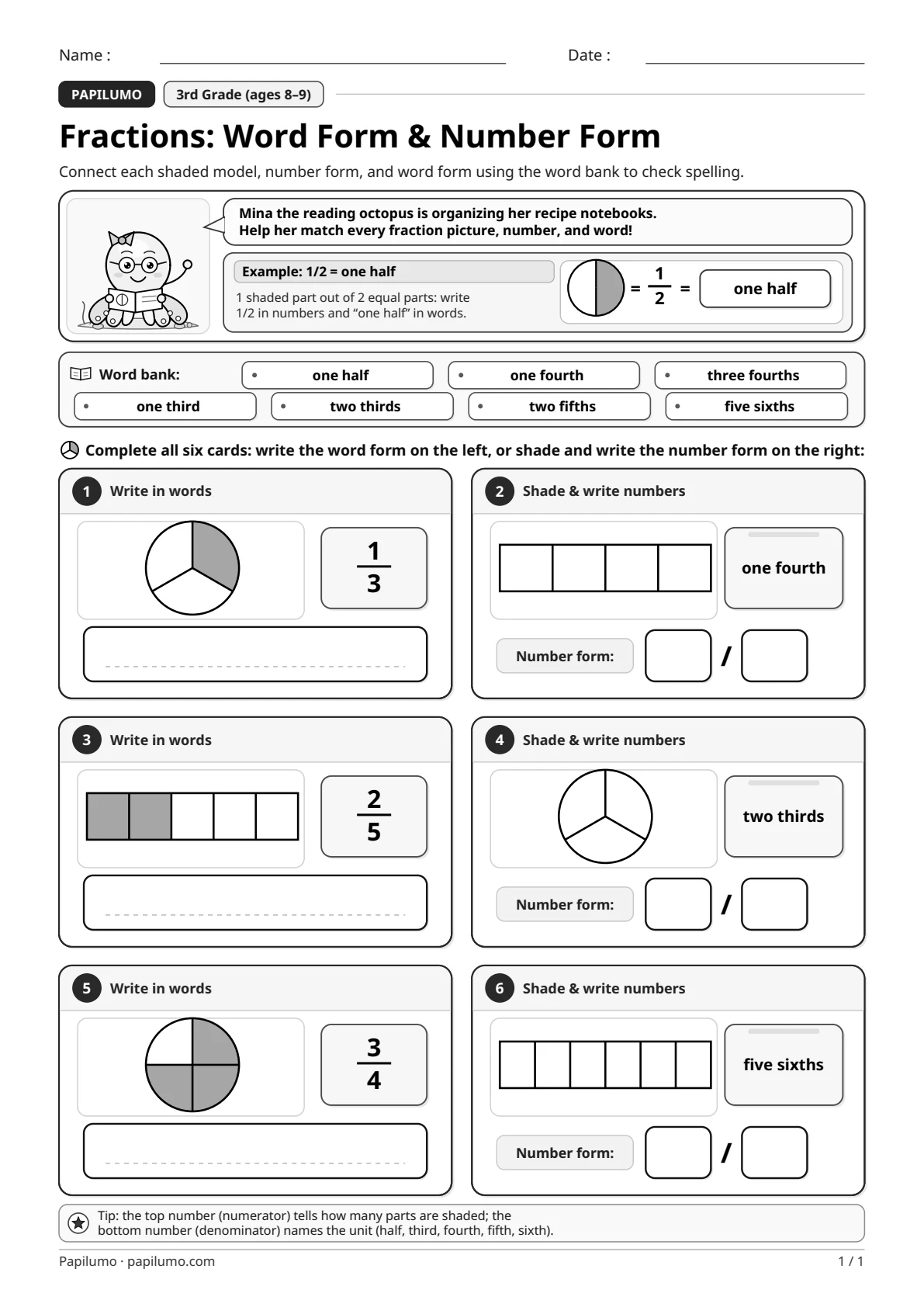
Use the follow-up to meet the same idea in a different setting. Offer it once the first task makes sense, without insisting that the whole page must be perfect. The child might explain a strategy, make an example or set a challenge for an adult. Return to the worksheet only when it helps connect the two situations. A short conversation or a practical activity can be enough to finish the session. To continue exploring, use Fractions in Word Form and Number Form with Mina the Octopus: Connect each shaded model, number form, and word form using the word bank to check spelling.
Downloading and printing the PDF
This free PDF contains one worksheet designed for A4 paper. Download the file using the button on this page and open it in your PDF reader. Choose actual size or a 100% scale, check the orientation in the print preview and turn off any browser headers or footers. The illustrations use vector lines, so their outlines stay sharp when printed. Check the margins on one copy before preparing several sheets for a group. The level shown on the page is a guide, rather than a requirement to complete the activity at a particular age.