
What this worksheet helps children practise
Give a high-five with one open hand first to feel 5 right away, then count on across the second hand!
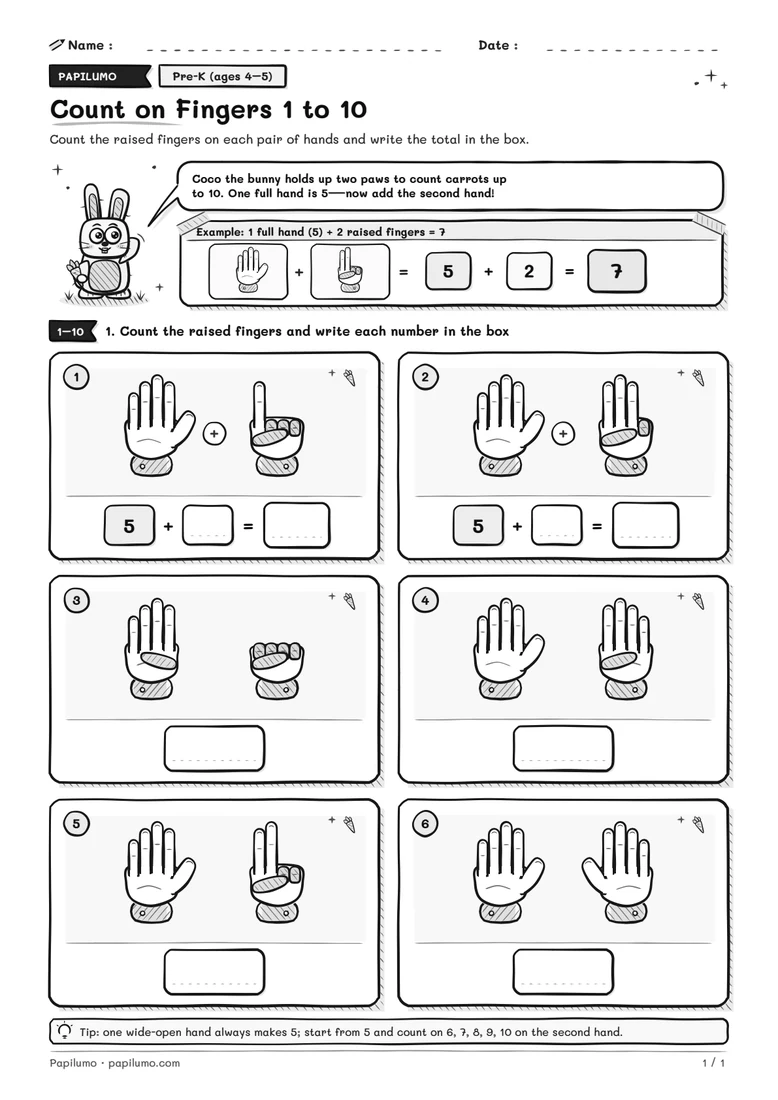
Counting to 10 on two hands while recognizing one open hand as 5 builds an essential early-number foundation in Pre-K. Rather than starting back at 1 every single time, children begin to subitize a full hand of five fingers at a glance and count on smoothly across the second hand (5, then 6, 7, 8, 9, or 10). Noticing the difference between tall raised fingers and curled-down fingers strengthens visual discrimination, part-part-whole thinking (5 + 1, 5 + 2, 5 + 3, 5 + 4, 5 + 5), and early readiness for adding up to ten. For a related skill, use Count on Fingers 1 to 5 with Nilo the Little Bear: Look at the solved model and 1–5 finger strip, count the raised fingers on each hand, and write the number.
Preparing a short session
Print the student worksheet at actual size (100%) on crisp white A4 or letter paper without shrinking page margins, and hand your child a sharpened pencil or chunky triangular crayon. Before writing any numbers, invite your learner to hold up both hands in front of them, palms facing forward, and copy five fingers on one hand plus two fingers on the other. Keep the separate answer key out of sight while your child inspects each hand drawing carefully.
A concrete example to get started
Inside the top example box beside Coco the bunny, children see the two-hand shortcut clearly modeled: the left hand spreads all five tall fingers (5) while the right hand raises two fingers with the other three curled neatly down into the palm (2), forming 5 + 2 = 7. Pointing out both the standing fingers and the tucked knuckles shows immediately which fingers count and encourages learners to read the full hand first.
Supporting the activity
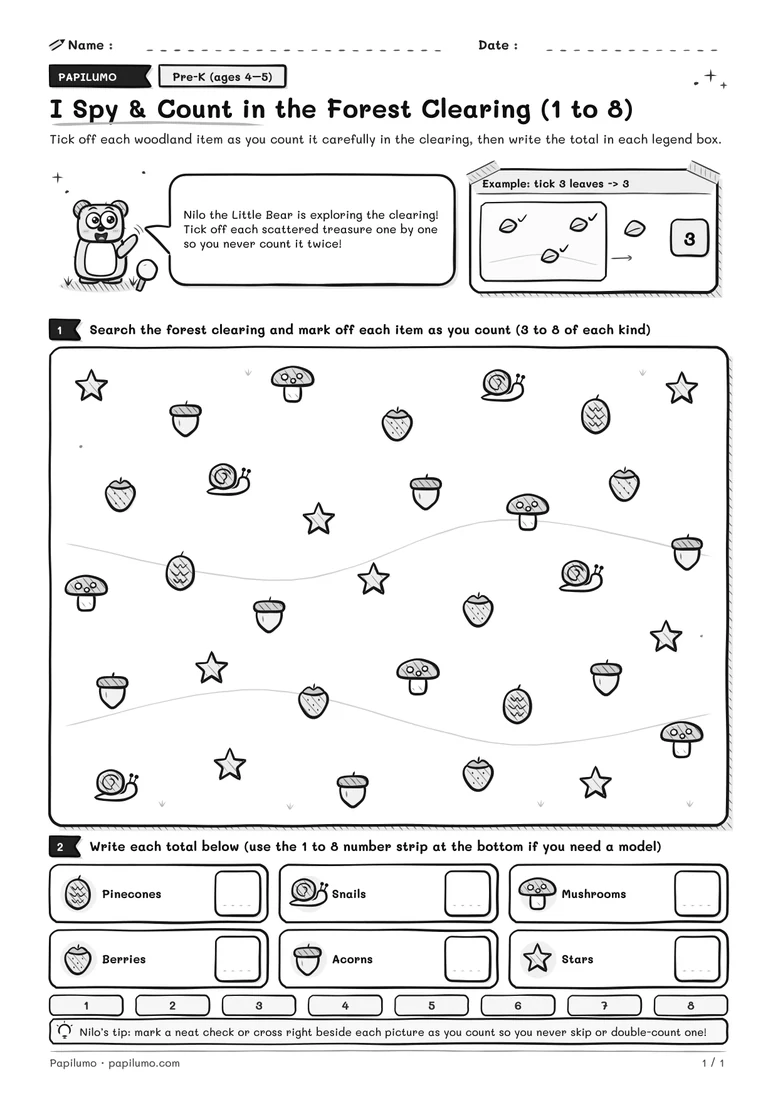
Next, students work through the six large cards arranged in two clean columns. Cards 1 and 2 include a gentle “5 + [ ] = [ ]” scaffold to guide counting on: 5 + [1] = [6], followed by 5 + [3] = [8]. Card 3 introduces a clever attention check—four fingers raised on the left hand and a closed fist on the right (4 + 0 = [4])—so children actually check both hands instead of assuming every left hand equals five. Cards 4, 5, and 6 feature a single large total box for 5 + 4 = [9], 5 + 2 = [7], and two full hands 5 + 5 = [10]. To vary the practice, try I Spy & Count in the Forest Clearing (1 to 8) with Nilo the Bear: Tick off each woodland item as you count it carefully in the clearing, then write the total in each legend box.
What to notice and how to check
When reviewing with the separate PDF answer sheet, check Card 3 first to celebrate careful counting of the four-finger hand and closed fist (0). If any total is off by one or a digit such as 6 or 9 is reversed, ask your child calmly to hold up their own two hands to match the picture, tap each raised fingertip aloud in order, and write the corrected number neatly inside the box.
Making the task easier
Tap each raised finger gently with a pencil eraser as you count 1, 2, 3… all the way to the total.
Keep the learning aim, but reduce how much the child has to handle at once. Cover part of the page with another sheet and reveal one task at a time. Demonstrate a separate example, then leave a real opportunity to work something out. An answer reached with support is still a useful attempt; it does not yet show that the same task can be completed independently.
Taking the idea beyond the worksheet
Take turns making a secret number from 1 to 10 on two hands and asking a grown-up to name it fast.
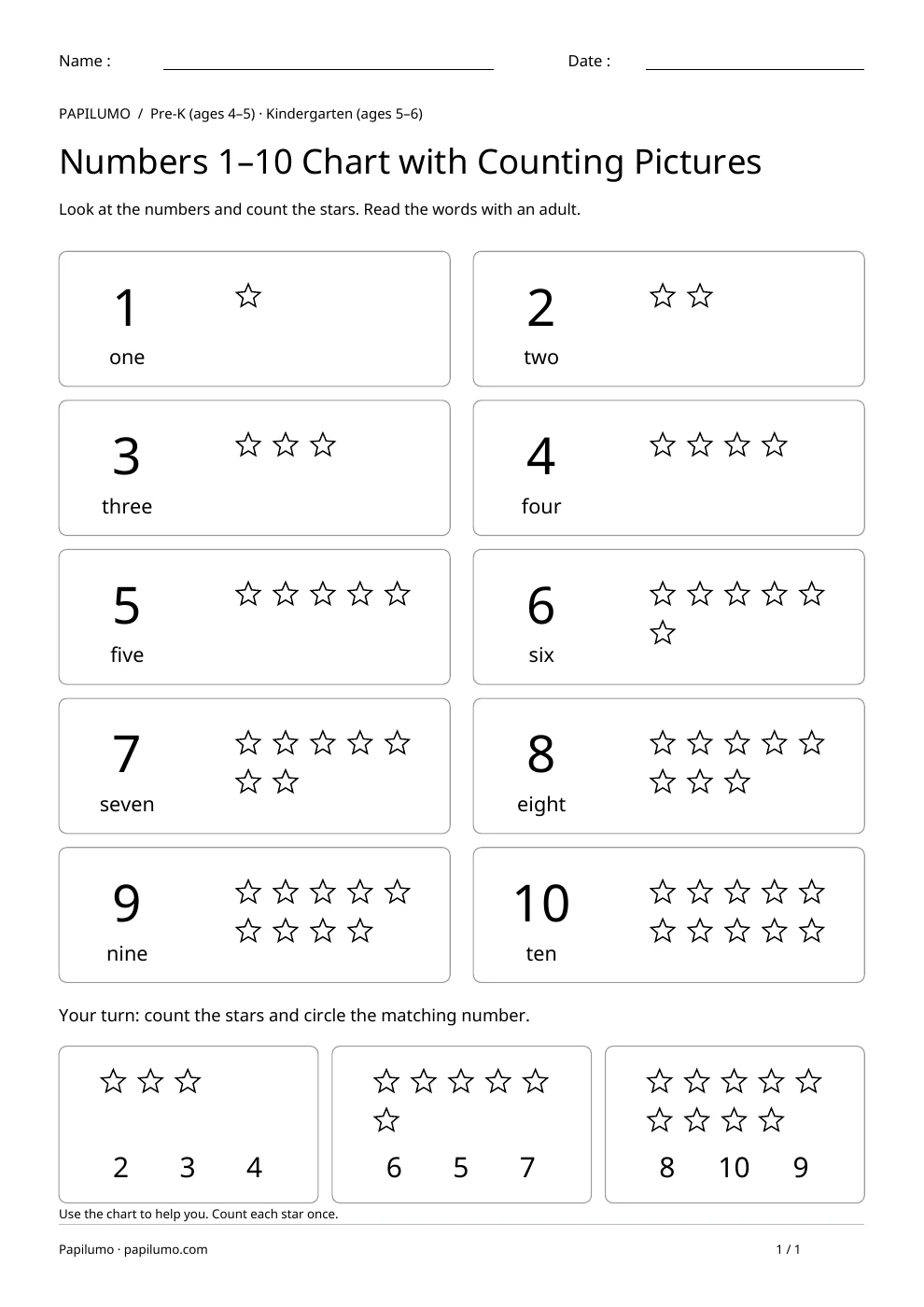
Use the follow-up to meet the same idea in a different setting. Offer it once the first task makes sense, without insisting that the whole page must be perfect. The child might explain a strategy, make an example or set a challenge for an adult. Return to the worksheet only when it helps connect the two situations. A short conversation or a practical activity can be enough to finish the session. To continue exploring, use Connecting Numerals, Five-Grouped Stars, and Number Words to 10: Look at the numbers and count the stars. Read the words with an adult.
Downloading and printing the PDF
This free PDF contains one worksheet designed for A4 paper. Download the file using the button on this page and open it in your PDF reader. Choose actual size or a 100% scale, check the orientation in the print preview and turn off any browser headers or footers. The illustrations use vector lines, so their outlines stay sharp when printed. Check the margins on one copy before preparing several sheets for a group. The level shown on the page is a guide, rather than a requirement to complete the activity at a particular age.