

What this worksheet helps children practise
Turn meters into hundreds first (1 m = 100 cm), then add the extra centimeters before comparing two lengths!
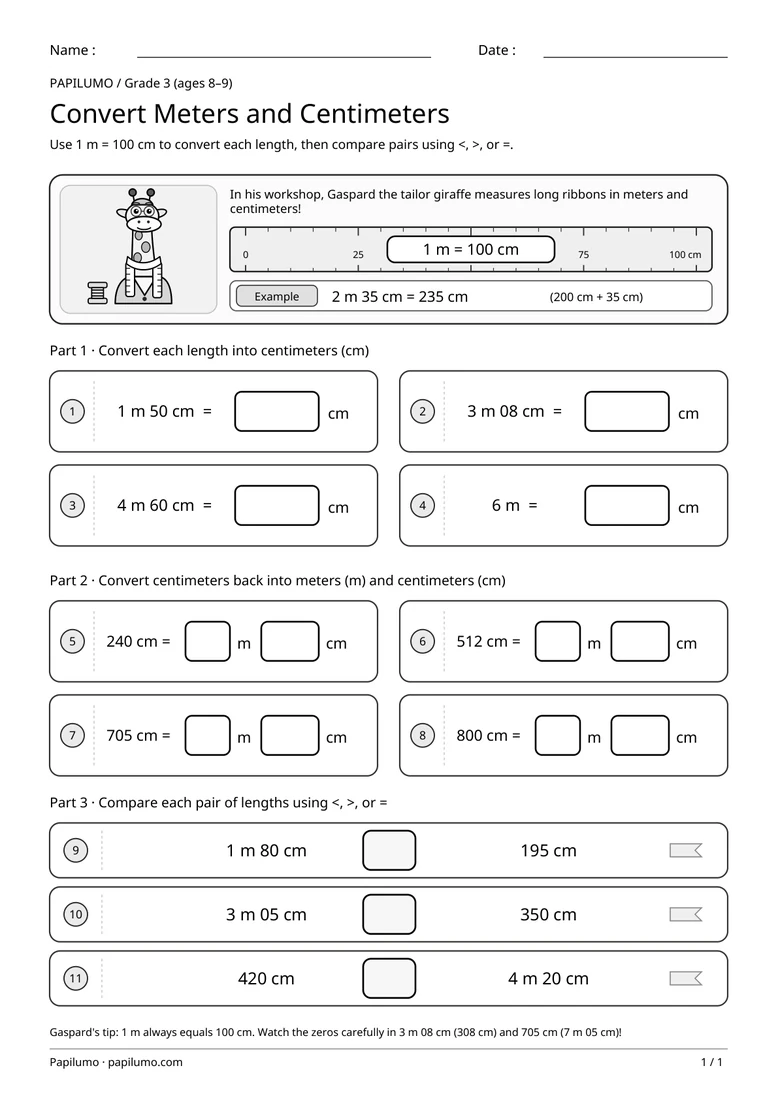
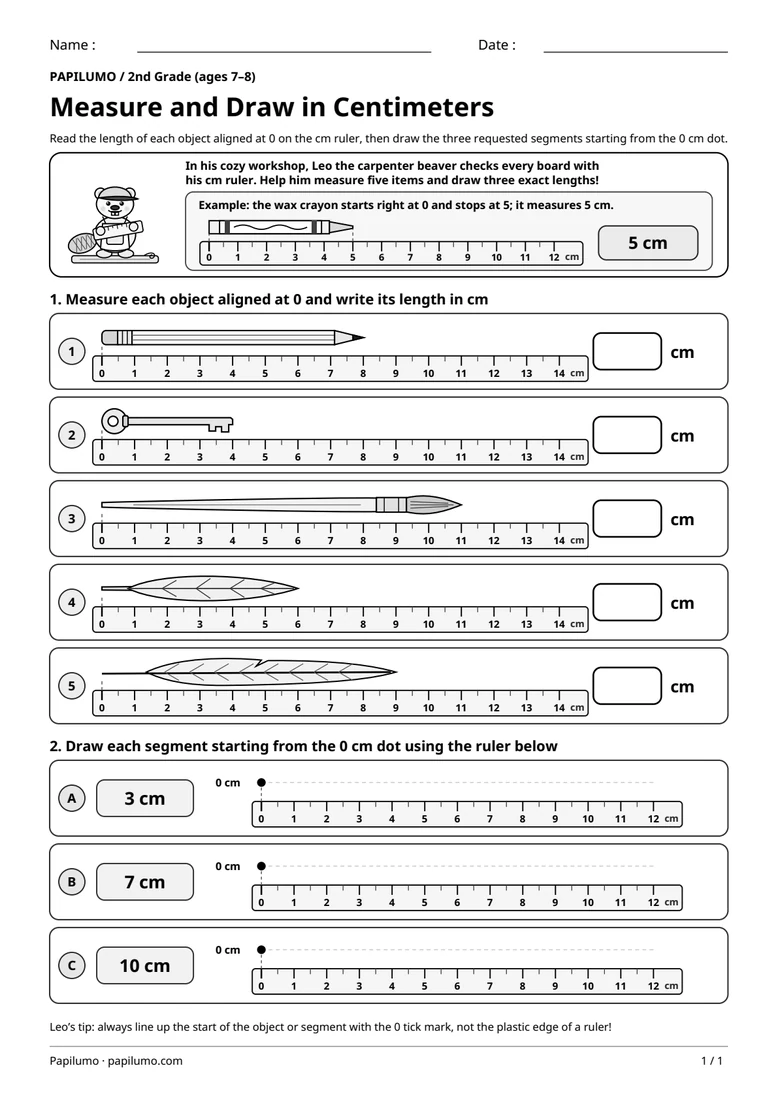
Converting metric lengths between meters and centimeters strengthens place-value understanding in Grade 3 because each full meter equals 100 centimeters, placing meters directly in the hundreds digit. Many students stumble when a zero sits in the tens or ones position, writing 38 cm instead of 308 cm for 3 m 08 cm or confusing 3 m 05 cm with 350 cm. Working smoothly in both directions and comparing mixed units trains children to link hundreds to whole meters and inspect every digit carefully. For a related skill, use Measure and Draw Centimeters with a Ruler (2nd Grade) with Leo the Beaver: Read the length of each object aligned at 0 on the cm ruler, then draw the three requested segments starting from the 0 cm dot.
Preparing a short session
Print the student page at 100% scale on white A4 paper so the measuring tape markings and answer boxes print crisp and easy to read, alongside a sharpened pencil and eraser. Keep the separate answer key PDF aside during independent work. Before starting Part 1, trace Gaspard's graduated tape-measure banner together at the top of the page, read 1 m = 100 cm aloud, and walk through why 2 meters become 200 centimeters in the worked example.
A concrete example to get started
Inside the top reminder banner beside Gaspard the tailor giraffe, a graduated 0 to 100 cm measuring tape visually anchors the core rule 1 m = 100 cm. Directly underneath, the worked example shows 2 m 35 cm = 235 cm alongside the step 200 cm + 35 cm. Students immediately see how whole meters turn into hundreds of centimeters and how converting backward splits off the hundreds digit as meters while leaving the last two digits as centimeters.
Supporting the activity
In Part 1, students convert four lengths into centimeters: 1 m 50 cm equals 150 cm, 3 m 08 cm equals 308 cm, 4 m 60 cm equals 460 cm, and 6 m equals 600 cm. In Part 2, they reverse the process: 240 cm becomes 2 m 40 cm, 512 cm becomes 5 m 12 cm, 705 cm becomes 7 m 05 cm, and 800 cm becomes 8 m 00 cm. In Part 3, they compare three mixed pairs using <, >, or =: 1 m 80 cm < 195 cm, 3 m 05 cm < 350 cm, and 420 cm = 4 m 20 cm. To vary the practice, try Shortest and Longest: Compare Lengths with Gus the Giraffe: Check the dashed starting line and circle the requested object in each of the six sets.
What to notice and how to check
When checking work against the separate answer key PDF, inspect the zero-placeholder items closely: 3 m 08 cm must read 308 cm, 705 cm splits into 7 m 05 cm, and 800 cm equals 8 m 00 cm (with zero extra centimeters). In Part 3, pay special attention to the second comparison (3 m 05 cm < 350 cm), where 305 cm is strictly less than 350 cm. Whenever a student misses a comparison, ask them to write both sides in centimeters in pencil first.
Making the task easier
Jot the total in centimeters lightly under each m-and-cm measurement before choosing <, >, or =.
Keep the learning aim, but reduce how much the child has to handle at once. Cover part of the page with another sheet and reveal one task at a time. Demonstrate a separate example, then leave a real opportunity to work something out. An answer reached with support is still a useful attempt; it does not yet show that the same task can be completed independently.
Taking the idea beyond the worksheet
Measure a desk, doorway, or rug with a tape measure and record its length two ways: in cm and in m and cm.
Use the follow-up to meet the same idea in a different setting. Offer it once the first task makes sense, without insisting that the whole page must be perfect. The child might explain a strategy, make an example or set a challenge for an adult. Return to the worksheet only when it helps connect the two situations. A short conversation or a practical activity can be enough to finish the session. To continue exploring, use Tallest and Shortest Height with Gaspard the Giraffe: Look closely at the three drawings standing on each ground line: circle the tallest and underline the shortest.
Downloading and printing the PDF
This free PDF contains one worksheet designed for A4 paper. Download the file using the button on this page and open it in your PDF reader. Choose actual size or a 100% scale, check the orientation in the print preview and turn off any browser headers or footers. The illustrations use vector lines, so their outlines stay sharp when printed. Check the margins on one copy before preparing several sheets for a group. The level shown on the page is a guide, rather than a requirement to complete the activity at a particular age.