
What this worksheet helps children practise
Always write both counts in the boxes first, then point the wide open mouth of the sign toward the bigger number!
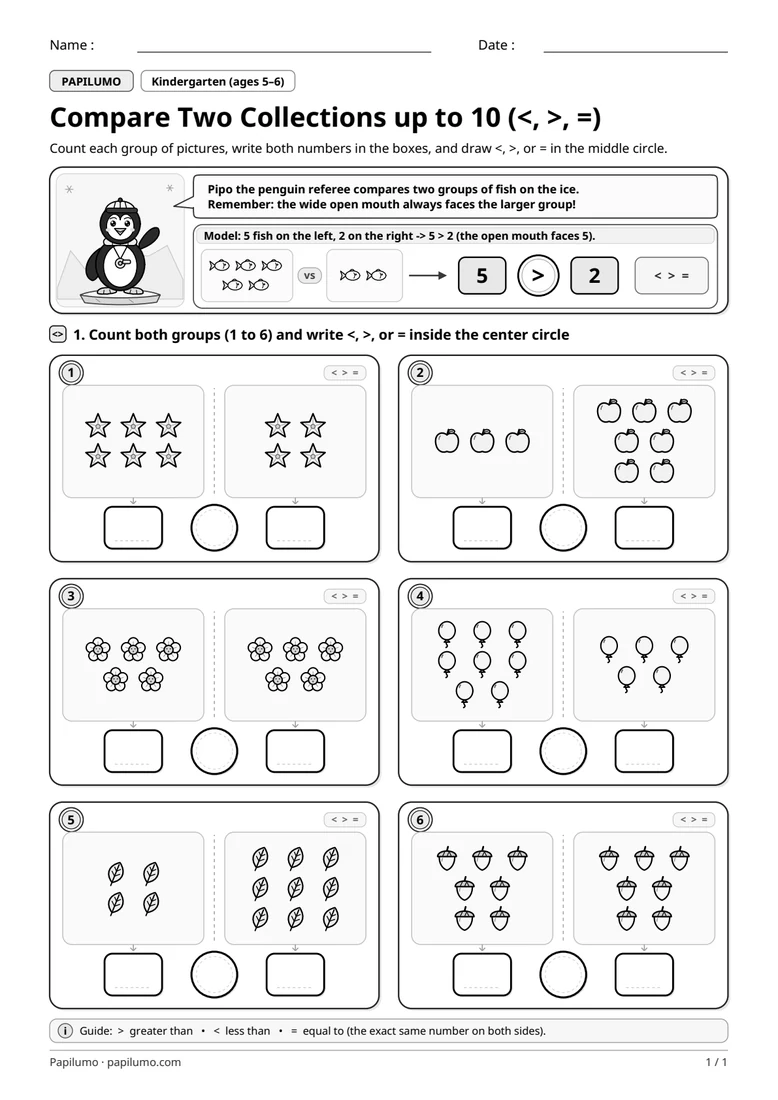
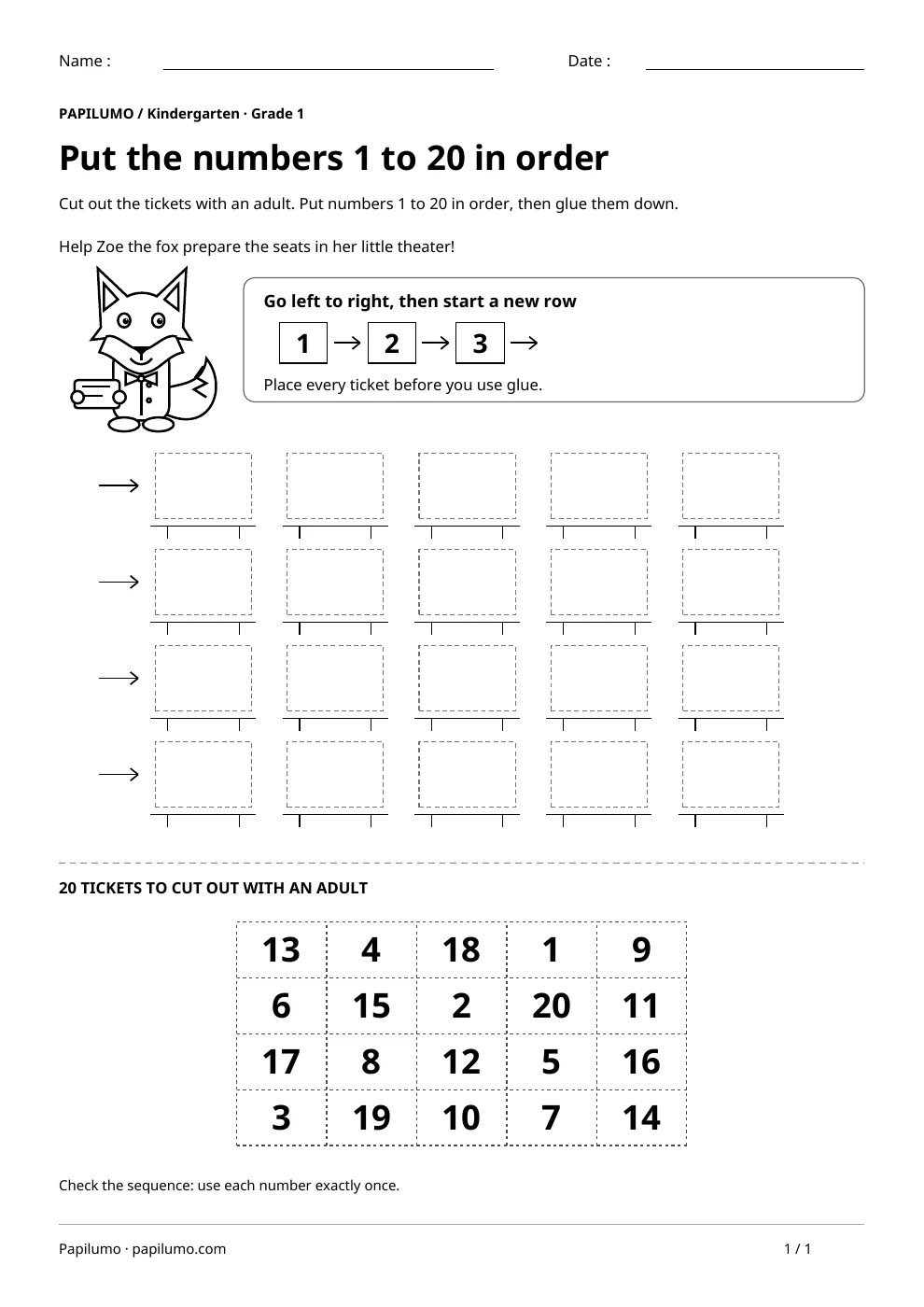
Counting and comparing two picture collections up to 10 with <, >, and = weaves together three foundational kindergarten math skills on one tidy page. First, children count each distinct set accurately using steady one-to-one correspondence. Second, they record both totals as written numerals in the left and right boxes underneath. Third, they judge whether the left quantity is greater than (>), less than (<), or equal to (=) the right quantity. Remembering that the wide open mouth always faces the larger number gives beginners a clear visual rule that sticks. For a related skill, use Ordering Numbers 1–20: Cut and Paste: Cut out the tickets with an adult. Put numbers 1 to 20 in order, then glue them down.
Preparing a short session
Print the student page at actual size (100%) on plain white letter or A4 paper without shrinking page margins, and hand your child a sharpened pencil with a soft eraser. Before touching paper, build two small piles of blocks or coins on the table and show with two fingers how the wide open mouth turns toward the bigger pile every time. Review Pipo the penguin’s worked example together at the top, and keep the separate one-page answer key tucked out of sight while your child works.
A concrete example to get started
Inside the top banner next to Pipo the penguin referee, the solved model demonstrates all three steps cleanly: children count 5 fish on the left and 2 fish on the right, see the digits 5 and 2 already written in the square boxes below, and observe the > symbol placed in the center circle because 5 is greater than 2. Pointing out how the wide opening aims directly at 5 prevents reversed inequality signs right from the start.
Supporting the activity
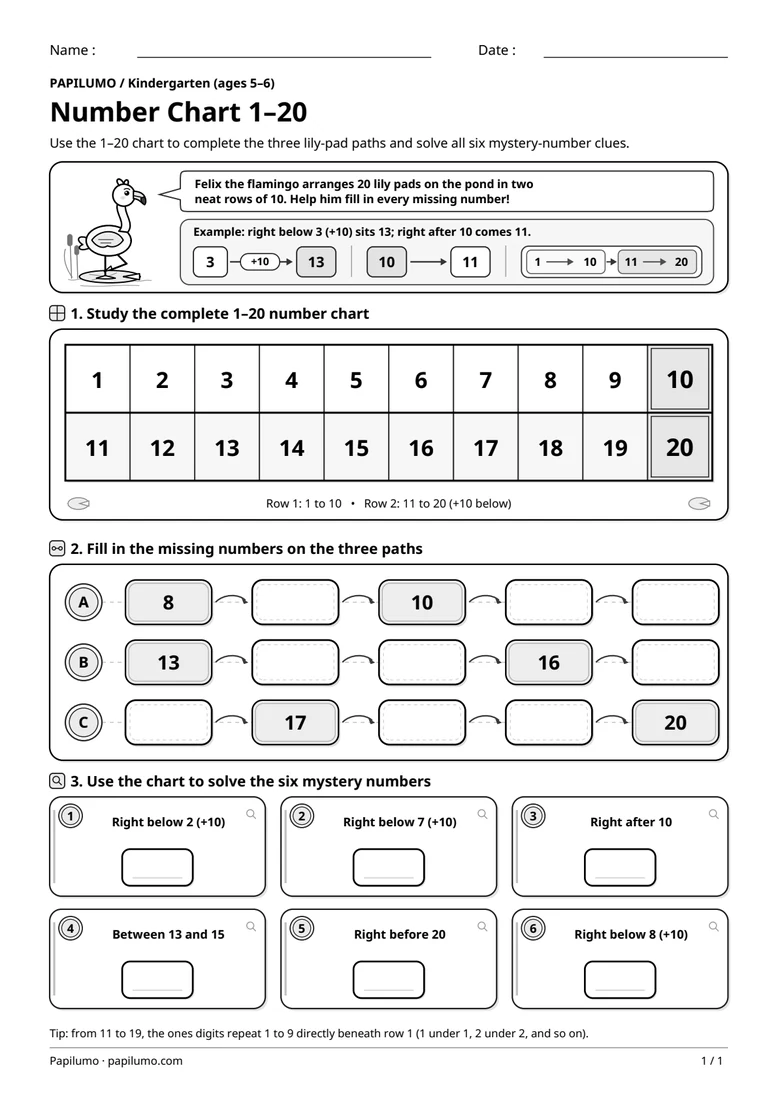
Next, students complete the six spacious cards arranged in two clean columns: Card 1 compares 6 stars and 4 stars (6 > 4); Card 2 compares 3 apples and 7 apples (3 < 7); Card 3 pairs 5 flowers with 5 flowers (5 = 5); Card 4 compares 8 balloons and 5 balloons (8 > 5); Card 5 compares 4 leaves and 9 leaves (4 < 9); and Card 6 pairs 7 acorns with 7 acorns (7 = 7). Writing both totals inside the boxes before drawing the central symbol encourages careful counting first. To vary the practice, try Number Chart 1 to 20 with Felix the Flamingo: Use the 1–20 chart to complete the three lily-pad paths and solve all six mystery-number clues.
What to notice and how to check
When checking work against the separate one-page answer key, look closely at the two written counts under each picture pair before checking the middle symbol. Most < or > mistakes happen when a child skips or double-counts a picture in larger sets like 8 balloons or 9 leaves. If a chevron points the wrong way, calmly ask your child to tap the bigger written number first and make sure the wide open mouth faces straight toward it.
Making the task easier
Lightly dot each picture with your pencil tip as you count, then underline the larger number before writing the sign.
Keep the learning aim, but reduce how much the child has to handle at once. Cover part of the page with another sheet and reveal one task at a time. Demonstrate a separate example, then leave a real opportunity to work something out. An answer reached with support is still a useful attempt; it does not yet show that the same task can be completed independently.
Taking the idea beyond the worksheet
Make two secret groups of up to 10 toys on the floor and place a sticky note with <, >, or = between them.
Use the follow-up to meet the same idea in a different setting. Offer it once the first task makes sense, without insisting that the whole page must be perfect. The child might explain a strategy, make an example or set a challenge for an adult. Return to the worksheet only when it helps connect the two situations. A short conversation or a practical activity can be enough to finish the session. To continue exploring, use Shortest and Longest: Compare Lengths with Gus the Giraffe: Check the dashed starting line and circle the requested object in each of the six sets.
Downloading and printing the PDF
This free PDF contains one worksheet designed for A4 paper. Download the file using the button on this page and open it in your PDF reader. Choose actual size or a 100% scale, check the orientation in the print preview and turn off any browser headers or footers. The illustrations use vector lines, so their outlines stay sharp when printed. Check the margins on one copy before preparing several sheets for a group. The level shown on the page is a guide, rather than a requirement to complete the activity at a particular age.