What this worksheet helps children practise
Start at the black dot, follow the arrow straight across, and make a sharp corner turn!
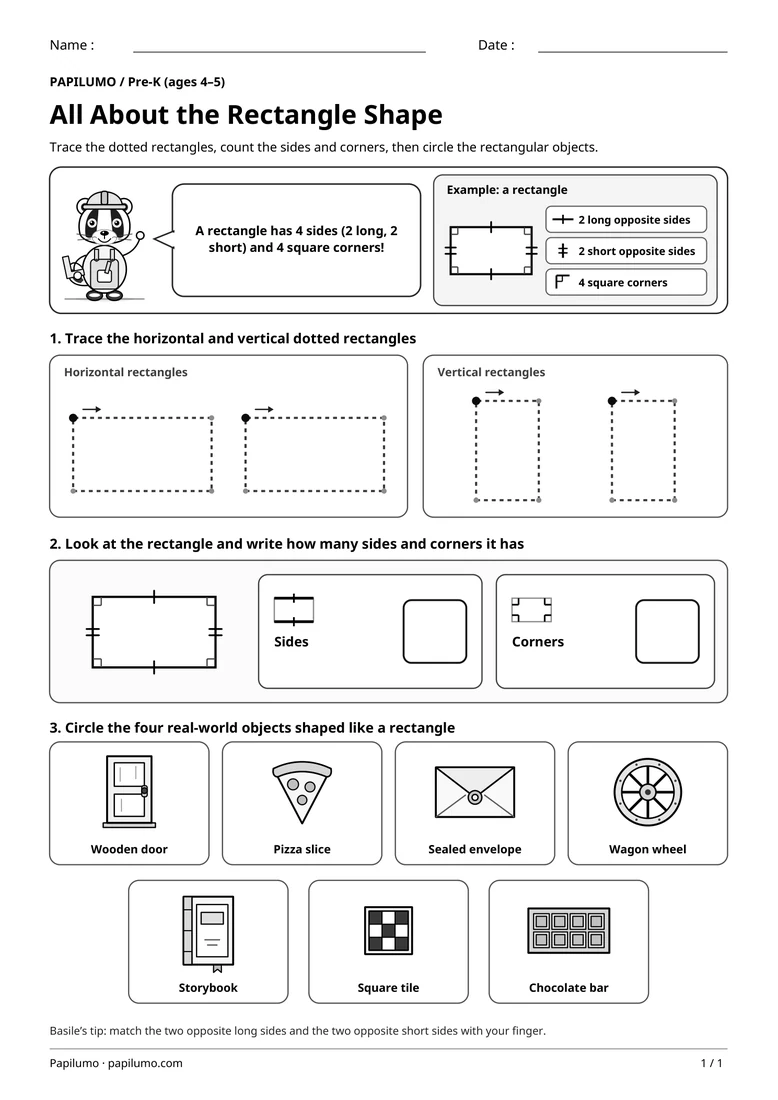
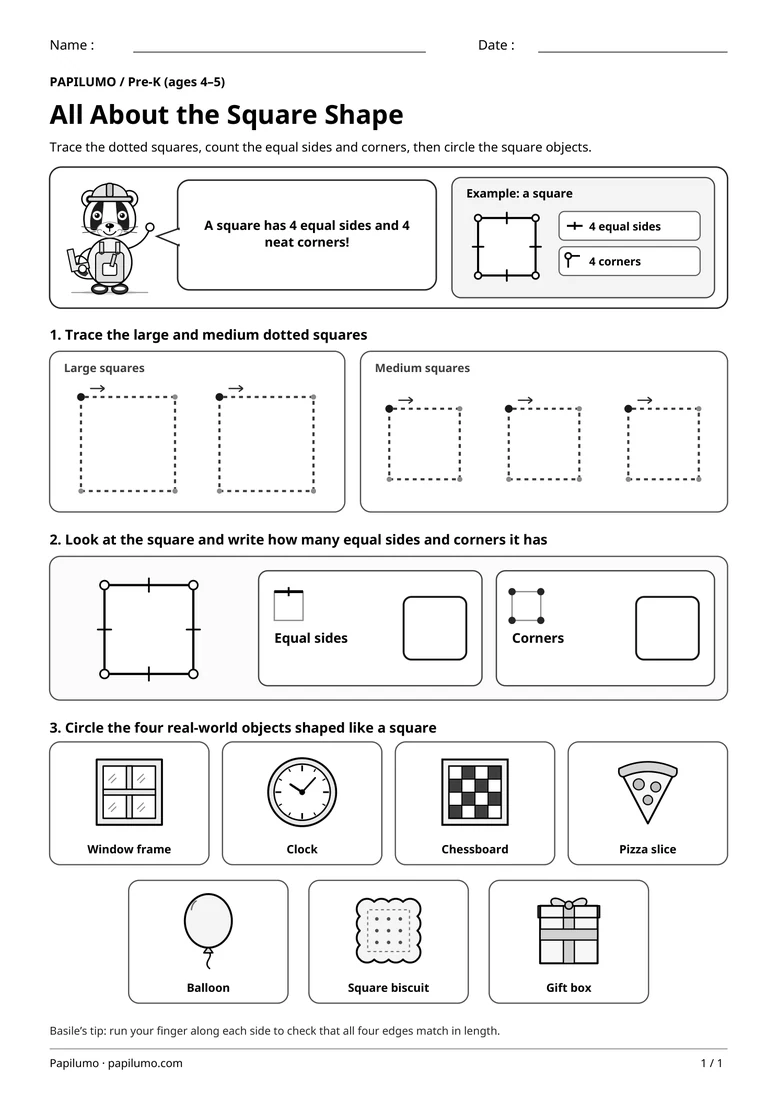
Learning all about the rectangle in Pre-K builds fine-motor pencil control, spatial awareness, and early shape reasoning. Tracing alternating long and short straight edges teaches young hands when to keep drawing straight and when to pause cleanly at each right-angle turn. Counting four sides—two long opposite sides and two short opposite sides—plus four square corners helps children tell true rectangles apart from squares, triangles, and circles. Sorting crisp black-and-white illustrations connects foundational classroom geometry directly to familiar objects seen at home and school. For a related skill, use All About the Square Shape: Trace, Count, and Spot with Basile the Badger: Trace the dotted squares, count the equal sides and corners, then circle the square objects.
Preparing a short session
Print the student worksheet at actual size (100%) on plain white A4 or letter paper without cropping any margins, and keep the separate answer key PDF tucked out of sight while your child works. Set out a sharpened beginner pencil or easy-grip marker alongside a soft eraser so mistakes wipe away cleanly. Before tracing, run one finger together along the worked rectangle beside Basile the carpenter badger, naming the two long opposite sides, the two short opposite sides, and gently tapping all four square corner marks aloud.
A concrete example to get started
Inside the top framed banner, Basile the carpenter badger points toward a friendly speech bubble and a clear worked rectangle diagram. The two long opposite edges share single matching tick marks, while the two short opposite edges carry double tick marks so children immediately spot each equal pair. Inside all four corners, crisp right-angle square brackets highlight the four square corners. Beside the diagram, three concise callouts summarize “2 long opposite sides,” “2 short opposite sides,” and “4 square corners” as a handy visual guide before starting.
Supporting the activity
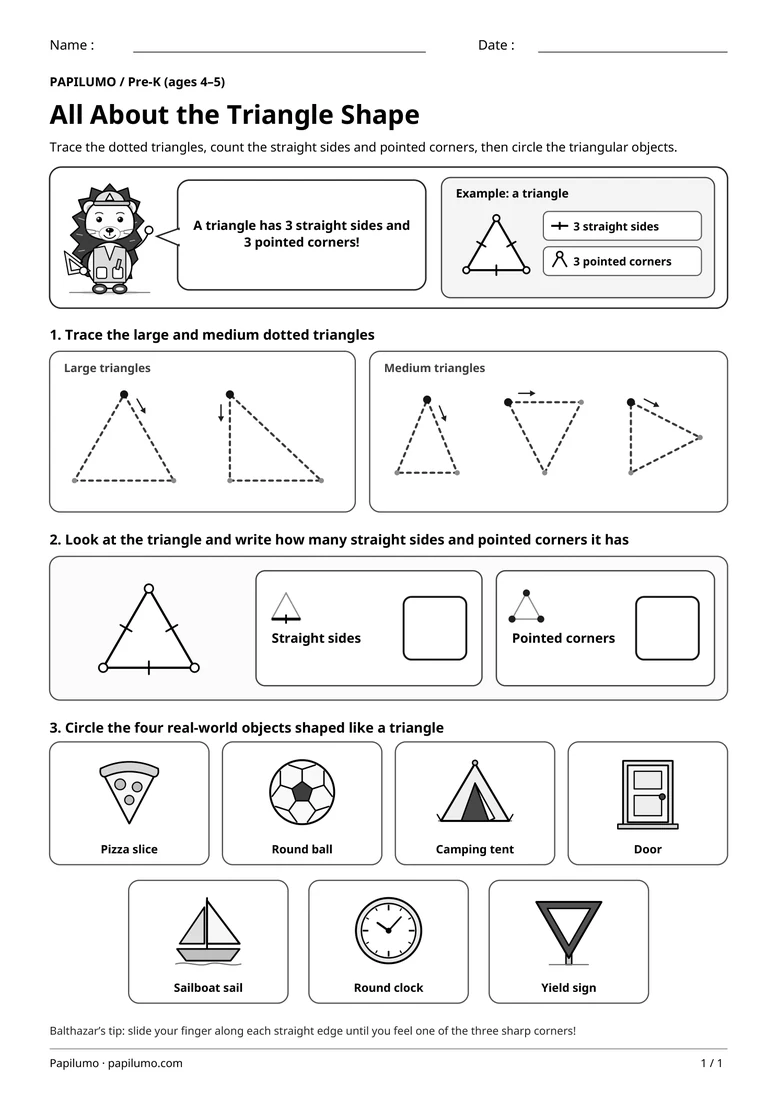
In Section 1, children place their pencil on each black start dot at the top-left corner, follow the directional arrow, and trace two horizontal dotted rectangles followed by two vertical dotted rectangles. In Section 2, they examine the reference rectangle on the left, touch and count its four sides and four square corners aloud, then write 4 in both the “Sides” and “Corners” boxes. In Section 3, they inspect seven illustrations and circle only the wooden door, sealed envelope, storybook, and segmented chocolate bar. To vary the practice, try All About the Triangle Shape: Trace, Count, and Spot with Balthazar the Hedgehog: Trace the dotted triangles, count the straight sides and pointed corners, then circle the triangular objects.
What to notice and how to check
When checking work with the separate one-page answer key, verify first that all four traced rectangles show straight edges, clear length contrast between long and short pairs, and crisp right-angle corners rather than rounded loops. Next, confirm that the numeral 4 appears neatly inside both Section 2 answer boxes. Finally, review all seven illustrated cards at the bottom together: only the wooden door, sealed envelope, storybook, and chocolate bar should be circled, leaving out the triangular pizza slice, round wagon wheel, and small square checkerboard tile.
Making the task easier
Trace the horizontal and vertical rectangles with your finger first before picking up a pencil.
Keep the learning aim, but reduce how much the child has to handle at once. Cover part of the page with another sheet and reveal one task at a time. Demonstrate a separate example, then leave a real opportunity to work something out. An answer reached with support is still a useful attempt; it does not yet show that the same task can be completed independently.
Taking the idea beyond the worksheet
Look around the room and spot three real rectangular objects, such as a door, book, or envelope.
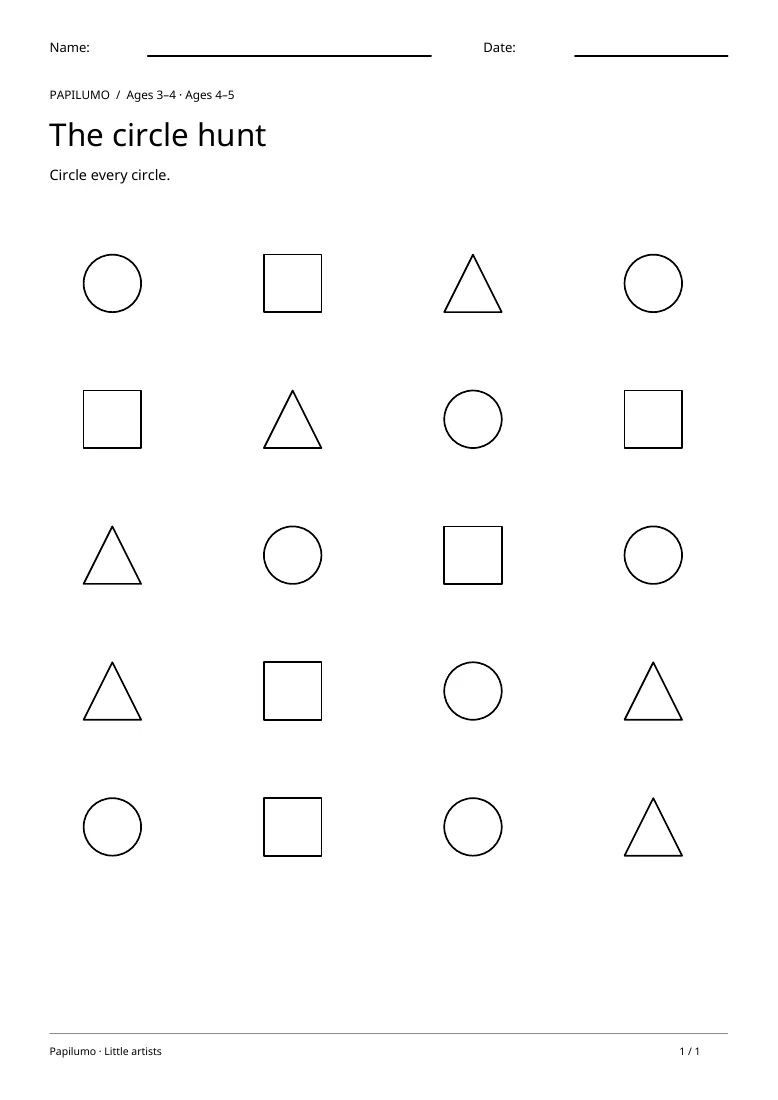
Use the follow-up to meet the same idea in a different setting. Offer it once the first task makes sense, without insisting that the whole page must be perfect. The child might explain a strategy, make an example or set a challenge for an adult. Return to the worksheet only when it helps connect the two situations. A short conversation or a practical activity can be enough to finish the session. To continue exploring, use Preschool Shape Worksheet: Find the Circles: Circle every circle.
Downloading and printing the PDF
This free PDF contains one worksheet designed for A4 paper. Download the file using the button on this page and open it in your PDF reader. Choose actual size or a 100% scale, check the orientation in the print preview and turn off any browser headers or footers. The illustrations use vector lines, so their outlines stay sharp when printed. Check the margins on one copy before preparing several sheets for a group. The level shown on the page is a guide, rather than a requirement to complete the activity at a particular age.