

What this worksheet helps children practise
When adding 45 + 18 in 7 × 9, encourage the child to add ten first (45 + 10 = 55) and then eight (55 + 8 = 63). You can also compare neighbor facts like 6 × 8 = 48 and 7 × 8 = 56.
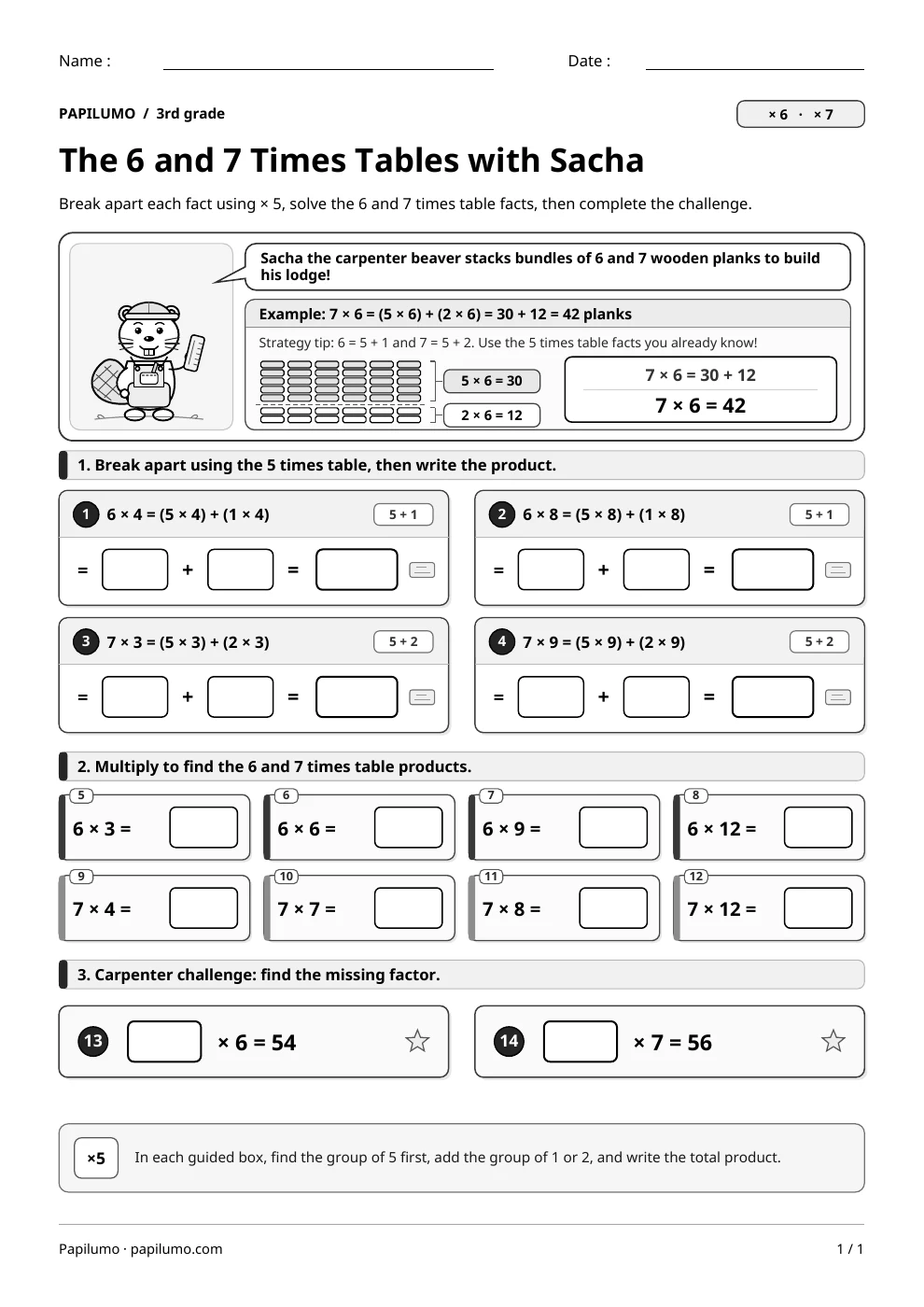
Learning the 6 and 7 multiplication facts is often a turning point in third-grade arithmetic. Rather than relying on slow skip-counting from one or guessing between similar products, children use the distributive property in an accessible way. Multiplying by 6 means taking five groups plus one more group, while multiplying by 7 means taking five groups plus double the group. Recording the two partial products before adding them builds conceptual understanding and leads to confident recall of facts such as 7 × 6 = 42, 7 × 8 = 56, and 7 × 12 = 84. For a related skill, use Multiply three numbers: group the factors with Pico: Group two adjacent factors to work out each product in two steps.
Preparing a short session
Print the student worksheet at 100% scale and provide a sharp pencil and eraser. No cutting or gluing is needed. Keep the answer key aside and examine the worked model at the top with Sacha the beaver: seven rows of six planks are divided by a dashed line into five rows of six (30 planks) and two rows of six (12 planks), making 42 planks altogether. Check that the student can quickly recall fives and doubles before starting the first section.
A concrete example to get started
The worked model highlights the classic fact 7 × 6. By splitting seven into five and two, the student calculates 5 × 6 = 30 and 2 × 6 = 12, then adds thirty and twelve to get 42. Point out how the visual array of planks makes the split concrete, and remind the learner that 6 × 7 and 7 × 6 yield the exact same product thanks to the commutative property of multiplication.
Supporting the activity
Section 1 presents four guided cards for 6 × 4, 6 × 8, 7 × 3, and 7 × 9. Each card has three answer boxes: two for the partial products (the five-group and the one- or two-group) and one for the final product. Section 2 offers eight direct multiplication facts out of sequence—6 × 3, 6 × 6, 6 × 9, 6 × 12, 7 × 4, 7 × 7, 7 × 8, and 7 × 12—so students must think about each equation rather than counting up a list. Section 3 reverses the reasoning with two missing-factor equations: [ ] × 6 = 54 and [ ] × 7 = 56. To vary the practice, try 7 Times Table Fluency Wheel, Facts & Calendar Problem with Oli: Check the calendar example, fill in all 8 outer wedges of the × 7 wheel, solve the 6 fact boxes, then answer the 5-week problem.
What to notice and how to check
In Section 1, check both partial products and totals: 6 × 4 gives 20 + 4 = 24; 6 × 8 gives 40 + 8 = 48; 7 × 3 gives 15 + 6 = 21; and 7 × 9 gives 45 + 18 = 63. In Section 2, the eight products are 18, 36, 54, and 72 for the sixes, and 28, 49, 56, and 84 for the sevens. In Section 3, the missing factors are 9 (since 9 × 6 = 54) and 8 (since 8 × 7 = 56). The separate answer key fills all twenty-two boxes.
Making the task easier
Start with the two 6-times-table cards where only one extra group is added to the fives fact, or sketch a quick dot array split at five rows.
Keep the learning aim, but reduce how much the child has to handle at once. Cover part of the page with another sheet and reveal one task at a time. Demonstrate a separate example, then leave a real opportunity to work something out. An answer reached with support is still a useful attempt; it does not yet show that the same task can be completed independently.
Taking the idea beyond the worksheet
On a dry-erase board, ask the student to break apart 6 × 7, 6 × 11, or 7 × 11 using the same five-plus strategy, then practice recalling the Section 2 products aloud.
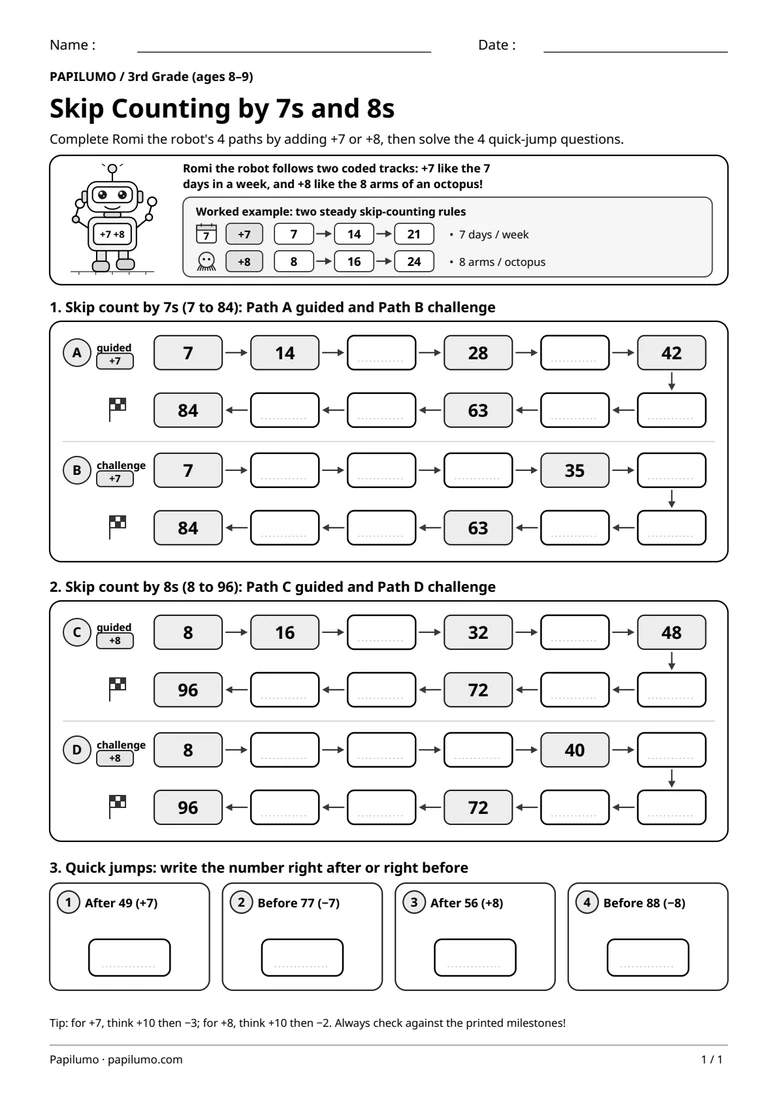
Use the follow-up to meet the same idea in a different setting. Offer it once the first task makes sense, without insisting that the whole page must be perfect. The child might explain a strategy, make an example or set a challenge for an adult. Return to the worksheet only when it helps connect the two situations. A short conversation or a practical activity can be enough to finish the session. To continue exploring, use Skip Counting by 7s and 8s with Romi the Robot: Complete Romi the robot's 4 paths by adding +7 or +8, then solve the 4 quick-jump questions.
Downloading and printing the PDF
This free PDF contains one worksheet designed for A4 paper. Download the file using the button on this page and open it in your PDF reader. Choose actual size or a 100% scale, check the orientation in the print preview and turn off any browser headers or footers. The illustrations use vector lines, so their outlines stay sharp when printed. Check the margins on one copy before preparing several sheets for a group. The level shown on the page is a guide, rather than a requirement to complete the activity at a particular age.